


Modern-day aviators failed on Wednesday to duplicate the pioneering flight of the Wright brothers a century ago as a replica of their primitive 1903 flying machine flopped into the mud in the birthplace of powered human flight.
On a rain-soaked field in Kill Devil Hills, North Carolina, where the bicycle mechanics from Ohio achieved the age-old dream on Dec. 17, 1903, an exact copy of the wood-and-cloth Wright Flyer trundled down a wooden rail but failed to generate the speed and lift it needed to fly in an unreliable breeze.

PHOTO: AP
On another attempt hours later, the engine was cranked but the wind died and the aircraft did not try a takeoff.
The two attempts, part of a celebration of the first century of flight that lured astronaut Neil Armstrong and a host of luminaries to North Carolina's Outer Banks, came hours after US President George W. Bush lauded Orville and Wilbur Wright's achievement as a triumph of American ingenuity.
"The Wright brothers' invention belongs to the world but the Wright brothers belong to America," Bush told a crowd of soggy spectators at the Wright Brothers National Memorial.
Downpours hit Kill Devil Hills early Wednesday and light winds that followed forced organizers of the weeklong event to postpone its highlight, an attempt to re-enact the Wrights' original 12-second, 36m flight in the muddy field where they made history.
The Wrights made four flights that day. The last, by Wilbur, measured 260m and lasted 59 seconds.
The re-enactment was to have been made at 10:35am, the same time Orville lifted off, but was delayed for nearly two hours by light winds. Organizers said the replica needed 16kph to 35kph of wind to fly.
Following a series of unsuccessful attempts to crank the balky engine, the Flyer's twin propellers came to life. Kevin Kochersberger, a 42-year-old flight instructor and engineering professor at the Rochester Institute of Technology, guided the replica across the field.
The machine moved slowly down a wooden track and its nose rose briefly before it dipped and settled into a mud puddle. The flight crew said later that photographs showed the plane was in the air briefly, at an altitude of 15cm for about a second.
Kochersberger said the venture was anything but a failure, noting the replica flew twice successfully in trials.
"We were just a little bit shy on the wind and a little bit shy on the engine power today," he said.
The weeklong festival attracted and thrilled tens of thousands of aviation buffs.
The US military's B-2 Stealth bomber and the Osprey tilt-rotor, short-takeoff-and-landing craft made appearances, along with Armstrong and Buzz Aldrin, the first men on the moon; Chuck Yeager, the pilot who first broke the sound barrier; and John Glenn, the former senator and astronaut.
"Here at the Wright Brothers National Memorial, we remember one small machine and we honor the giants who flew it," said Bush, who flew to North Carolina to take part in the festivities but left before the re-enactment was to take place.
Air Force One, with the president on board, flew over the Wright Memorial before heading back to Washington.
The failed re-enactment after a century of giant leaps in aviation highlighted the ingenuity of the brothers, who constructed a primitive 274kg biplane out of spruce, ash and muslin. The Wright Flyer had a 12m wingspan, was powered by a 12-horsepower engine and had a top speed of just 48kph.

Taiwan has experienced its most significant improvement in the QS World University Rankings by Subject, data provided on Sunday by international higher education analyst Quacquarelli Symonds (QS) showed. Compared with last year’s edition of the rankings, which measure academic excellence and influence, Taiwanese universities made great improvements in the H Index metric, which evaluates research productivity and its impact, with a notable 30 percent increase overall, QS said. Taiwanese universities also made notable progress in the Citations per Paper metric, which measures the impact of research, achieving a 13 percent increase. Taiwanese universities gained 10 percent in Academic Reputation, but declined 18 percent

Chinese President Xi Jinping (習近平) yesterday met with former president Ma Ying-jeou (馬英九) at the Great Hall of the People in Beijing, with Xi’s opening statement once more emphasizing that people on both sides of the Taiwan Strait are Chinese and that foreign intervention cannot change their inevitable unification. Xi said that 5,000 years of history of zhonghua minzu (中華民族, ethnic Chinese group) have seen their ancestors move to Taiwan to establish new lives, while also documenting them fighting side-by-side against foreign forces and finally freeing Taiwan. “Both sides are Chinese,” and there are no issues that cannot be worked through, he
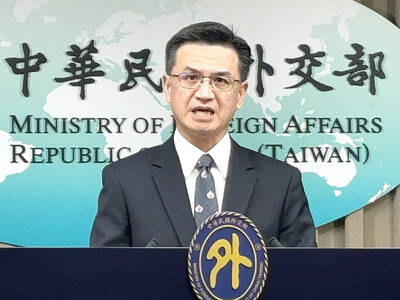
BULLY TACTICS: Beijing has continued its incursions into Taiwan’s airspace even as Xi Jinping talked about Taiwan being part of the Chinese family and nation China should stop its coercion of Taiwan and respect mainstream public opinion in Taiwan about sovereignty if its expression of goodwill is genuine, the Ministry of Foreign Affairs (MOFA) said yesterday. Ministry spokesman Jeff Liu (劉永健) made the comment in response to media queries about a meeting between former president Ma Ying-jeou (馬英九) and Chinese President Xi Jinping (習近平) the previous day. Ma voiced support for the so-called “1992 consensus,” while Xi said that although the two sides of the Taiwan Strait have “different systems,” this does not change the fact that they are “part of the same country,” and that “external
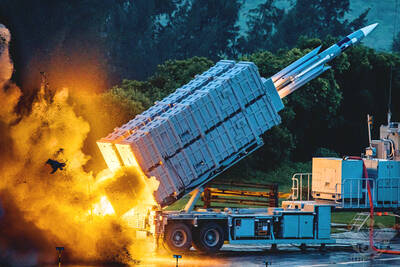
UNDER DISCUSSION: The combatant command would integrate fast attack boat and anti-ship missile groups to defend waters closest to the coastline, a source said The military could establish a new combatant command as early as 2026, which would be tasked with defending Taiwan’s territorial waters 24 nautical miles (44.4km) from the nation’s coastline, a source familiar with the matter said yesterday. The new command, which would fall under the Naval Command Headquarters, would be led by a vice admiral and integrate existing fast attack boat and anti-ship missile groups, along with the Naval Maritime Surveillance and Reconnaissance Command, said the source, who asked to remain anonymous. It could be launched by 2026, but details are being discussed and no final timetable has been announced, the source


 RSS
RSS