


President Chen Shui-bian (
In the interview, Chen said that the planned referendum would not involve independence, the touchiest issue from the perspective of China. But Beijing has expressed alarm about the precedent of holding any plebiscites on sensitive political topics.
Chen said in the interview that he will consider cancelling the referendum if China has responded with good-will to his calls.
On Wednesday, senior Chinese military officers publicly warned that Taiwan was facing an "abyss of war" and said that China was willing to accept boycotts of the 2008 Beijing Olympics, reduced foreign investment and military casualties to prevent Taiwan from using a referendum to advance the cause of independence.
Chen contended that a referendum would help make people here and countries around the world more aware of what he described as an imminent and growing military threat from China, and that this would reduce the risk of a conflict. "Some argue that holding such a defensive referendum might send our children to the front line," he said. "In fact, the opposite is true."
Chen is seeking re-election and his race with the Chinese Nationalist Party (KMT) candidate, Lien Chan (
Chen said that he had informed the US of his plans for the referendum, and he appealed for support on the grounds that Taiwan's democratic development needed strong US backing.
The State Department has bluntly discouraged Chen from holding a referendum on independence issues. But the administration has yet to respond to his new initiative to focus the referendum on China's military posture, especially as the precise wording has not yet been set.
In an interview late Friday morning, Chen devoted more than an hour to explaining his plans for the referendum. He said that the question posed on ballots "could be for the 23 million people of Taiwan to demand that China immediately withdraw the missiles targeting Taiwan and openly renounce the use of force against Taiwan."
Investing some of the extra money available from a booming economy, China has rapidly increased its arsenal of ballistic missiles and positioned many of them in easy striking range of Taiwan.
Although US and Taiwanese experts believe the missiles to be conventionally armed, Chen compared the danger they posed to Taiwan with the threat faced by the US during the Cuban missile crisis, when the Soviet Union built missile storage and launching facilities in Cuba that could have been used for a nuclear-tipped arsenal.
"In 1962, the US faced the 13 alarming days of the Cuban missile crisis," he said. "With 496 ballistic missiles aimed at the 23 million people of Taiwan, every day for us is an alarming day."
Chen repeatedly spoke of Taiwan's struggle to build a full democracy and called the referendum a historic first for Taiwan. He pointed out that efforts to bring democratic institutions to the island, suppressed for decades under martial law, were always met with opposition from China and the then ruling KMT.
"The holding of a referendum is a milestone in our democratic consolidation and the deepening of Taiwan's democracy," he said.
Lien criticized Chen in a separate interview Friday, saying that "this is no time for our government to provoke the Chinese communists on the mainland and create a situation of tension that will endanger the 23 million people on this island."
Advocates of independence have for years pressed for referendums as a way to bypass constitutional barriers to legal independence. After months of discussion this autumn, the legislature passed a bill mostly written by the KMT that severely limited the ability of the president to call a referendum except when the country is "facing an external threat which may jeopardize national sovereignty."
Chen said that the missiles, which were also protested in rallies across Taiwan last year, posed just such a threat. Lien said that his party disagreed and had been surprised that Chen was moving so swiftly to make use of the clause, which the KMT had only supported in the legislature as a last resort in a genuine crisis.
"We have a sense of betrayal," Lien said.
Chen asserted that personal ambition was not a factor in his decision.
"I'm already a president and it doesn't make a big difference to me whether I serve for one term or two terms," he said. "A referendum represents a concept and belief that I have pursued throughout my more-than-20-year political career. It is a universal value and a basic human right."
Additional reporrting by Lin Chieh-yu
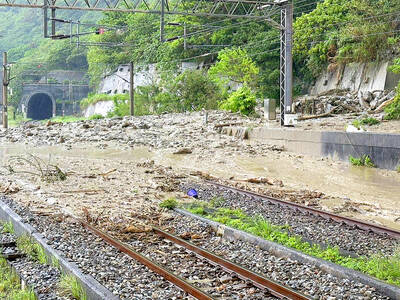
ROLLER-COASTER RIDE: More than five earthquakes ranging from magnitude 4.4 to 5.5 on the Richter scale shook eastern Taiwan in rapid succession yesterday afternoon Back-to-back weather fronts are forecast to hit Taiwan this week, resulting in rain across the nation in the coming days, the Central Weather Administration said yesterday, as it also warned residents in mountainous regions to be wary of landslides and rockfalls. As the first front approached, sporadic rainfall began in central and northern parts of Taiwan yesterday, the agency said, adding that rain is forecast to intensify in those regions today, while brief showers would also affect other parts of the nation. A second weather system is forecast to arrive on Thursday, bringing additional rain to the whole nation until Sunday, it
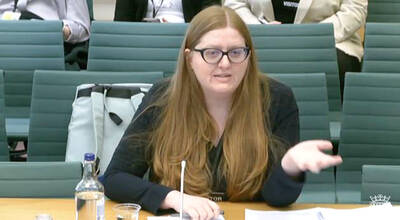
CONDITIONAL: The PRC imposes secret requirements that the funding it provides cannot be spent in states with diplomatic relations with Taiwan, Emma Reilly said China has been bribing UN officials to obtain “special benefits” and to block funding from countries that have diplomatic ties with Taiwan, a former UN employee told the British House of Commons on Tuesday. At a House of Commons Foreign Affairs Committee hearing into “international relations within the multilateral system,” former Office of the UN High Commissioner for Human Rights (OHCHR) employee Emma Reilly said in a written statement that “Beijing paid bribes to the two successive Presidents of the [UN] General Assembly” during the two-year negotiation of the Sustainable Development Goals. Another way China exercises influence within the UN Secretariat is
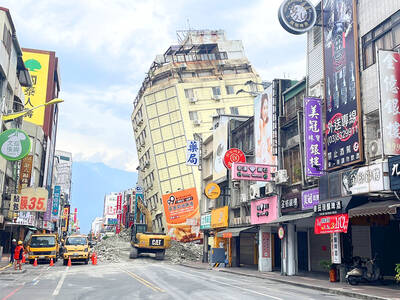
LANDSLIDES POSSIBLE: The agency advised the public to avoid visiting mountainous regions due to more expected aftershocks and rainfall from a series of weather fronts A series of earthquakes over the past few days were likely aftershocks of the April 3 earthquake in Hualien County, with further aftershocks to be expected for up to a year, the Central Weather Administration (CWA) said yesterday. Based on the nation’s experience after the quake on Sept. 21, 1999, more aftershocks are possible over the next six months to a year, the agency said. A total of 103 earthquakes of magnitude 4 on the local magnitude scale or higher hit Hualien County from 5:08pm on Monday to 10:27am yesterday, with 27 of them exceeding magnitude 5. They included two, of magnitude

Taiwan’s first drag queen to compete on the internationally acclaimed RuPaul’s Drag Race, Nymphia Wind (妮妃雅), was on Friday crowned the “Next Drag Superstar.” Dressed in a sparkling banana dress, Nymphia Wind swept onto the stage for the final, and stole the show. “Taiwan this is for you,” she said right after show host RuPaul announced her as the winner. “To those who feel like they don’t belong, just remember to live fearlessly and to live their truth,” she said on stage. One of the frontrunners for the past 15 episodes, the 28-year-old breezed through to the final after weeks of showcasing her unique


 RSS
RSS