


Georgia's opposition called on its supporters yesterday to press forward the "velvet revolution" by seizing state television and the police headquarters, while a growing number of security forces and other officials loyal to President Eduard Shevardnadze defected to the opposition.
Protest leader Mikhail Saakashvili gave Shevardnadze a half-hour to resign, threatening that the opposition would march on his residence on the outskirts of Tbilisi if he doesn't go.
``We will go and take the last presidential residence,'' Saakashvili told protesters,
Shevardnadze said earlier that he was willing to talk with opposition protesters but only if they left the parliament building they stormed the day before.
"It is a necessary demand. It is, if you wish, an ultimatum. I must demand they leave the buildings which have been seized by force immediately. And then we will meet and talk," he told reporters.
"Until later tonight or tomorrow, the state of emergency does not come into effect," he said.
Earlier his defense minister said the veteran leader had not given any orders to use force to block the opposition, but the army was ready to stop the political crisis from escalating.
Shevardnadze also sacked Tedo Dzhaparidze, his top security aide, who had publicly acknowledged fraud in the Nov. 2 parliamentary elections and called for a new vote, the president's office said.
Meanwhile, dozens of members of the national guard joined an opposition rally outside parliament yesterday, adding their voices to demands for Shevardnadze to step down or hold new elections.
The group of up to 200 men and women said they were members of the national guard.
"The guys are still coming and the whole of the national guard will be here," one colonel said.
Russian Foreign Minister Igor Ivanov, who flew into Tbilisi before dawn yesterday, met the opposition and Shevardnadze to try to broker a solution. One opposition leader said talks on a "reasonable compromise" were possible.
Saakashvili urged his supporters to seize the Interior Ministry headquarters if Shevardnadze tries to convene a new parliament there, and ordered them to take control of the state television, which he accused of airing "pro-Shevardnadze propaganda."
Saakashvili, speaking to more than 50,000 boisterous supporters outside parliament, also told them to begin ousting local administrators appointed by Shevardnadze.
The crowd swelled under bright, sunny skies as the day went on _ to such an extent that the opposition leaders encouraged them to spread out to other areas of the city to avoid a stampede. Its members sang soulful Georgian folk songs, danced and shouted their approval as their leaders announced each new advance.
On Saturday, tens of thousands took to the streets to demand Shevardnadze step down. As with the "people power" protests that swept eastern Europe in 1989, the military stood aside, even when protesters stormed parliament.
Shevardnadze was forced to flee the legislature and has been holed up in his private residence on the outskirts of the capital ever since.
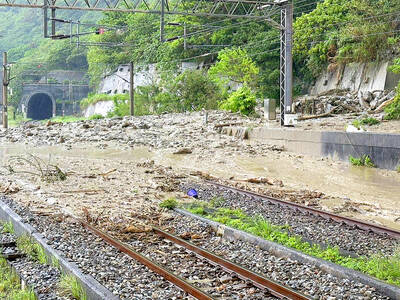
ROLLER-COASTER RIDE: More than five earthquakes ranging from magnitude 4.4 to 5.5 on the Richter scale shook eastern Taiwan in rapid succession yesterday afternoon Back-to-back weather fronts are forecast to hit Taiwan this week, resulting in rain across the nation in the coming days, the Central Weather Administration said yesterday, as it also warned residents in mountainous regions to be wary of landslides and rockfalls. As the first front approached, sporadic rainfall began in central and northern parts of Taiwan yesterday, the agency said, adding that rain is forecast to intensify in those regions today, while brief showers would also affect other parts of the nation. A second weather system is forecast to arrive on Thursday, bringing additional rain to the whole nation until Sunday, it

CONDITIONAL: The PRC imposes secret requirements that the funding it provides cannot be spent in states with diplomatic relations with Taiwan, Emma Reilly said China has been bribing UN officials to obtain “special benefits” and to block funding from countries that have diplomatic ties with Taiwan, a former UN employee told the British House of Commons on Tuesday. At a House of Commons Foreign Affairs Committee hearing into “international relations within the multilateral system,” former Office of the UN High Commissioner for Human Rights (OHCHR) employee Emma Reilly said in a written statement that “Beijing paid bribes to the two successive Presidents of the [UN] General Assembly” during the two-year negotiation of the Sustainable Development Goals. Another way China exercises influence within the UN Secretariat is
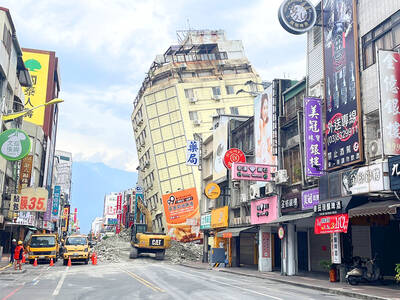
LANDSLIDES POSSIBLE: The agency advised the public to avoid visiting mountainous regions due to more expected aftershocks and rainfall from a series of weather fronts A series of earthquakes over the past few days were likely aftershocks of the April 3 earthquake in Hualien County, with further aftershocks to be expected for up to a year, the Central Weather Administration (CWA) said yesterday. Based on the nation’s experience after the quake on Sept. 21, 1999, more aftershocks are possible over the next six months to a year, the agency said. A total of 103 earthquakes of magnitude 4 on the local magnitude scale or higher hit Hualien County from 5:08pm on Monday to 10:27am yesterday, with 27 of them exceeding magnitude 5. They included two, of magnitude

Taiwan’s first drag queen to compete on the internationally acclaimed RuPaul’s Drag Race, Nymphia Wind (妮妃雅), was on Friday crowned the “Next Drag Superstar.” Dressed in a sparkling banana dress, Nymphia Wind swept onto the stage for the final, and stole the show. “Taiwan this is for you,” she said right after show host RuPaul announced her as the winner. “To those who feel like they don’t belong, just remember to live fearlessly and to live their truth,” she said on stage. One of the frontrunners for the past 15 episodes, the 28-year-old breezed through to the final after weeks of showcasing her unique


 RSS
RSS