


US President George W. Bush vowed Monday to stay the course in Iraq, after a series of bold attacks around the Iraqi capital killed 43 people and wounded more than 200 in the deadliest day for two months.
"The more progress we make on the ground ... the more desperate these killers become," Bush said.
Yesterday, four more US soldiers were wounded near the northern city of Mosul, according to the military, as US officials urged aid groups to keep working in Iraq after suicide bombers struck the Red Cross headquarters and three police stations in Baghdad.
One soldier was wounded when insurgents attacked his convoy in southeastern Mosul and three others were injured, one seriously, when their patrol was attacked by rocket-propelled grenades and automatic weapons in the town of Tal Afar, just west of Mosul, the US command said.
The five Monday morning attacks which plunged the capital into terror and sparked worldwide condemnation were launched with two simultaneous blasts at the police stations in Al-Bayaa, also known as Al-Elam, and Al-Dora, south of Baghdad.
Within barely an hour, explosions also rocked the International Committee of the Red Cross (ICRC) office, and three other police stations in the capital. Another car bomb attack was foiled.
At the White House, Bush said the escalating attacks were a reaction to US successes on the ground.
"It's in the national interest of the United States that a peaceful Iraq emerge, and we will stay the course in order to achieve this objective," Bush said as he gathered with his top advisers on Iraq.
But US military leaders appeared split on who was behind the attacks.
US Brigadier General Mark Hertling told reporters in Baghdad that the five suicide bombings bore all the hallmarks of foreign fighters.
"We have not seen attacks we could attribute to foreign fighters before. We have seen those today," the general said.
But later Major General Raymond Odierno, commander of the US Army's 4th Infantry Division, discounted that theory, saying foreign fighters accounted for only "a very, very small percentage" of the forces resisting the US-led occupation.
"What I found is Iraqis do not like people from other countries fooling in Iraqi business," he told reporters in Washington in a video-teleconference from his headquarters in Tikrit.
The bombings, which shrouded the Baghdad skyline in smoke, were an ominous start for the first day of the Muslim fasting month of Ramadan as the anti-US insurgents escalated their campaign from bleeding the coalition with ambushes to apparently executing mass terror.
A survey of nine hospitals earlier counted 42 dead from the blasts, including two children and 19 women, and 216 people wounded.
The death of the US soldier, announced by the military late Monday, raised the number of fatalities to 43. The military also reported six wounded, raising the number of injured to 222.
The attacks came a day after a barrage of rockets pounded a hotel in the coalition's heavily-guarded Baghdad complex, housing dozens of US military and civilian staff, as well as visiting US Deputy Defense Secretary Paul Wolfowitz.
One US soldier was killed and 17 other people wounded in the attack.
UN Secretary General Kofi Annan called Monday's attack on the ICRC a crime against humanity.
"All terrorist acts, from whatever quarter and whatever their justification, are morally repugnant and indefensible," his spokesman Fred Eckhard said in a statement.
"The ICRC is a universally respected humanitarian organization. Its neutrality and impartiality are the mainstays of its operations," he said.
The ICRC is to begin pulling foreign staff out of Baghdad in the wake of the bombing but will continue to refuse military protection, said its head of delegation in Baghdad.
"We will begin tomorrow to fly out expatriate staff and then we'll see how we can continue our work with our Iraqi staff," Pierre Gassmann said in an interview on the Web site of Germany's ARD public television.
He said the ICRC has about 35 foreign staff in Iraq and 800 Iraqi workers.
The ICRC -- which has stayed in the country for more than two decades even at the height of recent wars -- started cutting back on foreign staff in the Iraqi capital after a Sri Lankan aid worker was shot dead in July.
Secretary of State Colin Powell urged the Red Cross and other nongovernment organizations -- as well as foreign contractors and the UN -- to stay in Iraq.
"They are needed. Their work is needed. And if they are driven out, then the terrorists win," Powell said Monday in Washington.

Chinese President Xi Jinping (習近平) yesterday met with former president Ma Ying-jeou (馬英九) at the Great Hall of the People in Beijing, with Xi’s opening statement once more emphasizing that people on both sides of the Taiwan Strait are Chinese and that foreign intervention cannot change their inevitable unification. Xi said that 5,000 years of history of zhonghua minzu (中華民族, ethnic Chinese group) have seen their ancestors move to Taiwan to establish new lives, while also documenting them fighting side-by-side against foreign forces and finally freeing Taiwan. “Both sides are Chinese,” and there are no issues that cannot be worked through, he

Taiwan has experienced its most significant improvement in the QS World University Rankings by Subject, data provided on Sunday by international higher education analyst Quacquarelli Symonds (QS) showed. Compared with last year’s edition of the rankings, which measure academic excellence and influence, Taiwanese universities made great improvements in the H Index metric, which evaluates research productivity and its impact, with a notable 30 percent increase overall, QS said. Taiwanese universities also made notable progress in the Citations per Paper metric, which measures the impact of research, achieving a 13 percent increase. Taiwanese universities gained 10 percent in Academic Reputation, but declined 18 percent
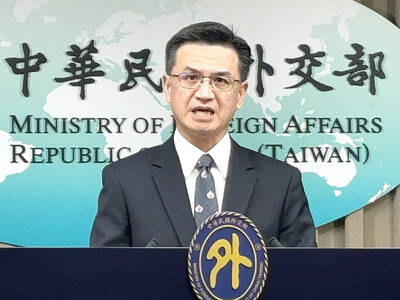
BULLY TACTICS: Beijing has continued its incursions into Taiwan’s airspace even as Xi Jinping talked about Taiwan being part of the Chinese family and nation China should stop its coercion of Taiwan and respect mainstream public opinion in Taiwan about sovereignty if its expression of goodwill is genuine, the Ministry of Foreign Affairs (MOFA) said yesterday. Ministry spokesman Jeff Liu (劉永健) made the comment in response to media queries about a meeting between former president Ma Ying-jeou (馬英九) and Chinese President Xi Jinping (習近平) the previous day. Ma voiced support for the so-called “1992 consensus,” while Xi said that although the two sides of the Taiwan Strait have “different systems,” this does not change the fact that they are “part of the same country,” and that “external
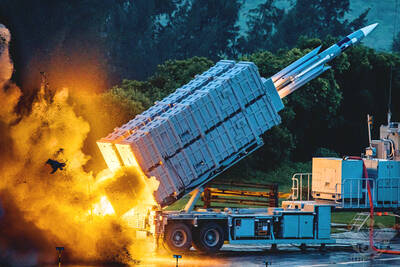
UNDER DISCUSSION: The combatant command would integrate fast attack boat and anti-ship missile groups to defend waters closest to the coastline, a source said The military could establish a new combatant command as early as 2026, which would be tasked with defending Taiwan’s territorial waters 24 nautical miles (44.4km) from the nation’s coastline, a source familiar with the matter said yesterday. The new command, which would fall under the Naval Command Headquarters, would be led by a vice admiral and integrate existing fast attack boat and anti-ship missile groups, along with the Naval Maritime Surveillance and Reconnaissance Command, said the source, who asked to remain anonymous. It could be launched by 2026, but details are being discussed and no final timetable has been announced, the source


 RSS
RSS