


Those convicted of engaging in acts of terrorism could face the death penalty, according to the draft bill of the anti-terrorism act (
They could, however, have their sentence reduced or revoked if they turn themselves in and provide information leading to the stoppage of the acts of terrorism.
If approved by the legislature, the draft will also empower the National Security Bureau to intercept wire, oral and electronic communications. The bureau could authorize the installation and use of trap and trace devices anywhere in the country in the course of a criminal investigation.
According to a Cabinet official who asked not to be named, the draft was drawn up to keep in line with the global ethos of anti-terrorism, especially after the Sept. 11 terrorist attack in the US.
"Although we're not a member of the United Nations, we, as a part of the global community, have been making tremendous efforts to abide by the UN conventions and safeguard international peace," the official said. "In addition to taking all effective measures, including enacting a new law, to prevent and punish acts of terrorism, we'd also like to cooperate with other countries in this regard."
Under the Cabinet's draft, an anti-terrorism action team should be established under the Cabinet to coordinate the nation's anti-terrorism efforts.
"Acts of terrorism" are defined as activities committed to cause death or serious bodily injury relating to arson, bombing, kidnapping, hijacking or controlling public or private transportation vehicles, vessels and aircraft; interfering and sabotaging electronic, energy or computer systems; or emitting nuclear energy, radioactivity, biological agent or toxin.
A "terrorist organization" is defined as a group of two or more individuals engaging in terrorist activities or providing material or financial support to further a terrorist activity.
A "terrorist" is an individual partaking in terrorist activities or funding a terrorist organization.
Terrorists convicted of engaging in terrorist activities and causing the death of other persons would be subject to an imprisonment for a term greater than 10 years, a life sentence or a death penalty.
Those turning themselves in and providing information leading to the breaking up of terrorist organizations, arrest of terrorists or stoppage of terrorist activities could have their sentences reduced or annulled.
Those confessing during the investigation or trial process and providing information leading to the breaking up of terrorist organizations, arrest of terrorists or stoppage of terrorist activities could have their sentences lessened.
A jail term of up to five years and a fine of up to NT$100 million could be imposed on those convicted of conspiring in terrorist activities. Those providing or soliciting funds to further a terrorist activity would be subject to a jail term of between one and seven years and a fine of up to NT$10 million.
The draft would also empower the director of the NSB to issue a warrant to intercept wire, oral, and electronic communications. The bureau has to obtain the consent of the Supreme Court to authorize the installation and use of trap and trace devices in the course of a criminal investigation if the person under surveillance has a domestic household registry record.
To combat money laundering, government agencies concerned could freeze or seize the chattel, real estate and other property of value of the suspected terrorist when authorities have reasonable grounds to believe that such a measure could prevent or impede the occurrence of a terrorist activity. The period could not, however, exceed one month and could be extended for another month if necessary.
Authorities could also freeze all transactions of the suspected terrorist's bank account. The maximum period was six months.
Telecommunication companies would be required to disclose communication information relating to a terrorist activity to intelligence agencies. The communication records should be kept for 90 days and could be extended for another 90 days if necessary.
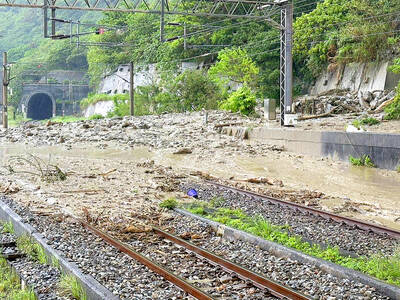
ROLLER-COASTER RIDE: More than five earthquakes ranging from magnitude 4.4 to 5.5 on the Richter scale shook eastern Taiwan in rapid succession yesterday afternoon Back-to-back weather fronts are forecast to hit Taiwan this week, resulting in rain across the nation in the coming days, the Central Weather Administration said yesterday, as it also warned residents in mountainous regions to be wary of landslides and rockfalls. As the first front approached, sporadic rainfall began in central and northern parts of Taiwan yesterday, the agency said, adding that rain is forecast to intensify in those regions today, while brief showers would also affect other parts of the nation. A second weather system is forecast to arrive on Thursday, bringing additional rain to the whole nation until Sunday, it
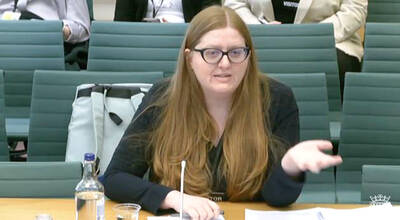
CONDITIONAL: The PRC imposes secret requirements that the funding it provides cannot be spent in states with diplomatic relations with Taiwan, Emma Reilly said China has been bribing UN officials to obtain “special benefits” and to block funding from countries that have diplomatic ties with Taiwan, a former UN employee told the British House of Commons on Tuesday. At a House of Commons Foreign Affairs Committee hearing into “international relations within the multilateral system,” former Office of the UN High Commissioner for Human Rights (OHCHR) employee Emma Reilly said in a written statement that “Beijing paid bribes to the two successive Presidents of the [UN] General Assembly” during the two-year negotiation of the Sustainable Development Goals. Another way China exercises influence within the UN Secretariat is
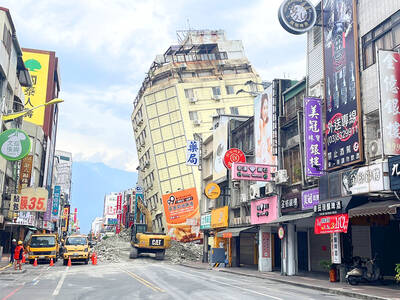
LANDSLIDES POSSIBLE: The agency advised the public to avoid visiting mountainous regions due to more expected aftershocks and rainfall from a series of weather fronts A series of earthquakes over the past few days were likely aftershocks of the April 3 earthquake in Hualien County, with further aftershocks to be expected for up to a year, the Central Weather Administration (CWA) said yesterday. Based on the nation’s experience after the quake on Sept. 21, 1999, more aftershocks are possible over the next six months to a year, the agency said. A total of 103 earthquakes of magnitude 4 on the local magnitude scale or higher hit Hualien County from 5:08pm on Monday to 10:27am yesterday, with 27 of them exceeding magnitude 5. They included two, of magnitude

Taiwan’s first drag queen to compete on the internationally acclaimed RuPaul’s Drag Race, Nymphia Wind (妮妃雅), was on Friday crowned the “Next Drag Superstar.” Dressed in a sparkling banana dress, Nymphia Wind swept onto the stage for the final, and stole the show. “Taiwan this is for you,” she said right after show host RuPaul announced her as the winner. “To those who feel like they don’t belong, just remember to live fearlessly and to live their truth,” she said on stage. One of the frontrunners for the past 15 episodes, the 28-year-old breezed through to the final after weeks of showcasing her unique


 RSS
RSS