


Premier Yu Shyi-kun said yesterday that the government might consider designating official languages in the Constitution, as 112 other countries have done.
"The Constitution and existing laws do not specify any particular language as the nation's official language, so constitutional amendments or legislation would be needed to legalize an official language," Cabinet Spokesman Lin Chia-lung (
There is no doubt that Mandarin is the nation's most commonly used official language, judging from a functional and practical point of view, Yu was quoted as saying.
"Of course, we'll respect public opinion and the decision of the legislature, which has the final say on the matter," Yu said.
Yu also explained why the Cabinet decided in March to let the Council for Cultural Affairs take over the drafting of a language law from the Mandarin Promotion Council under the Ministry of Education.
"The United Nations has expressed its concern over the gradual disappearance of Taiwan's native tongues," Yu said.
As the disappearance of native languages would be a loss to mankind, Yu said, the Cabinet thought it was a good idea to let the Council for Cultural Affairs handle the drafting of the language law to help conserve and develop the nation's languages.
Yu made the remarks after the weekly closed-door Cabinet meeting yesterday morning at which Government Information Office head Huang Hui-chen (
A draft of the national languages development law (國家語言發展法), approved by the Council for Cultural Affairs on Monday, caused a stir by stating that the nation has no official language and that local governments may decide what languages they want to use.
During the Cabinet meeting, Minister of Education Huang Jong-tsun (
"If amending the Constitution is the way to go in terms of designating the official language, I hope Mandarin is not the only language taken into consideration," Huang said.
Council for Hakka Affairs Chairwoman Yeh Chu-lan (葉菊蘭), who recently visited Examination Yuan President Yao Chia-wen (姚嘉文) to express her opposition to Hoklo language questions in the national examination for civil servants, said that each language should be treated equally.
"The government has to move very carefully in designating the nation's official language because all languages spoken by ethnic groups are a nation's important cultural heritage," she said.
But discussion of language was overshadowed yesterday by the ongoing rift between Lin and Taipei Mayor Ma Ying-jeou (馬英九).
The quarrel began after Lin claimed that at last week's Cabinet meeting Ma had likened the Cabinet's plan to hold non-binding referendums to China's Cultural Revolution.
Ma requested an apology from Lin, saying he had been misquoted.
The mayor yesterday seemed to claim victory in the squabble.
"I believe [Lin] must have learned a lesson from this incident," Ma told reporters after the Cabinet meeting.
Lin retorted by saying he hoped Ma himself had been "enlightened" by the incident.
Also See Stories:
KMT says language policy stirring up ethnic strife
Editorial: Ensuring linguistic diversity
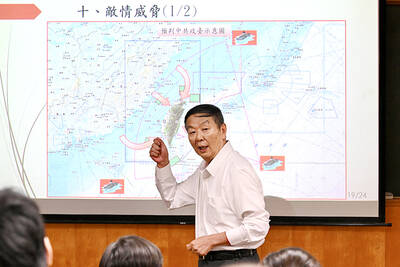
RETHINK? The defense ministry and Navy Command Headquarters could take over the indigenous submarine project and change its production timeline, a source said Admiral Huang Shu-kuang’s (黃曙光) resignation as head of the Indigenous Submarine Program and as a member of the National Security Council could affect the production of submarines, a source said yesterday. Huang in a statement last night said he had decided to resign due to national security concerns while expressing the hope that it would put a stop to political wrangling that only undermines the advancement of the nation’s defense capabilities. Taiwan People’s Party Legislator Vivian Huang (黃珊珊) yesterday said that the admiral, her older brother, felt it was time for him to step down and that he had completed what he
Taiwan has experienced its most significant improvement in the QS World University Rankings by Subject, data provided on Sunday by international higher education analyst Quacquarelli Symonds (QS) showed. Compared with last year’s edition of the rankings, which measure academic excellence and influence, Taiwanese universities made great improvements in the H Index metric, which evaluates research productivity and its impact, with a notable 30 percent increase overall, QS said. Taiwanese universities also made notable progress in the Citations per Paper metric, which measures the impact of research, achieving a 13 percent increase. Taiwanese universities gained 10 percent in Academic Reputation, but declined 18 percent

UNDER DISCUSSION: The combatant command would integrate fast attack boat and anti-ship missile groups to defend waters closest to the coastline, a source said The military could establish a new combatant command as early as 2026, which would be tasked with defending Taiwan’s territorial waters 24 nautical miles (44.4km) from the nation’s coastline, a source familiar with the matter said yesterday. The new command, which would fall under the Naval Command Headquarters, would be led by a vice admiral and integrate existing fast attack boat and anti-ship missile groups, along with the Naval Maritime Surveillance and Reconnaissance Command, said the source, who asked to remain anonymous. It could be launched by 2026, but details are being discussed and no final timetable has been announced, the source
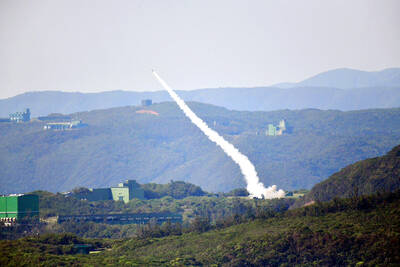
SHOT IN THE ARM: The new system can be integrated with Avenger and Stinger missiles to bolster regional air defense capabilities, a defense ministry report said Domestically developed Land Sword II (陸射劍二) missiles were successfully launched and hit target drones during a live-fire exercise at the Jiupeng Military Base in Pingtung County yesterday. The missiles, developed by the Chungshan Institute of Science and Technology (CSIST), were originally scheduled to launch on Tuesday last week, after the Tomb Sweeping Day holiday long weekend, but were postponed to yesterday due to weather conditions. Local residents and military enthusiasts gathered outside the base to watch the missile tests, with the first one launching at 9:10am. The Land Sword II system, which is derived from the Sky Sword II (天劍二) series, was turned


 RSS
RSS