


A second test on a Singapore man suspected of having SARS has confirmed he has the illness, the government said yesterday.
"It appears to be a single isolated case," the Ministry of Health said.
The case is Singapore's first in four months.
It is not yet known how the 27-year-old Singaporean laboratory technician contracted the illness. He is a postdoctoral student working on the West Nile virus, the ministry said in a statement.
Twenty-five people who came in contact with the man have been issued home quarantine orders, it said.
Acting Minister of Health Khaw Boon Wan told reporters that the man had no recent travel history and no known contact with any SARS patients.
Khaw said he thought the man posed a "low public health risk" because he was isolated quickly.
The case could mark the return of SARS, which killed more 900 people worldwide after it first emerged last November in China.
However, officials from the World Health Organization (WHO) were hesitant to say the case was the start of a fresh epidemic.
By the WHO's current definition of a probable case, there must be at least two SARS patients reported in the same hospital environment.
WHO regional spokesman Peter Cordingley said in the Philippines that Singapore officials have already traced people who were in contact with the man, "and none of them is sick."
Cordingley said the man had no lung infection or respiratory problems, which made his case unusual, adding that the WHO would like to see further testing to confirm the diagnosis.
Khaw also sought to play down the risk of another full-blown epidemic.
"I don't think this is a repeat of the crisis many months ago," Khaw said.
SARS virus samples were handled at the Environmental Health Institute lab at the National Environment Agency where the man worked, Khaw said.
But Khaw refused to speculate on whether the man may have gotten sick from samples in the lab.
The man also did research on the West Nile virus in a microbiology laboratory at the National University of Singapore. Both labs have been temporarily shut down as a precaution and staff have been given a leave of absence, the health ministry said.
Hitoshi Oshitani, WHO regional adviser for communicable disease surveillance and response, said earlier yesterday that the man apparently did not specifically work on the SARS virus but that Singapore officials are checking whether he could have had contact with it in the laboratory.
The last case of SARS in Singapore was reported in early May and Singapore's tough isolation measures were praised by the WHO. The disease killed 33 and sickened 238 in Singapore.
More than 8,400 people were sickened worldwide before the WHO declared in June that the disease had been "stopped dead in its tracks."
Singapore's SARS epidemic began in March this year and raged for three months, sending the city-state's economy into a tailspin. Visitor arrivals fell by as much as 75 percent and hotel occupancy rates plunged from their average 75 percent to as low as 25 percent as tourists and business travelers stayed away.
Responding to the Singapore case, Taiwan's Center for Disease Control (CDC) said it is taking the temperatures of all incoming and outgoing passengers at international airports, with special attention being given to visitors from Singapore.
The center said it will monitor visitors from Singapore and that they should follow a 10-day program of self health management. Under the program, these visitors should wear a facemask if they have a cough and should go to a hospital if they have a fever.
The CDC urged citizens to take precautions against the disease.
"People who have a fever should refrain from going to work or school and stay at home for three days," said Shih Wen-yi (施文儀), the center's deputy director-general.
Taipei City Bureau of Health Director Chang Heng (
"When a fever comes up, go to a fever station at a big hospital instead of going to small clinics. The public can also call 119 to have the police take them to a hospital should they have a fever," Chang said.
additional reporting by Debby Wu
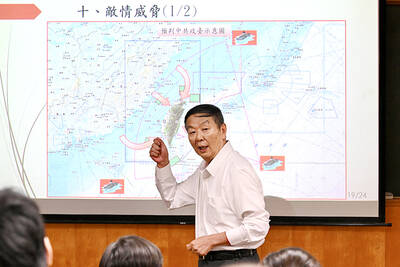
RETHINK? The defense ministry and Navy Command Headquarters could take over the indigenous submarine project and change its production timeline, a source said Admiral Huang Shu-kuang’s (黃曙光) resignation as head of the Indigenous Submarine Program and as a member of the National Security Council could affect the production of submarines, a source said yesterday. Huang in a statement last night said he had decided to resign due to national security concerns while expressing the hope that it would put a stop to political wrangling that only undermines the advancement of the nation’s defense capabilities. Taiwan People’s Party Legislator Vivian Huang (黃珊珊) yesterday said that the admiral, her older brother, felt it was time for him to step down and that he had completed what he
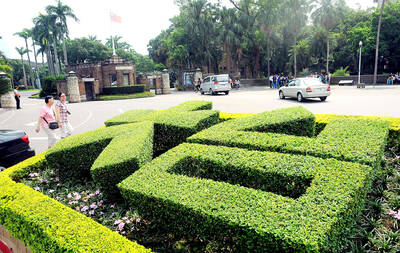
Taiwan has experienced its most significant improvement in the QS World University Rankings by Subject, data provided on Sunday by international higher education analyst Quacquarelli Symonds (QS) showed. Compared with last year’s edition of the rankings, which measure academic excellence and influence, Taiwanese universities made great improvements in the H Index metric, which evaluates research productivity and its impact, with a notable 30 percent increase overall, QS said. Taiwanese universities also made notable progress in the Citations per Paper metric, which measures the impact of research, achieving a 13 percent increase. Taiwanese universities gained 10 percent in Academic Reputation, but declined 18 percent

UNDER DISCUSSION: The combatant command would integrate fast attack boat and anti-ship missile groups to defend waters closest to the coastline, a source said The military could establish a new combatant command as early as 2026, which would be tasked with defending Taiwan’s territorial waters 24 nautical miles (44.4km) from the nation’s coastline, a source familiar with the matter said yesterday. The new command, which would fall under the Naval Command Headquarters, would be led by a vice admiral and integrate existing fast attack boat and anti-ship missile groups, along with the Naval Maritime Surveillance and Reconnaissance Command, said the source, who asked to remain anonymous. It could be launched by 2026, but details are being discussed and no final timetable has been announced, the source
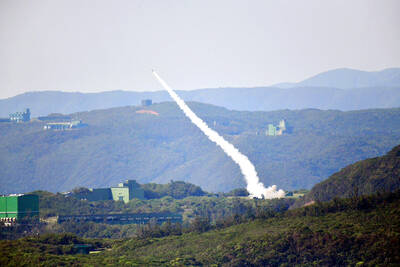
SHOT IN THE ARM: The new system can be integrated with Avenger and Stinger missiles to bolster regional air defense capabilities, a defense ministry report said Domestically developed Land Sword II (陸射劍二) missiles were successfully launched and hit target drones during a live-fire exercise at the Jiupeng Military Base in Pingtung County yesterday. The missiles, developed by the Chungshan Institute of Science and Technology (CSIST), were originally scheduled to launch on Tuesday last week, after the Tomb Sweeping Day holiday long weekend, but were postponed to yesterday due to weather conditions. Local residents and military enthusiasts gathered outside the base to watch the missile tests, with the first one launching at 9:10am. The Land Sword II system, which is derived from the Sky Sword II (天劍二) series, was turned


 RSS
RSS