


Although strong winds and heavy rain brought by Typhoon Dujuan will subside today, residents in eastern and northern parts of the country should be alert to landslides and mudflows in mountainous areas, the Central Weather Bureau said yesterday.
Rain from the typhoon fell on much of Taiwan yesterday, prompting the government to establish disaster relief centers.
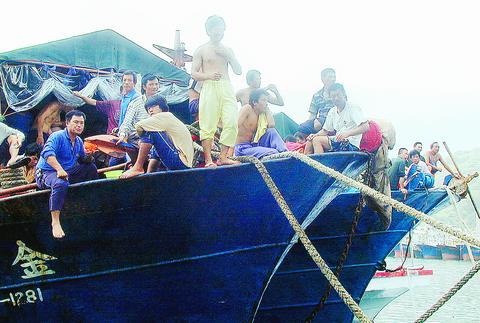
PHOTO: CHIANG CHIH-HSIUNG, TAIPEI TIMES
The Penghu County government announced that all fishing and shuttle boats would be confined to ports until the sea warning is lifted. All schools in the county will be closed today. Schools and offices will also be closed in Taitung, Pingtung and parts of Hualien counties.
The Hengchun Peninsula in southern Pingtung County was hit by severe winds and torrential rains. More than 1,000 fishermen from China living on 23 boats were allowed to take shelter from the wind at the county's Tungkang Port.
Airports in Taitung County were closed.
Forecasters said that Dujuan would pass southern Taiwan and head for southern China today but that wind and rain could still make mountainous areas dangerous.
Rainfall in Ilan and Hsinchu counties exceeded 100mm yesterday.
Water Resources Agency Director Chen Shen-hsien (
Chen said that the Ministry of Economic Affairs would meet on Thursday to discuss whether to impose stricter water rationing in the Taipei and Taoyuan areas.
"We predict that stricter water restrictions might be imposed after Sept. 11," Chen said.
TransAsia Airways yesterday announced it was canceling all domestic flights scheduled to take off before 10am this morning. The company also urged its customers planning to travel between Kaohsiung and Macau to call their travel agencies before leaving for the airport.
China Airlines yesterday also announced it was canceling all its flights leaving and arriving in Kaohsiung this morning.
Scientists yesterday took advantage of the typhoon to try out a new government-sponsored scientific research project using dropsondes.
A aircraft took off from a military base in Taichung and released the dropsonde, which was attached to a parachute. The dropsonde gathered information on air pressure, temperature, humidity and wind speed and transmitted the data to the aircraft via its global positioning system receivers.
According to Wu Chun-Chieh (
Scientists say the observations will significantly improve the accuracy of typhoon forecasts, further enhancing the effectiveness of disaster-prevention measures.
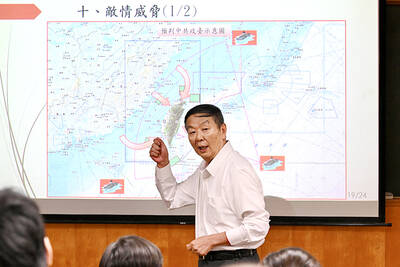
RETHINK? The defense ministry and Navy Command Headquarters could take over the indigenous submarine project and change its production timeline, a source said Admiral Huang Shu-kuang’s (黃曙光) resignation as head of the Indigenous Submarine Program and as a member of the National Security Council could affect the production of submarines, a source said yesterday. Huang in a statement last night said he had decided to resign due to national security concerns while expressing the hope that it would put a stop to political wrangling that only undermines the advancement of the nation’s defense capabilities. Taiwan People’s Party Legislator Vivian Huang (黃珊珊) yesterday said that the admiral, her older brother, felt it was time for him to step down and that he had completed what he

Taiwan has experienced its most significant improvement in the QS World University Rankings by Subject, data provided on Sunday by international higher education analyst Quacquarelli Symonds (QS) showed. Compared with last year’s edition of the rankings, which measure academic excellence and influence, Taiwanese universities made great improvements in the H Index metric, which evaluates research productivity and its impact, with a notable 30 percent increase overall, QS said. Taiwanese universities also made notable progress in the Citations per Paper metric, which measures the impact of research, achieving a 13 percent increase. Taiwanese universities gained 10 percent in Academic Reputation, but declined 18 percent
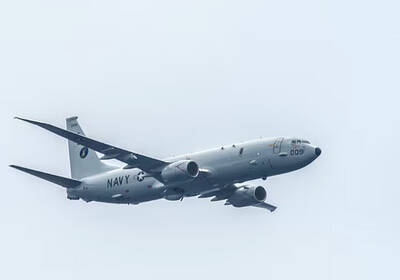
CHINA REACTS: The patrol and reconnaissance plane ‘transited the Taiwan Strait in international airspace,’ the 7th Fleet said, while Taipei said it saw nothing unusual The US 7th Fleet yesterday said that a US Navy P-8A Poseidon flew through the Taiwan Strait, a day after US and Chinese defense heads held their first talks since November 2022 in an effort to reduce regional tensions. The patrol and reconnaissance plane “transited the Taiwan Strait in international airspace,” the 7th Fleet said in a news release. “By operating within the Taiwan Strait in accordance with international law, the United States upholds the navigational rights and freedoms of all nations.” In a separate statement, the Ministry of National Defense said that it monitored nearby waters and airspace as the aircraft
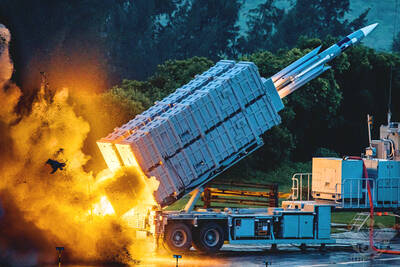
UNDER DISCUSSION: The combatant command would integrate fast attack boat and anti-ship missile groups to defend waters closest to the coastline, a source said The military could establish a new combatant command as early as 2026, which would be tasked with defending Taiwan’s territorial waters 24 nautical miles (44.4km) from the nation’s coastline, a source familiar with the matter said yesterday. The new command, which would fall under the Naval Command Headquarters, would be led by a vice admiral and integrate existing fast attack boat and anti-ship missile groups, along with the Naval Maritime Surveillance and Reconnaissance Command, said the source, who asked to remain anonymous. It could be launched by 2026, but details are being discussed and no final timetable has been announced, the source


 RSS
RSS