


An Internet worm called "Blaster" that attacks Windows operating systems spread across the globe on Tuesday, infecting and crashing home and office computers faster than technicians could install safeguards.
A computer security expert said the worm, which specifically targets computers running Windows XP and Windows 2000, could spread for a few days before tapering off.
At least 124,000 computers using Microsoft Corp's Windows software have been infected worldwide, according to a sample by Symantec Corp's Security Response sensor network.
"Corporate networks are getting hit pretty hard," said Alfred Huger, a senior director of engineering at Symantec. "Hundreds of machines are spontaneously rebooting throughout the environment."
Johannes Ullrich of the SANS Institute said the rate at which the worm was spreading seemed to be slowing late Tuesday afternoon.
SANS (SysAdmin, Auditing, Networking and Security Institute) is a security training and information organization based in Bethesda, Maryland.
Russ Cooper of TruSecure Corp, a security services provider in Herndon, Virginia, said peak worm activity had occurred between 2am and 3am eastern time on Tuesday.
Computers infected by Blaster scan the Internet looking for other machines running Windows that have an open security hole.
The worm then sends itself to those computers.
Windows 2000 and XP computers in North America were getting scanned or infected after being connected to the Internet for an average of 25 minutes, Huger said.
Although some corporate networks were slowed by the worm, no impact on overall Internet traffic was detected.
The worm, also called MSBlaster or LoveSan, surfaced on Monday in the US and quickly spread, taking advantage of a security hole discovered last month in Windows 2000, Windows XP, Windows NT, and Windows Server 2003 operating systems.
Also See Story:
Blaster blows hole in nation's defenses

RETHINK? The defense ministry and Navy Command Headquarters could take over the indigenous submarine project and change its production timeline, a source said Admiral Huang Shu-kuang’s (黃曙光) resignation as head of the Indigenous Submarine Program and as a member of the National Security Council could affect the production of submarines, a source said yesterday. Huang in a statement last night said he had decided to resign due to national security concerns while expressing the hope that it would put a stop to political wrangling that only undermines the advancement of the nation’s defense capabilities. Taiwan People’s Party Legislator Vivian Huang (黃珊珊) yesterday said that the admiral, her older brother, felt it was time for him to step down and that he had completed what he

Taiwan has experienced its most significant improvement in the QS World University Rankings by Subject, data provided on Sunday by international higher education analyst Quacquarelli Symonds (QS) showed. Compared with last year’s edition of the rankings, which measure academic excellence and influence, Taiwanese universities made great improvements in the H Index metric, which evaluates research productivity and its impact, with a notable 30 percent increase overall, QS said. Taiwanese universities also made notable progress in the Citations per Paper metric, which measures the impact of research, achieving a 13 percent increase. Taiwanese universities gained 10 percent in Academic Reputation, but declined 18 percent
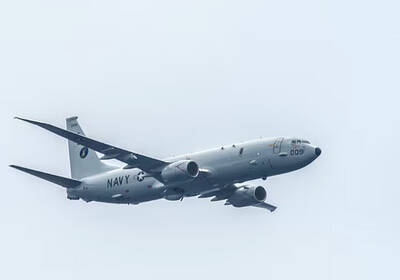
CHINA REACTS: The patrol and reconnaissance plane ‘transited the Taiwan Strait in international airspace,’ the 7th Fleet said, while Taipei said it saw nothing unusual The US 7th Fleet yesterday said that a US Navy P-8A Poseidon flew through the Taiwan Strait, a day after US and Chinese defense heads held their first talks since November 2022 in an effort to reduce regional tensions. The patrol and reconnaissance plane “transited the Taiwan Strait in international airspace,” the 7th Fleet said in a news release. “By operating within the Taiwan Strait in accordance with international law, the United States upholds the navigational rights and freedoms of all nations.” In a separate statement, the Ministry of National Defense said that it monitored nearby waters and airspace as the aircraft

UNDER DISCUSSION: The combatant command would integrate fast attack boat and anti-ship missile groups to defend waters closest to the coastline, a source said The military could establish a new combatant command as early as 2026, which would be tasked with defending Taiwan’s territorial waters 24 nautical miles (44.4km) from the nation’s coastline, a source familiar with the matter said yesterday. The new command, which would fall under the Naval Command Headquarters, would be led by a vice admiral and integrate existing fast attack boat and anti-ship missile groups, along with the Naval Maritime Surveillance and Reconnaissance Command, said the source, who asked to remain anonymous. It could be launched by 2026, but details are being discussed and no final timetable has been announced, the source


 RSS
RSS