


US President George W. Bush chose one of Africa's most stable democracies as his first stop yesterday on a five-nation tour of countries he hopes are leading the way toward a hopeful and democratic future for the troubled continent.
But looming large over his trip was Liberia, epitomizing Africa's chaotic and brutal conflicts.
Bush arrived yesterday morning after an overnight flight from Washington and headed straight into a meeting with Senegalese President Abdoulaye Wade, an ally in Bush's campaign against terrorism.
"I'm very appreciative of the fine hospitality of my friend, the president," Bush said as he, Wade and their wives headed into the Presidential Palace.
After that session, Bush and Wade met with the presidents of seven democratic West African governments: Mathieu Kerekou of Benin, Pedro Pires of Cape Verde, Yahya Jammeh of Gambia, John Kufuor of Ghana, Amadou Toumani Toure of Mali, Mamadou Tandja of Niger and Ahmad Tejan Kabbah of Sierra Leone.
Clusters of curious onlookers gathered on dirt roads to watch Bush's motorcade pass by, many standing with their arms folded across their chests. They numbered in the hundreds, with some clapping and waving as Bush sped from the airport to the palace.
It was a marked contrast to the reception given Bush's predecessor, Bill Clinton, on his first Africa trip, in March 1998.
The emotional highlight of Bush's daylong visit to Senegal was a boat ride to Goree Island, just off the western coast, where he spoke about race. Bush and his wife, Laura, made the trip in Wade's presidential yacht.
Standing on the shore from which Africans were once dis-patched to the Americas in chains, Bush branded slavery one of history's greatest crimes.
"At this place, liberty and life were stolen and sold," Bush said at a former slave trading station on Goree Island, off Senegal's capital Dakar, where some 2 million en-slaved Africans had a last glimpse of their homeland.
"One of the largest migrations of history was also one of the greatest crimes of history," Bush said in a speech, adding that slavery had corrupted US society and left a legacy yet to be eradicated. An estimated 20 million Africans were enslaved.
Bush's speech at the start of a five-day African trip stopped short of an explicit apology for slavery that some Americans and others had hoped for, but he said it was no excuse to say values were different in the slavery era.
He said African slaves had helped awaken the American conscience through their struggle for freedom and that "the very people traded into slavery helped to set America free."
But he said the journey toward racial justice in the US was not over.
He said the struggle against slavery enriched a US devotion to liberty that the country was now trying to spread across Africa and elsewhere.
After leaving the island, Bush was to depart for South Africa.
Bush's five-day trip to Africa, his first to the continent as president, also takes him to Botswana, Uganda and Nigeria.
A likely constant will be a country not on his itinerary: Liberia. Bush is contemplating whether he will send US troops to help supervise an end to the carnage there.
Many African leaders see Bush's visit as a key part of a strategy to combat rising anti-American sentiment and the image of Washington as an international bully.
Also see story:
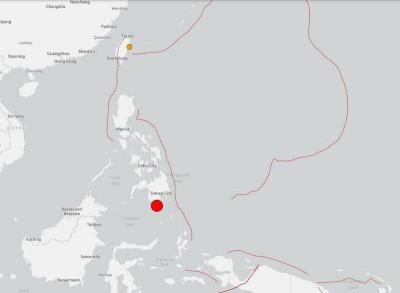
A magnitude 7.8 earthquake struck off the southern coast of Mindanao in the Philippines at 7:38am today, prompting the US Tsunami Warning System to issue an alert for neighboring countries, including Taiwan. The system issued a purple alert indicating a "tsunami threat." The potential threat zone includes Taiwan, the Philippines, Papua New Guinea, Yap and Palau. Philippine authorities were assessing the damage from the quake, with the office of civil defense seeking to verifying initial reports that 15 people had been killed and 129 injured in the region, mostly from falling debris. Arlene Hollero, disaster chief of Maasim town in the Philippines' Sarangani Province,
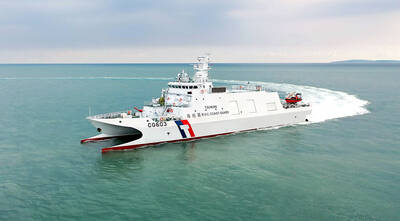
‘GRAY ZONE’ PRESSURE: Beijing’s activities are intended to create the deceitful impression that China has jurisdiction over the area around Taiwan, the CGA said Taiwan’s rights over its territorial waters and exclusive economic zone must not be violated by any country, the Mainland Affairs Council said yesterday, adding that it will not accept any unprovoked actions. The council issued the remarks in response to the China Coast Guard conducting maritime enforcement drills near eastern Taiwan and claiming to fully exercise China’s maritime administrative law enforcement authority. The Coast Guard Administration (CGA) has been closely monitoring the situation and is taking concrete steps to defend the nation’s sovereignty and secure its waters, the council said. China has no sovereign rights over the waters off eastern
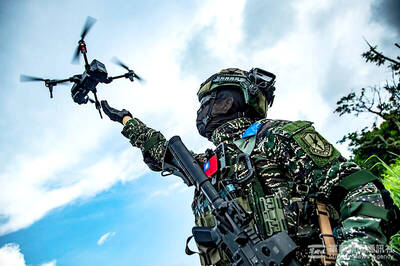
RESILIENCE: Taiwan plays a key role in semiconductors, energy, information infrastructure and advanced manufacturing, AIT Director Raymond Greene said Taiwan’s continued investment in deterrence and resilience remains vital, especially in uncrewed systems and other emerging technologies, American Institute in Taiwan (AIT) Director Raymond Greene said yesterday. Greene made the remarks at the annual National Strategic Summit on Supply Chain Resilience held by the Research Institute for Democracy, Society and Emerging Technology (DSET), a government-backed think tank. As Taiwan last year became the US’ fourth-largest trading partner and supply chain security is becoming more important, cooperation in emerging technologies continues to deepen between the two countries, he said. The US is committed to accelerating innovation, building key infrastructure, strengthening cooperation

RIGHT DIRECTION: Taiwan’s efforts to prevent forced labor include a proposal to ‘fully prohibit’ employers from withholding workers’ documents, an official said Taiwan is to establish a mechanism to restrict imports of goods linked to forced labor, the Executive Yuan said yesterday, after the US proposed imposing additional tariffs on Taiwanese goods over labor concerns. “The Ministry of Labor and the Ministry of Economic Affairs are to establish an interministerial review procedure,” Executive Yuan spokesperson Michelle Lee (李慧芝) said at a news briefing in Taipei. “The government is to use the Foreign Trade Act [貿易法] as the legal basis to restrict imports of goods produced with forced labor” and bring its supply chain governance more in line with international standards on human rights, resilience


 RSS
RSS