


Surveying the wreckage of the Middle East's last big push for peace in January 2001, Israel's then-prime minister Ehud Barak said something that turned out to be prophetic:
"In a few years, we will bury our hundreds of dead and they will bury their thousands of dead, and we will go back to the negotiating table, and we will face the same issues."
After about 1,000 days of fighting, 2,416 are dead on the Palestinian side, 807 on the Israeli side, and the issues are no closer to resolution. If there is any hope at all, it is for an end to the current round of fighting and a deepening recognition on both sides that neither can get everything it wants.
The "road map" to peace pushed by the Bush administration has yielded its first concrete results. Palestinian militants agreed to suspend attacks, Israeli troops began easing their hold on Palestinians, and leaders of both sides shared a platform in a startling display of bonhomie.
Nael Qassem, a Palestinian engineer in the Gaza Strip, was able to commute to work in 25 minutes last week, instead of spending hours getting through Israeli checkpoints. In Tel Aviv, economist Eli Palotinsky took heart from a stock market that has anticipated US President George W. Bush's intervention by shooting up 40 percent in recent months.
The road map has broad international backing, including for the first time by the Arab world, which contributed to the collapse of the 2001 talks by staying on the sidelines. Also, Iraq, perhaps Israel's most formidable foe under former president Saddam Hussein, has been neutralized, and US clout in the region is at a high as a result.
What hope there is for this latest effort comes with strong doses of dread and skepticism. But even though Israel's army chief and Hamas each claimed victory, more Israelis and Palestinians are now persuaded that there is no winner and that they must divide the land between them.
The intifada has made many Israelis realize that hanging on to the West Bank and Gaza Strip comes with a high price -- terror and recession -- and that giving the Palestinians independence is not an act of generosity, but the key to Israel's survival as a Jewish state.
Barak had offered such a state already three years ago, but with little domestic support. Now, most Israelis would happily settle for such a deal, if they could be convinced their security was assured.
The Palestinians emerged with a sense of national dignity; they had pushed a far more powerful opponent as hard as they could. But Israel didn't break, making many Palestinians realize they will have to make concessions -- for example, by giving up the demand that their refugee brethren be allowed to reclaim homes they abandoned or lost when Israel became a state in 1948.
After 33 months of attack and counterattack, the Palestinian militants blinked first, calling a unilateral truce. But Israel -- unable to stop the suicide bombings despite massive military campaigns -- has also discovered the limits of force.
The Palestinians have won unprecedented international backing for their claim to statehood, along with a detailed US plan on how to establish it within two years, but they now face Prime Minister Ariel Sharon, from whom they will likely get less than Barak offered.
Both sides seem eager for a break, if not an end, to the fighting.
"There is optimism that something has ended," said Eran Lehrman, a former military intelligence officer. "It seems the process has played itself out."
Palestinian pollster Khalil Shekaki, who measured strong support for the three-month ceasefire declared last weekend by Islamic militants, said that "the public on both sides wants to take a time-out."
The break in fighting has allowed both sides to take stock of what some Israelis -- in a subtle sign of hope -- are referring to in past tense as "The Thousand Day War."
Horrific images linger: a young Palestinian gleefully raising bloodied palms after the lynching of two Israeli soldiers; rows of bodies covered by white sheets in a makeshift West Bank morgue; workers with a squeegee clearing blood from the floor of a hotel dining room after a suicide bomber killed 29 people during a Passover meal; a Palestinian boy screaming in panic as he huddled behind his father during crossfire that would kill him.
There are many thousands like security guard Bilal Nassan in the West Bank town of Ramallah, who has seen 22 relatives caught up in Israeli sweeps, and Nitzan Dagan, a 33-year-old Tel Aviv man who avoids buses and restaurants as potential targets of bombers. Or Marco Elimeleh, a contractor from the Israeli coastal town of Ashkelon whose business has dried up; and Wael Bassyouni, 26, whose Gaza home was razed by Israeli bulldozers to deprive militants of cover.
And it will take years to recover from the economic setbacks. The Palestinians have lost about US$5 billion, or a year's worth of income and 65 percent of Palestinians in Gaza are now poor, living on less than US$2 a day. Israel is mired in a recession. More than one in 10 are jobless and the economy has shrunk for two years running.
For fear of more disappointment, few are celebrating today. And there's dread that if the latest peace plan, the US-backed "road map," fails, bloodshed will be worse.
"Six months down the road, if we will not be able to move forward, it will be very dangerous," Shekaki said.
Danger and deadlock lurk at every turn.
Israel withdrew from Bethlehem last week but says it won't leave other West Bank towns until Palestinian security forces begin disarming the militants. Palestinian Prime Minister Mahmoud Abbas says he's not strong enough to use force.
Without further withdrawals and the lifting of travel bans, the militants will claim justification for resuming bombings and shootings.
In parallel, Sharon is required to freeze Jewish settlement construction and remove small outposts, a bitter pill for Israel's leading hard-liner and one that would also risk breaking up his coalition. Israel has removed nearly a dozen outposts, but settlement monitors say just as many have been put back up by settlers. Israel has freed about 200 Palestinian prisoners, out of more than 5,000, but those released including many whose sentences were up already.
In a second phase, Israel would probably have to dismantle more than a dozen older settlements to make way for the Palestinian state, and Jewish hard-liners, who see the West Bank as Israel's biblical birthright, are sure to resist.
And on the horizon lie more peace talks on issues that have proven unresolvable before -- the exact borders of a partition, how to share Jerusalem, the future of millions of displaced Palestinians.
Was the battle worth it? More philosophical voices are starting to be heard.
"The intifadda was a political message," said Palestinian economist Salah Abdel Shafi.
But, he adds, "we could have delivered this message without all the suffering and loss."
The suicide bombings hardened Israeli public opinion, he said, and "were very harmful to the Palestinian cause, on moral grounds and politically."
While Israelis tend to see themselves as having withstood the onslaught and shown the Palestinians that they cannot be blasted out of their country, they have become more aware that the land must be shared, Lehrman said.
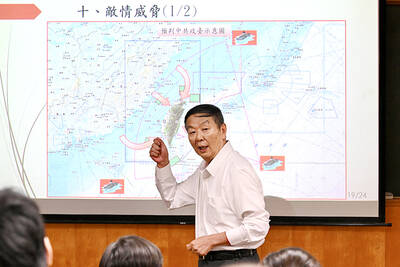
RETHINK? The defense ministry and Navy Command Headquarters could take over the indigenous submarine project and change its production timeline, a source said Admiral Huang Shu-kuang’s (黃曙光) resignation as head of the Indigenous Submarine Program and as a member of the National Security Council could affect the production of submarines, a source said yesterday. Huang in a statement last night said he had decided to resign due to national security concerns while expressing the hope that it would put a stop to political wrangling that only undermines the advancement of the nation’s defense capabilities. Taiwan People’s Party Legislator Vivian Huang (黃珊珊) yesterday said that the admiral, her older brother, felt it was time for him to step down and that he had completed what he

Taiwan has experienced its most significant improvement in the QS World University Rankings by Subject, data provided on Sunday by international higher education analyst Quacquarelli Symonds (QS) showed. Compared with last year’s edition of the rankings, which measure academic excellence and influence, Taiwanese universities made great improvements in the H Index metric, which evaluates research productivity and its impact, with a notable 30 percent increase overall, QS said. Taiwanese universities also made notable progress in the Citations per Paper metric, which measures the impact of research, achieving a 13 percent increase. Taiwanese universities gained 10 percent in Academic Reputation, but declined 18 percent
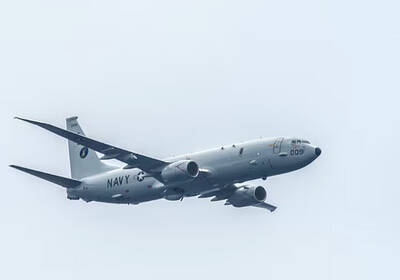
CHINA REACTS: The patrol and reconnaissance plane ‘transited the Taiwan Strait in international airspace,’ the 7th Fleet said, while Taipei said it saw nothing unusual The US 7th Fleet yesterday said that a US Navy P-8A Poseidon flew through the Taiwan Strait, a day after US and Chinese defense heads held their first talks since November 2022 in an effort to reduce regional tensions. The patrol and reconnaissance plane “transited the Taiwan Strait in international airspace,” the 7th Fleet said in a news release. “By operating within the Taiwan Strait in accordance with international law, the United States upholds the navigational rights and freedoms of all nations.” In a separate statement, the Ministry of National Defense said that it monitored nearby waters and airspace as the aircraft
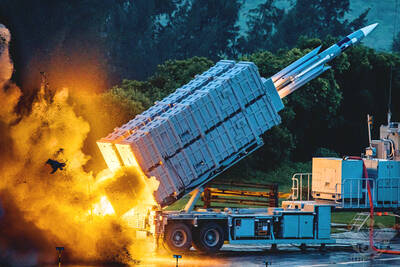
UNDER DISCUSSION: The combatant command would integrate fast attack boat and anti-ship missile groups to defend waters closest to the coastline, a source said The military could establish a new combatant command as early as 2026, which would be tasked with defending Taiwan’s territorial waters 24 nautical miles (44.4km) from the nation’s coastline, a source familiar with the matter said yesterday. The new command, which would fall under the Naval Command Headquarters, would be led by a vice admiral and integrate existing fast attack boat and anti-ship missile groups, along with the Naval Maritime Surveillance and Reconnaissance Command, said the source, who asked to remain anonymous. It could be launched by 2026, but details are being discussed and no final timetable has been announced, the source


 RSS
RSS