


A huge protest against an anti-subversion bill highlighted deep fears among the public that Hong Kong's freedoms could be eroded, and pro-democracy lawmakers said yesterday the government should reconsider it.
"The people had one key message for Hong Kong leader Tung Chee Wah's (
The demonstration was Hong Kong's biggest since a million people took to the streets in outrage and fear after China used troops to crush the Tiananmen Square pro-democracy movement in Beijing on June 4, 1989.
Journalists gathered outside Tung's office early yesterday to ask about the latest protest, but the highly unpopular Hong Kong chief executive brushed aside their questions.
"It just shows a complete disconnect," Loh said. "He can't just hide in a bunker."
Twenty-one pro-democracy lawmakers, from the 60-member Legislative Council, signed a letter to Tung yesterday asking that he stop the bill from moving forward and consult more openly with the public. They also want to meet with Tung, said lawmaker Cyd Ho.
"Now that he's seen the number of people marching in the streets, if he still keeps his head in the sand, the next time there's going to be more," Ho said by telephone.
Tung issued a statement Tuesday night saying he was "concerned" about the large number of protesters and reiterating assurances his government will "continue to take active steps to maintain and safeguard rights and freedoms."
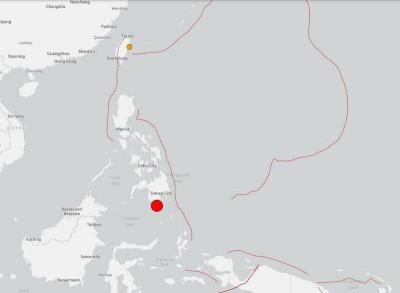
A magnitude 7.8 earthquake struck off the southern coast of Mindanao in the Philippines at 7:38am today, prompting the US Tsunami Warning System to issue an alert for neighboring countries, including Taiwan. The system issued a purple alert indicating a "tsunami threat." The potential threat zone includes Taiwan, the Philippines, Papua New Guinea, Yap and Palau. Philippine authorities were assessing the damage from the quake, with the office of civil defense seeking to verifying initial reports that 15 people had been killed and 129 injured in the region, mostly from falling debris. Arlene Hollero, disaster chief of Maasim town in the Philippines' Sarangani Province,
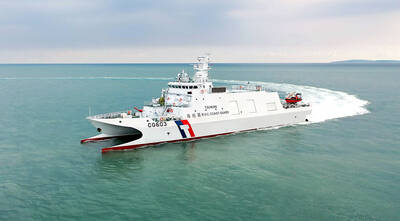
‘GRAY ZONE’ PRESSURE: Beijing’s activities are intended to create the deceitful impression that China has jurisdiction over the area around Taiwan, the CGA said Taiwan’s rights over its territorial waters and exclusive economic zone must not be violated by any country, the Mainland Affairs Council said yesterday, adding that it will not accept any unprovoked actions. The council issued the remarks in response to the China Coast Guard conducting maritime enforcement drills near eastern Taiwan and claiming to fully exercise China’s maritime administrative law enforcement authority. The Coast Guard Administration (CGA) has been closely monitoring the situation and is taking concrete steps to defend the nation’s sovereignty and secure its waters, the council said. China has no sovereign rights over the waters off eastern

RESILIENCE: Taiwan plays a key role in semiconductors, energy, information infrastructure and advanced manufacturing, AIT Director Raymond Greene said Taiwan’s continued investment in deterrence and resilience remains vital, especially in uncrewed systems and other emerging technologies, American Institute in Taiwan (AIT) Director Raymond Greene said yesterday. Greene made the remarks at the annual National Strategic Summit on Supply Chain Resilience held by the Research Institute for Democracy, Society and Emerging Technology (DSET), a government-backed think tank. As Taiwan last year became the US’ fourth-largest trading partner and supply chain security is becoming more important, cooperation in emerging technologies continues to deepen between the two countries, he said. The US is committed to accelerating innovation, building key infrastructure, strengthening cooperation

RIGHT DIRECTION: Taiwan’s efforts to prevent forced labor include a proposal to ‘fully prohibit’ employers from withholding workers’ documents, an official said Taiwan is to establish a mechanism to restrict imports of goods linked to forced labor, the Executive Yuan said yesterday, after the US proposed imposing additional tariffs on Taiwanese goods over labor concerns. “The Ministry of Labor and the Ministry of Economic Affairs are to establish an interministerial review procedure,” Executive Yuan spokesperson Michelle Lee (李慧芝) said at a news briefing in Taipei. “The government is to use the Foreign Trade Act [貿易法] as the legal basis to restrict imports of goods produced with forced labor” and bring its supply chain governance more in line with international standards on human rights, resilience


 RSS
RSS