


The UN has begun a top-level investigation into the bugging of its delegations by the US, first revealed in The Observer newspaper last week.
Sources in the office of UN Secretary General Kofi Annan confirmed Saturday night that the spying operation had already been discussed at the UN's counter-terrorism committee and will be further investigated.
The news comes as British police confirmed the arrest of a 28-year-old woman working at the top secret Government Communications Headquarters (GCHQ) on suspicion of contravening the Official Secrets Act.
Last week The Observer published details of a memo sent by Frank Koza, defense chief of staff (Regional Targets) at the US National Security Agency (NSA), which monitors international communications. The memo ordered an intelligence "surge" directed against Angola, Cameroon, Chile, Bulgaria and Guinea with "extra focus on Pakistan UN matters." The "dirty tricks" operation was designed to win votes in favor of intervention in Iraq.
The Observer reported that the memo was sent to a friendly foreign intelligence agency asking for help in the operation. It has been known for some time that elements within the British security services were unhappy with the British government's use of intelligence information.
The leak was described as "more timely and potentially more important than the Pentagon Papers" by Daniel Ellsberg, the most celebrated whistleblower in recent American history.
In 1971, Ellsberg was responsible for leaking a secret history of US involvement in Vietnam, which became known as "the Pentagon Papers," while working as a Defense Department analyst. The papers fed the American public's hostility to the war and put Ellsberg in prison.
The revelations of the spying operation have caused deep embarrassment to the George W. Bush administration at a key point in the sensitive diplomatic negotiations to gain support for a second UN resolution authorizing intervention in Iraq.
White House spokesman Ari Fleischer and Secretary of Defense Donald Rumsfeld were both challenged about the operation last week, but said they could not comment on security matters.
The operation is thought to have been authorized by US National Security Adviser Condoleezza Rice, but American intelligence experts told The Observer that a decision of this kind would also have involved Rumsfeld, CIA Director George Tenet and NSA chief General Michael Hayden.
Bush himself would have been informed at one of the daily intelligence briefings held every morning at the White House.
Attention has now turned to the foreign intelligence agency responsible for the leak. It is now believed the memo was sent out via Echelon, an international surveillance network set up by the NSA with the cooperation of GCHQ in Britain and similar organizations in Australia, New Zealand and Canada.
Wayne Madsen, of the Electronic Privacy Information Center and himself a former NSA intelligence officer, said the leak demonstrated that there was deep unhappiness in the intelligence world over attempts to link Iraq to the terrorist network al-Qaeda.
"My feeling is that this was an authorized leak. I've been hearing for months of people in the US and British intelligence community who are deeply concerned about their governments `cooking' intelligence to link Iraq to al-Qaeda," Madsen said.
The Observer story caused a political furore in Chile, where President Ricardo Lagos demanded an immediate explanation of the spying operation. The Chilean public is extremely sensitive to reports of US "dirty tricks" after decades of American secret service involvement in the country's internal affairs.
In 1973 the CIA supported a coup that toppled the democratically-elected socialist government of Salvador Allende and installed the dictator General Augusto Pinochet.
Lagos spoke on the telephone with British Prime Minister Tony Blair about the memo last Sunday, immediately after the publication of the story, and twice again on Wednesday. Chile's Foreign Minister Soledad Alvear also raised the matter with UK Foreign Secretary Jack Straw.
Chile's ambassador to Britain Mariano Fernandez told The Observer: "We cannot understand why the United States was spying on Chile. We were very surprised. Relations have been good with America since the time of George Bush Senior."
He said that the position of the Chilean mission to the UN was published in regular diplomatic bulletins, which were public documents openly available.
While the bugging of foreign diplomats at the UN is permissible under the US Foreign Intelligence Services Act, it is a breach of the Vienna Convention on Diplomatic Relations, according to one of the US' leading experts on international law, John Quigley of Ohio University.
He says the convention stipulates that: "The receiving state shall permit and protect free communication on the part of the mission for all official purposes ... The official correspondence of the mission shall be inviolable."
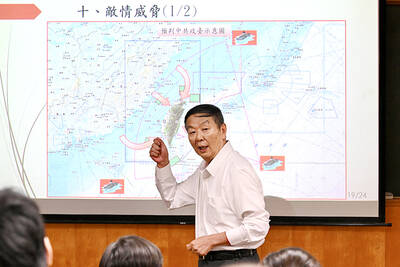
RETHINK? The defense ministry and Navy Command Headquarters could take over the indigenous submarine project and change its production timeline, a source said Admiral Huang Shu-kuang’s (黃曙光) resignation as head of the Indigenous Submarine Program and as a member of the National Security Council could affect the production of submarines, a source said yesterday. Huang in a statement last night said he had decided to resign due to national security concerns while expressing the hope that it would put a stop to political wrangling that only undermines the advancement of the nation’s defense capabilities. Taiwan People’s Party Legislator Vivian Huang (黃珊珊) yesterday said that the admiral, her older brother, felt it was time for him to step down and that he had completed what he
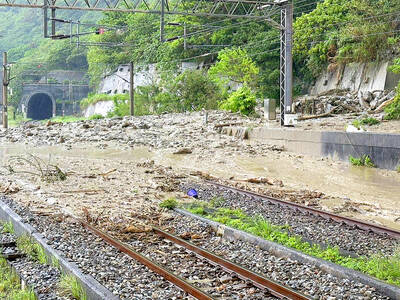
ROLLER-COASTER RIDE: More than five earthquakes ranging from magnitude 4.4 to 5.5 on the Richter scale shook eastern Taiwan in rapid succession yesterday afternoon Back-to-back weather fronts are forecast to hit Taiwan this week, resulting in rain across the nation in the coming days, the Central Weather Administration said yesterday, as it also warned residents in mountainous regions to be wary of landslides and rockfalls. As the first front approached, sporadic rainfall began in central and northern parts of Taiwan yesterday, the agency said, adding that rain is forecast to intensify in those regions today, while brief showers would also affect other parts of the nation. A second weather system is forecast to arrive on Thursday, bringing additional rain to the whole nation until Sunday, it
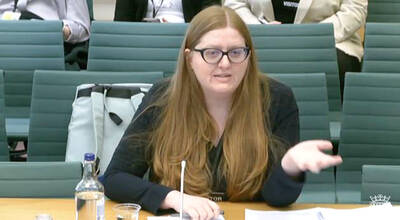
CONDITIONAL: The PRC imposes secret requirements that the funding it provides cannot be spent in states with diplomatic relations with Taiwan, Emma Reilly said China has been bribing UN officials to obtain “special benefits” and to block funding from countries that have diplomatic ties with Taiwan, a former UN employee told the British House of Commons on Tuesday. At a House of Commons Foreign Affairs Committee hearing into “international relations within the multilateral system,” former Office of the UN High Commissioner for Human Rights (OHCHR) employee Emma Reilly said in a written statement that “Beijing paid bribes to the two successive Presidents of the [UN] General Assembly” during the two-year negotiation of the Sustainable Development Goals. Another way China exercises influence within the UN Secretariat is
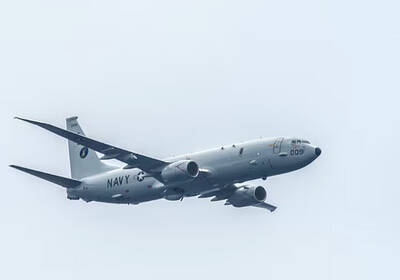
CHINA REACTS: The patrol and reconnaissance plane ‘transited the Taiwan Strait in international airspace,’ the 7th Fleet said, while Taipei said it saw nothing unusual The US 7th Fleet yesterday said that a US Navy P-8A Poseidon flew through the Taiwan Strait, a day after US and Chinese defense heads held their first talks since November 2022 in an effort to reduce regional tensions. The patrol and reconnaissance plane “transited the Taiwan Strait in international airspace,” the 7th Fleet said in a news release. “By operating within the Taiwan Strait in accordance with international law, the United States upholds the navigational rights and freedoms of all nations.” In a separate statement, the Ministry of National Defense said that it monitored nearby waters and airspace as the aircraft


 RSS
RSS