


High over Texas and just short of home, space shuttle Columbia fell to pieces, raining debris over hundreds of miles of countryside. Seven astronauts perished.
Saturday's catastrophe occurred 63km above the Earth, in the last 16 minutes of the 16-day mission as the spaceship re-entered the atmosphere and glided in for a landing in Florida. The day echoed one almost exactly 17 years before, when the Challenger space shuttle exploded.
"The Columbia is lost," said US President George W. Bush, after telephoning the families of the astronauts to console them.
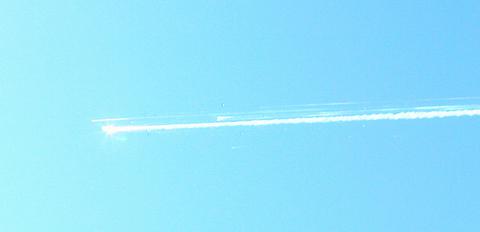
PHOTO: AP PHOTO/TYLER MORNING TELEGRAPH, DR. SCOTT LIEBERMAN
"The same creator who names the stars also knows the names of the seven souls we mourn today," Bush said. "The crew of the shuttle Columbia did not return safely to Earth but we can pray they are safely home."
The search for the cause began immediately. One focus: possible damage to Columbia's protective thermal tiles on the left wing from a flying piece of debris during liftoff on Jan. 16.
The loss of seven explorers of space's dark reaches -- shuttle commander Rick Husband, Michael Anderson, David Brown, Kalpana Chawla, Laurel Clark, William McCool and Ilan Ramon -- brought grief to the nation.
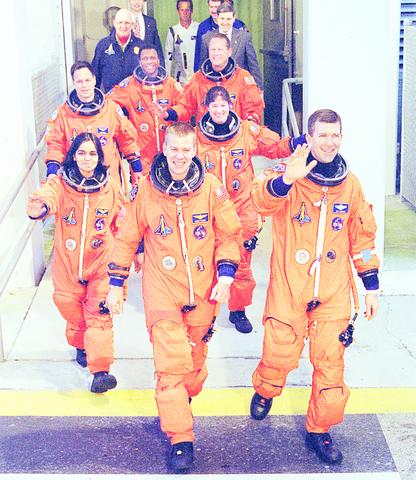
PHOTO: AFP
Investigations
NASA appointed an independent commission to investigate. The agency said the first indication of trouble Saturday was the loss of temperature sensors in the left wing's hydraulic system.
The spacecraft had just re-entered the atmosphere and had reached the point at which it was subjected to the highest temperatures.
NASA officials said they suspected the wing was damaged on liftoff, but felt there was no reason for concern.
A piece of insulating foam on its external fuel tank came off shortly after liftoff and was believed to have hit the left wing of the shuttle. Leroy Cain, the lead flight director in Mission Control, assured reporters Friday that engineers had concluded any damage was considered minor and posed no safety hazard.
"As we look at that now in hindsight ... we can't discount that there might be a connection," shuttle program manager Ron Dittemore said Saturday. "But we have to caution you and ourselves that we can't rush to judgment on it because there are a lot of things in this business that look like the smoking gun but turn out not even to be close."
Authorities said there was no indication of terrorism; at 62,140m and traveling at 20,112kph, 18 times the speed of sound, the shuttle was out of range of any surface-to-air missile. Security was extraordinarily tight on this mission because Ramon, Israel's first astronaut, was among the crew members.
Inexperienced crew
It was a relatively inexperienced crew; only three -- Husband, Anderson and Indian-born Chawla -- had flown before.
The others were rookies, including Ramon, the 48-year-old Israeli Air Force colonel. A former fighter pilot who survived two wars, he carried into space a small pencil drawing titled Moon Landscape by Peter Ginz, a 14-year-old Jewish boy killed at Auschwitz.
"The state of Israel and its citizens are as one at this difficult time," Israeli Prime Minister Ariel Sharon's office said in a statement.
Television footage showed a bright light followed by white smoke plumes streaking diagonally across the sky. Debris appeared to break off into separate balls of light as it continued downward.
"We saw it coming across the sky real bright and shiny and all in one piece. We thought it was the sun shining off an airplane," said Doug Ruby, who was driving along a Texas highway. "Then it broke up in about six pieces -- they were all balls of fire -- before it went over the tree line."
Pieces of the spacecraft were found in several Texas counties and in Louisiana. Among the items found: An astronaut's charred patch and a flight helmet.
There was at least one report of human remains recovered: In Hemphill, Texas, a hospital employee reported finding what appeared to be a charred torso, thigh bone and skull on a rural road near what was believed to be other debris.
In Nacogdoches, 217km northeast of Houston, a National Guardsman stood watch over a steel rod with silver bolts. People streamed up to take photos of the debris.
The Federal Aviation Administration issued a notice to airmen because the National Weather Service radar picked up a debris cloud about 153km long and 21km to 35km wide over Lake Charles, Louisiana.
The Army's 1st Cavalry Division sent a helicopter search-and-rescue task force from Fort Hood, Texas. NASA also asked members of the public to help in its search for debris, but warned people not to touch the pieces because they might be contaminated with toxic propellants.
The flight was the 113th in the shuttle program's 22 years and the 28th flight for Columbia, NASA oldest shuttle, which was built in 1981 at a cost of about US$1 billion.
Blow to space program
The horrific end of shuttle mission STS-107 was a devastating blow to the nation's space program; the Challenger explosion led to a two-and-a-half-year moratorium on launches, and Saturday's accident could bring construction of the international space station to a standstill.
The shuttle delivers components of the space station to be installed; it also carries crews to and from the station. The three astronauts now on board the station could return to Earth at a moment's notice via a Russian vehicle attached to the space station.
Six shuttle flights had been planned for this year -- five of them to the space station. The next was scheduled for March 1.
"We trust the prayers of the nation will be with them and with their families. A more courageous group of people you could not have hoped to know," said NASA Administrator Sean O'Keefe.
Columbia had been scheduled to land at Kennedy Space Center at 9:16am.
Dittemore said "there was no indication of any impending threats to the vehicle." Then there was a loss of data from temperature sensors on the left wing, followed by a loss of data from tire pressure indicators on the left main landing gear.
The final radio transmission between Mission Control and the shuttle, at 9am, gave little indication of any trouble.
Mission Control radios: "Columbia, Houston, we see your tire pressure messages and we did not copy your last."
Columbia's commander, Rick Husband, calmly responds: "Roger, uh, buh ..."
For several seconds, the transmission goes silent.
Then, there is static.
In 42 years of US human spaceflight, there had never been an accident during the descent to Earth or landing.
The US flag next to Mission Control's countdown clock was lowered to half-staff.
O'Keefe met with the astronauts' families, who had been waiting at the landing site for the shuttle's return. Six of the seven astronauts were married, and five had children.
The shuttle is essentially a glider during the hour-long decent from orbit toward the landing strip. It is covered by about 20,000 thermal tiles to protect against temperatures as high as 1,648 degrees centigrade.
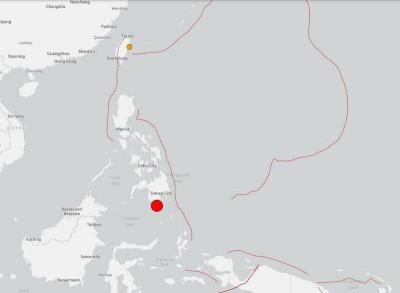
A magnitude 7.8 earthquake struck off the southern coast of Mindanao in the Philippines at 7:38am today, prompting the US Tsunami Warning System to issue an alert for neighboring countries, including Taiwan. The system issued a purple alert indicating a "tsunami threat." The potential threat zone includes Taiwan, the Philippines, Papua New Guinea, Yap and Palau. Philippine authorities were assessing the damage from the quake, with the office of civil defense seeking to verifying initial reports that 15 people had been killed and 129 injured in the region, mostly from falling debris. Arlene Hollero, disaster chief of Maasim town in the Philippines' Sarangani Province,

‘GRAY ZONE’ PRESSURE: Beijing’s activities are intended to create the deceitful impression that China has jurisdiction over the area around Taiwan, the CGA said Taiwan’s rights over its territorial waters and exclusive economic zone must not be violated by any country, the Mainland Affairs Council said yesterday, adding that it will not accept any unprovoked actions. The council issued the remarks in response to the China Coast Guard conducting maritime enforcement drills near eastern Taiwan and claiming to fully exercise China’s maritime administrative law enforcement authority. The Coast Guard Administration (CGA) has been closely monitoring the situation and is taking concrete steps to defend the nation’s sovereignty and secure its waters, the council said. China has no sovereign rights over the waters off eastern

RESILIENCE: Taiwan plays a key role in semiconductors, energy, information infrastructure and advanced manufacturing, AIT Director Raymond Greene said Taiwan’s continued investment in deterrence and resilience remains vital, especially in uncrewed systems and other emerging technologies, American Institute in Taiwan (AIT) Director Raymond Greene said yesterday. Greene made the remarks at the annual National Strategic Summit on Supply Chain Resilience held by the Research Institute for Democracy, Society and Emerging Technology (DSET), a government-backed think tank. As Taiwan last year became the US’ fourth-largest trading partner and supply chain security is becoming more important, cooperation in emerging technologies continues to deepen between the two countries, he said. The US is committed to accelerating innovation, building key infrastructure, strengthening cooperation

RIGHT DIRECTION: Taiwan’s efforts to prevent forced labor include a proposal to ‘fully prohibit’ employers from withholding workers’ documents, an official said Taiwan is to establish a mechanism to restrict imports of goods linked to forced labor, the Executive Yuan said yesterday, after the US proposed imposing additional tariffs on Taiwanese goods over labor concerns. “The Ministry of Labor and the Ministry of Economic Affairs are to establish an interministerial review procedure,” Executive Yuan spokesperson Michelle Lee (李慧芝) said at a news briefing in Taipei. “The government is to use the Foreign Trade Act [貿易法] as the legal basis to restrict imports of goods produced with forced labor” and bring its supply chain governance more in line with international standards on human rights, resilience


 RSS
RSS