


President Chen Shui-bian (
Chen's signature was followed by that of Premier Yu Shyi-kun, Academia Sinica President Lee Yuan-tseh (李遠哲), Buddhist master Sheng Yen (聖嚴法師) and agriculturalist Chung Wen-fang (鍾文芳).
Last October, while meeting with Taiwan's representatives to the World Summit on Sustainable Development in Johannesburg, Chen designated 2003 as the First Year of Sustainable Development in Taiwan.
"There's an urgency for us to promote sustainable development, because Taiwan is a densely populated, disaster-prone country with limited natural resources and is in a unique political situation," Chen said.
Chen stressed that he would push the Cabinet to back the sustainability plan in order to balance conservation and economic development and make Taiwan a "Green Silicon Island."
To highlight the importance of leaving future generations a liveable environment, Chen and other leading figures gave seedlings of endemic species to children's representatives.
Yu, also convener of the Cabinet's National Council for Sustainable Development, said that the council's status had been upgraded last year in order to make it more effective.
Taiwan is one of only a few countries whose premier convenes such a council.
Lee said that the First Year of Sustainable Development in Taiwan was the beginning of a sustainable development dynasty, whose rulers are the Taiwanese people.
Lee said that it was a pity that the Western model of economic development has been mimicked by most developing Asian countries for decades.
"Taiwan has to wake up and search for its own roads leading to sustainable development rather than following the steps of Western countries," Lee said.
According to Minister without Portfolio Yeh Jiunn-rong (
Juju Wang (
Wang said that the public still sees many construction projects lacking the spirit of sustainable development.
"We haven't found any place to dump radioactive waste but the Fourth Nuclear Power Plant is still under construction," Wang said.
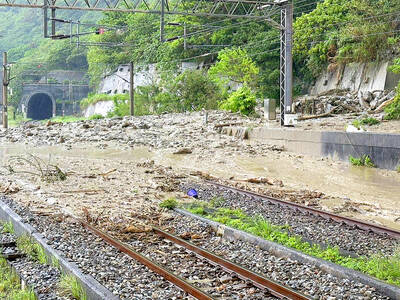
ROLLER-COASTER RIDE: More than five earthquakes ranging from magnitude 4.4 to 5.5 on the Richter scale shook eastern Taiwan in rapid succession yesterday afternoon Back-to-back weather fronts are forecast to hit Taiwan this week, resulting in rain across the nation in the coming days, the Central Weather Administration said yesterday, as it also warned residents in mountainous regions to be wary of landslides and rockfalls. As the first front approached, sporadic rainfall began in central and northern parts of Taiwan yesterday, the agency said, adding that rain is forecast to intensify in those regions today, while brief showers would also affect other parts of the nation. A second weather system is forecast to arrive on Thursday, bringing additional rain to the whole nation until Sunday, it

CONDITIONAL: The PRC imposes secret requirements that the funding it provides cannot be spent in states with diplomatic relations with Taiwan, Emma Reilly said China has been bribing UN officials to obtain “special benefits” and to block funding from countries that have diplomatic ties with Taiwan, a former UN employee told the British House of Commons on Tuesday. At a House of Commons Foreign Affairs Committee hearing into “international relations within the multilateral system,” former Office of the UN High Commissioner for Human Rights (OHCHR) employee Emma Reilly said in a written statement that “Beijing paid bribes to the two successive Presidents of the [UN] General Assembly” during the two-year negotiation of the Sustainable Development Goals. Another way China exercises influence within the UN Secretariat is
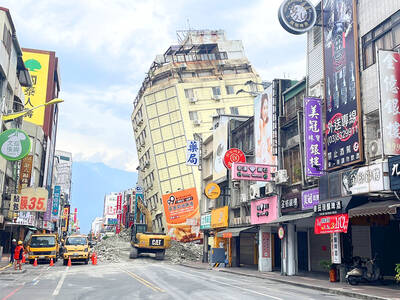
LANDSLIDES POSSIBLE: The agency advised the public to avoid visiting mountainous regions due to more expected aftershocks and rainfall from a series of weather fronts A series of earthquakes over the past few days were likely aftershocks of the April 3 earthquake in Hualien County, with further aftershocks to be expected for up to a year, the Central Weather Administration (CWA) said yesterday. Based on the nation’s experience after the quake on Sept. 21, 1999, more aftershocks are possible over the next six months to a year, the agency said. A total of 103 earthquakes of magnitude 4 on the local magnitude scale or higher hit Hualien County from 5:08pm on Monday to 10:27am yesterday, with 27 of them exceeding magnitude 5. They included two, of magnitude

Taiwan’s first drag queen to compete on the internationally acclaimed RuPaul’s Drag Race, Nymphia Wind (妮妃雅), was on Friday crowned the “Next Drag Superstar.” Dressed in a sparkling banana dress, Nymphia Wind swept onto the stage for the final, and stole the show. “Taiwan this is for you,” she said right after show host RuPaul announced her as the winner. “To those who feel like they don’t belong, just remember to live fearlessly and to live their truth,” she said on stage. One of the frontrunners for the past 15 episodes, the 28-year-old breezed through to the final after weeks of showcasing her unique


 RSS
RSS