


US President George Bush said Iraq was clearly not disarming and brushed aside increasingly frank opposition from allies, as the momentum for war grew.
He showed impatience with UN weapons inspectors who want more months to check Iraq's denials that it is developing chemical, biological or nuclear arms, and with fellow UN Security Council states that have backed their calls.
"It's clear to me now that he is not disarming," Bush said of Iraq's President Saddam Hussein. "Time is running out."
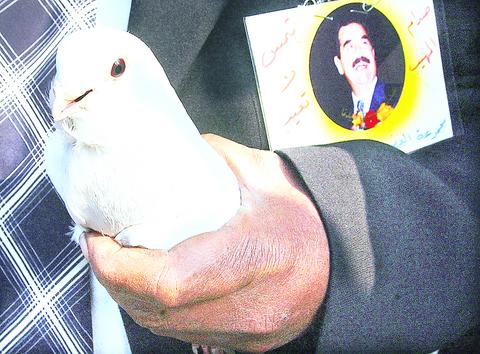
PHOTO: AP
"How much more time do we need to be sure he is not disarming? This looks to me like a re-run of a bad movie and I'm not interested in watching it."
The US sees no need for further UN approval for an attack on Iraq.
With a crucial 10 days ahead on the path to war or peace, France and Russia underlined that the US would not get such a mandate any time soon and cautioned against conflict.
"We see no justification today for [military] intervention, since the inspectors are able to do their work," French Foreign Minister Dominique de Villepin said.
"We could not support unilateral action," he said
France, which has still left the door open to eventual use of force, has a veto on the 15-seat Security Council, along with the US, Britain, Russia and China.
Germany, also on the council, has said it will not join any attack and made clear on Tuesday it would not support UN authorization for war.
"Do not expect that Germany will agree to a resolution that legitimizes war," Chancellor Gerhard Schroeder said in his strongest indication yet of how Berlin would vote.
Bush is massing more than 150,000 troops in the oil-rich Gulf and has made clear he is ready to use them, with or without a new UN mandate, if it considers Iraq has not disarmed.
Oil prices hit two-year highs as the Pentagon ordered two more aircraft carriers and 37,000 troops to the Gulf.
Britain, Bush's main military ally, has also ordered thousands of troops to the region. Australia said yesterday it was sending troops and the transport ship Kanimbla to the Middle East this week for a possible war with Iraq.
The next 10 days appear crucial on the path to possible war.
White House officials said Bush would use his major State of the Union speech on Monday to underscore the threat posed by Iraq but would not deliver an ultimatum or declare war.
The same day, chief UN arms inspector Hans Blix delivers a report to the Security Council, which convenes two days later.
If he voices dissatisfaction with Iraq's cooperation -- and he has said there are still "many questions" unanswered -- it could mean war.
On Jan. 31, Bush hosts British Prime Minister Tony Blair for talks at Camp David which some see as a possible council of war.
Asked on Tuesday how much more time he would give Saddam to comply with UN demands to disarm or face military action, Bush said: "I will let you know when the moment has come."
"We have not seen anything that indicates the Iraqi regime has made a strategic decision to disarm," he told Congress later. "On the contrary, we believe Iraq is actively working to disrupt, deny and defeat inspection efforts."
Resolution 1441, passed unanimously by the Security Council in November to force Baghdad to come clean about its arms programs, threatens "serious consequences" in the event of a "material breach" -- meaning Iraqi evasion or obstruction.
Deputy Secretary of State Richard Armitage said alternatives to force against Baghdad were "just about exhausted."
"This regime has very little time left to undo the legacy of 12 years," he said of the country whose invasion of Kuwait sparked the 1991 Gulf War that expelled its forces.
Russia disagreed. "Most countries believe that opportunities for a diplomatic solution are far from exhausted," Foreign Minister Igor Ivanov said in Moscow.
Armitage flew to the Russian capital yesterday for talks with First Deputy Foreign Minister Vyacheslav Trubnikov.
"I trust ... I can shed some light on why we're thinking as we are and taking the view that our options are just about exhausted," he said.
Mohamed ElBaradei, the UN nuclear agency chief who will report with Blix on Monday, said the inspectors needed "quite a few months" more to finish their work.
He said: "I am pleading for the inspection process to take its course."
Turkey, a staunch NATO ally which has misgivings about helping start a war on its own doorstep, said it would host a meeting of regional foreign ministers in Istanbul today. They would urge Baghdad to obey UN disarmament demands.
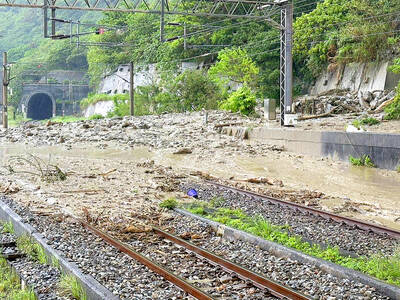
ROLLER-COASTER RIDE: More than five earthquakes ranging from magnitude 4.4 to 5.5 on the Richter scale shook eastern Taiwan in rapid succession yesterday afternoon Back-to-back weather fronts are forecast to hit Taiwan this week, resulting in rain across the nation in the coming days, the Central Weather Administration said yesterday, as it also warned residents in mountainous regions to be wary of landslides and rockfalls. As the first front approached, sporadic rainfall began in central and northern parts of Taiwan yesterday, the agency said, adding that rain is forecast to intensify in those regions today, while brief showers would also affect other parts of the nation. A second weather system is forecast to arrive on Thursday, bringing additional rain to the whole nation until Sunday, it
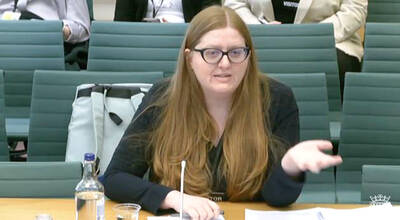
CONDITIONAL: The PRC imposes secret requirements that the funding it provides cannot be spent in states with diplomatic relations with Taiwan, Emma Reilly said China has been bribing UN officials to obtain “special benefits” and to block funding from countries that have diplomatic ties with Taiwan, a former UN employee told the British House of Commons on Tuesday. At a House of Commons Foreign Affairs Committee hearing into “international relations within the multilateral system,” former Office of the UN High Commissioner for Human Rights (OHCHR) employee Emma Reilly said in a written statement that “Beijing paid bribes to the two successive Presidents of the [UN] General Assembly” during the two-year negotiation of the Sustainable Development Goals. Another way China exercises influence within the UN Secretariat is

LANDSLIDES POSSIBLE: The agency advised the public to avoid visiting mountainous regions due to more expected aftershocks and rainfall from a series of weather fronts A series of earthquakes over the past few days were likely aftershocks of the April 3 earthquake in Hualien County, with further aftershocks to be expected for up to a year, the Central Weather Administration (CWA) said yesterday. Based on the nation’s experience after the quake on Sept. 21, 1999, more aftershocks are possible over the next six months to a year, the agency said. A total of 103 earthquakes of magnitude 4 on the local magnitude scale or higher hit Hualien County from 5:08pm on Monday to 10:27am yesterday, with 27 of them exceeding magnitude 5. They included two, of magnitude

Taiwan’s first drag queen to compete on the internationally acclaimed RuPaul’s Drag Race, Nymphia Wind (妮妃雅), was on Friday crowned the “Next Drag Superstar.” Dressed in a sparkling banana dress, Nymphia Wind swept onto the stage for the final, and stole the show. “Taiwan this is for you,” she said right after show host RuPaul announced her as the winner. “To those who feel like they don’t belong, just remember to live fearlessly and to live their truth,” she said on stage. One of the frontrunners for the past 15 episodes, the 28-year-old breezed through to the final after weeks of showcasing her unique


 RSS
RSS