


China, wary about US influence in Southeast Asia, will seek in Brunei this week to strengthen ties with its southern neighbors while fending off US accusations it exports weapons of mass destruction, diplomats said.
Chinese Foreign Minister Tang Jiaxuan (
The highlight of China's diplomatic overtures with ASEAN nations has been a plan to create the world's largest free-trade zone, uniting 1.7 billion people, and a preliminary framework could be ready late this year.
But Chinese officials say they are hoping for a stepped up security role for ASEAN, which suffers nagging concerns that Islamic militant groups are fostering terrorism in the region.
"We hope the Southeast Asian cooperation would move from mainly economics to be expanded to political areas, to dialogue on security and detailed discussions on anti-terrorism," Vice Foreign Minister Wang Yi (
Tang also is due to hold bilateral talks with US Secretary of State Colin Powell, who is expected to broach China's sales of weapons to North Korea, Iraq and Iran, states that US President George W. Bush has labeled an "axis of evil."
The US slapped sanctions on nine Chinese firms earlier this month for transfer of arms-related material or technology to Iran. China either denies the firms were violating any agreements or says they carried out the exports without its knowledge.
China maintains it abides by all international agreements including a pledge to the US in November 2000 to halt transfers of missile technology to Pakistan and implement an export control system.
Tang also may raise Beijing's concerns over US plans to sell submarines and other weapons to Taiwan.
Beijing has simmered uncomfortably as the Bush administration vowed more than once to "do whatever it takes" to defend the nation and met with Taiwan officials in the US, breaking with former president Bill Clinton's policy of strategic ambiguity over Taiwan's diplomatic status.
Despite disagreements, the Tang-Powell meeting is expected to remain cordial. Analysts say China has been making an effort to keep ties on a warming track ahead of a visit to the US by President Jiang Zemin (江澤民) in October.
Jiang, slated to retire as China's top Communist Party leader in a leadership reshuffle due in coming months and as president next March, is eager to be remembered as the man who consolidated Sino-US relations, analysts say.
Tang will also seek stronger ties with Southeast Asia, laying the foundation for a leaders summit at the year end in Cambodia to be attended by Chinese Premier Zhu Rongji (
The sudden presence of US troops on China's Central Asian borders -- and a six-month operation in the Philippines -- - after the Sept. 11 attacks alarmed Beijing, which sees the US as an unwanted houseguest in the region, diplomats said.
"The Chinese ultimately want to push the Americans back but at the moment they have toned down their anti-American rhetoric," said a Western diplomat in Beijing.
China has responded by stepping up its wooing of Southeast Asian nations, working to overcome suspicions dating back decades to its financing of Communist guerrilla movements in the region.
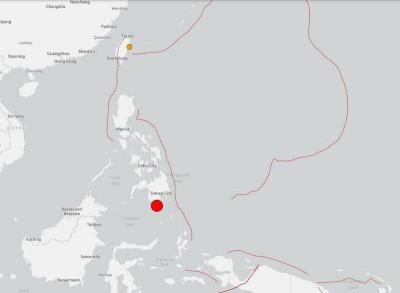
A magnitude 7.8 earthquake struck off the southern coast of Mindanao in the Philippines at 7:38am today, prompting the US Tsunami Warning System to issue an alert for neighboring countries, including Taiwan. The system issued a purple alert indicating a "tsunami threat." The potential threat zone includes Taiwan, the Philippines, Papua New Guinea, Yap and Palau. Philippine authorities were assessing the damage from the quake, with the office of civil defense seeking to verifying initial reports that 15 people had been killed and 129 injured in the region, mostly from falling debris. Arlene Hollero, disaster chief of Maasim town in the Philippines' Sarangani Province,
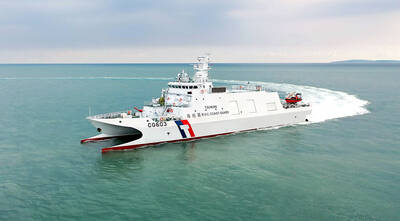
‘GRAY ZONE’ PRESSURE: Beijing’s activities are intended to create the deceitful impression that China has jurisdiction over the area around Taiwan, the CGA said Taiwan’s rights over its territorial waters and exclusive economic zone must not be violated by any country, the Mainland Affairs Council said yesterday, adding that it will not accept any unprovoked actions. The council issued the remarks in response to the China Coast Guard conducting maritime enforcement drills near eastern Taiwan and claiming to fully exercise China’s maritime administrative law enforcement authority. The Coast Guard Administration (CGA) has been closely monitoring the situation and is taking concrete steps to defend the nation’s sovereignty and secure its waters, the council said. China has no sovereign rights over the waters off eastern
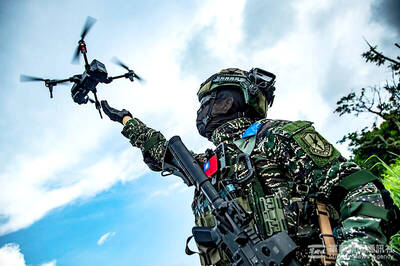
RESILIENCE: Taiwan plays a key role in semiconductors, energy, information infrastructure and advanced manufacturing, AIT Director Raymond Greene said Taiwan’s continued investment in deterrence and resilience remains vital, especially in uncrewed systems and other emerging technologies, American Institute in Taiwan (AIT) Director Raymond Greene said yesterday. Greene made the remarks at the annual National Strategic Summit on Supply Chain Resilience held by the Research Institute for Democracy, Society and Emerging Technology (DSET), a government-backed think tank. As Taiwan last year became the US’ fourth-largest trading partner and supply chain security is becoming more important, cooperation in emerging technologies continues to deepen between the two countries, he said. The US is committed to accelerating innovation, building key infrastructure, strengthening cooperation

RIGHT DIRECTION: Taiwan’s efforts to prevent forced labor include a proposal to ‘fully prohibit’ employers from withholding workers’ documents, an official said Taiwan is to establish a mechanism to restrict imports of goods linked to forced labor, the Executive Yuan said yesterday, after the US proposed imposing additional tariffs on Taiwanese goods over labor concerns. “The Ministry of Labor and the Ministry of Economic Affairs are to establish an interministerial review procedure,” Executive Yuan spokesperson Michelle Lee (李慧芝) said at a news briefing in Taipei. “The government is to use the Foreign Trade Act [貿易法] as the legal basis to restrict imports of goods produced with forced labor” and bring its supply chain governance more in line with international standards on human rights, resilience


 RSS
RSS