


The nation's top two chipmakers will be allowed to invest a combined NT$103 billion (US$3 billion) in China under a plan being developed by the government, Lin Hsin-yi (林信義), vice premier and chairman of the Council for Economic Planning and Development, told lawmakers yesterday.
Offering a broad outline of the unfinished government plan, Lin said that Taiwan Semiconductor Manufacturing Co (台積電), the world's largest maker of chips on a contract basis, would be allowed to invest up to NT$55.5 billion.
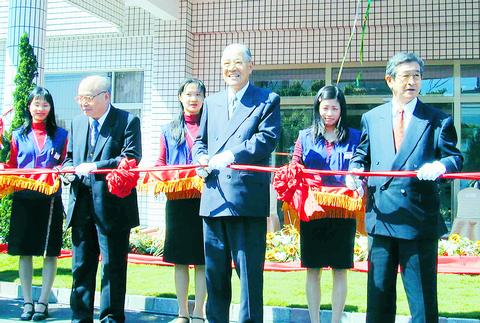
PHOTO: CHEN MEI-NIEN
United Microelectronics Corp (
Both companies would be limited to setting up older, eight-inch fabs that use an etching process of 0.25 microns or larger.
The highest technology in use today is found in 12-inch fabs using 0.13-micron processing technology. Larger wafer sizes allow manufacturers to squeeze on more chips -- thus saving costs -- as do finer line-width geometries.
The ban on Taiwanese companies setting up 12-inch fabs in China would remain, Lin said.
Lin also said that the government's final plan for "active opening, effective management" of the chip sector in China would be in place by the end of the month.
The phrase refers to the government's philosophy in regard to cross-strait investment and replaced the previous slogan of "no haste, be patient."
The government has failed three times to reach a consensus on whether to allow chip firms to set up eight-inch fabs in China.
The issue reached a fever pitch this week, with a group of academics and the TSU calling on the government to prevent the move.
Critics of the plan fear that allowing Taiwan's US$20-billion-a-year chip industry to invest in China would exacerbate unemployment, cause the nation to lose its high-tech competitiveness and threaten national security.
"The advantages in those high-tech industries is a bargaining chip for Taiwan," said Andrew Yang (楊念祖), secretary-general of the Chinese Center for Advanced Policy Studies in Taipei. "If Taiwan loses that advantage, it will lose control over the interaction between the two sides and Taiwan will fall more under China's pressure."
Lin told lawmakers yesterday that the government's management plan would ensure firms keep their base of operations in Taiwan.
The amount of capital a firm is allowed to invest in China will be determined by its total assets.
A chipmaker with less than NT$5 billion in assets will be allowed to invest 40 percent of the value of its assets in China. Those with between NT$5 billion and NT$10 billion in assets will be allowed up to 30 percent.
A company with assets above NT$10 billion will be allowed to invest up to 20 percent of the value of its assets in China, according to Lin.
With NT$270 billion in assets, TSMC will be allowed to invest NT$55.5 billion, Lin said. UMC, with NT$230 billion in assets, will be allowed up to NT$47.5 billion.
The vice premier said TSMC and UMC will likely build just one eight-inch plant in China each with a single production line during the first two years of open investment.
The cost of building a new eight-inch plant is around NT$35 billion, while moving used equipment into a new building would lower costs to NT$22 billion, Lin said.
Business leaders have long stressed that chipmakers must be permitted to invest in China to survive.
Jeffrey Koo (辜濂松), chairman of the Chinese National Association of Industry and Commerce, said yesterday that any further delay would cost Taiwanese companies the opportunity to invest in China.
"If the government continues to ban the nation's chipmakers from building eight-inch plants ... in China for another two years, then they may as well not even bother, because by that time it will be too late," Koo said.
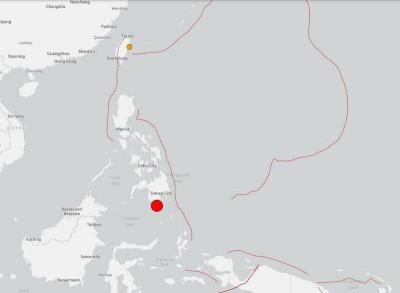
A magnitude 7.8 earthquake struck off the southern coast of Mindanao in the Philippines at 7:38am today, prompting the US Tsunami Warning System to issue an alert for neighboring countries, including Taiwan. The system issued a purple alert indicating a "tsunami threat." The potential threat zone includes Taiwan, the Philippines, Papua New Guinea, Yap and Palau. Philippine authorities were assessing the damage from the quake, with the office of civil defense seeking to verifying initial reports that 15 people had been killed and 129 injured in the region, mostly from falling debris. Arlene Hollero, disaster chief of Maasim town in the Philippines' Sarangani Province,

‘GRAY ZONE’ PRESSURE: Beijing’s activities are intended to create the deceitful impression that China has jurisdiction over the area around Taiwan, the CGA said Taiwan’s rights over its territorial waters and exclusive economic zone must not be violated by any country, the Mainland Affairs Council said yesterday, adding that it will not accept any unprovoked actions. The council issued the remarks in response to the China Coast Guard conducting maritime enforcement drills near eastern Taiwan and claiming to fully exercise China’s maritime administrative law enforcement authority. The Coast Guard Administration (CGA) has been closely monitoring the situation and is taking concrete steps to defend the nation’s sovereignty and secure its waters, the council said. China has no sovereign rights over the waters off eastern

RESILIENCE: Taiwan plays a key role in semiconductors, energy, information infrastructure and advanced manufacturing, AIT Director Raymond Greene said Taiwan’s continued investment in deterrence and resilience remains vital, especially in uncrewed systems and other emerging technologies, American Institute in Taiwan (AIT) Director Raymond Greene said yesterday. Greene made the remarks at the annual National Strategic Summit on Supply Chain Resilience held by the Research Institute for Democracy, Society and Emerging Technology (DSET), a government-backed think tank. As Taiwan last year became the US’ fourth-largest trading partner and supply chain security is becoming more important, cooperation in emerging technologies continues to deepen between the two countries, he said. The US is committed to accelerating innovation, building key infrastructure, strengthening cooperation

RIGHT DIRECTION: Taiwan’s efforts to prevent forced labor include a proposal to ‘fully prohibit’ employers from withholding workers’ documents, an official said Taiwan is to establish a mechanism to restrict imports of goods linked to forced labor, the Executive Yuan said yesterday, after the US proposed imposing additional tariffs on Taiwanese goods over labor concerns. “The Ministry of Labor and the Ministry of Economic Affairs are to establish an interministerial review procedure,” Executive Yuan spokesperson Michelle Lee (李慧芝) said at a news briefing in Taipei. “The government is to use the Foreign Trade Act [貿易法] as the legal basis to restrict imports of goods produced with forced labor” and bring its supply chain governance more in line with international standards on human rights, resilience


 RSS
RSS