


The CIA secretly began to send teams of American officers to northern Afghanistan about three years ago in an attempt to convince the leader of the anti-Taliban Afghan opposition to capture and perhaps kill Osama bin Laden, according to American intelligence officials.
The covert effort, which had not been previously disclosed, was based on an attempt to work with Ahmed Shah Massoud, who was then the military leader of the largest anti-Taliban group in the northern mountains of Afghanistan, and to have his forces go after bin Laden. Massoud was himself killed, CIA officials say, only two days before the terrorist attacks on the US, and the CIA believes he was assassinated by members of bin Laden's organization.
The CIA's efforts to deal with Massoud were among the most sensitive and highly classified elements of a broader long-term campaign, continuing unsuccessfully through the end of the Bill Clinton administration and into the George W. Bush administration, to destroy bin Laden's terrorist network. The US campaign against bin Laden intensified following the August 1998 bombings of two US embassies in East Africa, which transformed the Saudi-born exile into America's most wanted terrorist.
Today, the hunt for Osama bin Laden and his lieutenants in al-Qaeda, the terrorist network he leads from his sanctuary in Afghanistan, has escalated to wartime levels. The Bush administration is considering a full range of overt and covert military and intelligence proposals that Washington policy makers would have considered too risky or unworkable before the Sept. 11 attacks.
But according to intelligence officials and other policy makers, the US has been trying to kill bin Laden and destroy al-Qaeda for years, as the terrorist organization has become more ruthless and ambitious in its efforts to attack US interests around the world.
Clinton administration lawyers determined that the US could legitimately seek to kill bin Laden and his lieutenants despite the presidential ban on assassinations, according to those officials. The lawyers concluded that efforts to hunt and kill bin Laden were defensible either as acts of war or as national self defense, legitimate under both American and international law.
There have been an array of unsuccessful attempts to capture or kill bin Laden and disrupt or destroy al-Qaeda, American officials say. The Clinton administration even considered mounting a secret effort to steal millions of dollars from the bin Laden terrorist network by siphoning it out of the international financial system, but discarded the scheme because of objections from the US Treasury about the implications for world finance.
The US launched cruise missiles against a meeting bin Laden was believed to be attending, encouraged Massoud and other Afghan leaders to try to capture him, and received a secret report from one Afghan group last year about its failed attempt to assassinate bin Laden.
The US also led an international effort to shut down Afghanistan's airline, which American intelligence officials believed was being used by al-Qaeda to ship money and personnel around the world, while also pressuring other nations to arrest and disrupt al-Qaeda cells.
Top priority
"This was a top priority for us over the past several years, and not a day went by when we didn't press as hard as we could," said Sandy Berger, national security adviser in the Clinton administration. "But this is a tough, tough problem. I think we were pushing it as hard as we could. And I think the Bush administration is handling it in a smart way."
But until the devastating attacks on New York and Washington, the American-led efforts to hunt bin Laden lacked the sense of urgency that prevails today. US intelligence and law enforcement officials grew complacent about the threat of a domestic attack by al-Qaeda, failed by their own admission to share information adequately or coordinate their efforts, and were caught by surprise on Sept. 11.
Washington did not build a strong international coalition to focus on defeating al-Qaeda, which was seen by other nations largely as an American problem. Banks in Europe and the Middle East repeatedly balked at American pressure to cut off al-Qaeda financing, while wealthy individuals in Persian Gulf states -- sometimes in the guise of donating to Islamic charities -- continued to provide financial support to al-Qaeda.
At the same time, al-Qaeda was rapidly evolving into a larger and more complex terrorist threat, making it difficult for the US to keep up with its scope and capabilities. Bin Laden's great achievement within the terrorist world has been to forge alliances with other Islamic extremist groups under the umbrella of al-Qaeda, providing them financing, training and a sanctuary in Afghanistan, while encouraging coordinated action.
The US had only a hazy understanding of bin Laden's growing significance before 1996, when an al-Qaeda insider, Jamal Ahmed Al-Fadl, defected to the US and began to describe the extent of bin Laden's plans and objectives. Based largely on al-Fadl's information, a federal grand jury indicted bin Laden on terrorist conspiracy charges in June 1998, just two months before the twin bombings of the American embassies in Kenya and Tanzania.
Security threat
The embassy bombings forced Washington to recognize that bin Laden had become a major national security threat. Sometime after the bombings, the CIA began its efforts to work with Massoud against bin Laden, American officials said.
The officials declined to provide many details of the effort. But officials say that CIA officers secretly traveled to Massoud's mountain stronghold in northern Afghanistan and opened talks in an effort to fashion an anti-bin Laden alliance.
Current and former officials said that Massoud was promised large sums of money if he and his rebel fighters could find a way to get to bin Laden. Short of capturing the terrorist leader, Massoud was asked by the CIA to provide intelligence from inside Afghanistan about bin Laden and his organization, officials said.
It remains unclear whether Massoud -- more interested in toppling the Taliban -- ever made a serious effort to go after bin Laden. He would have faced enormous obstacles in doing so, considering that bin Laden was based in territory controlled by the Taliban and its military forces.
The effort to work with Massoud followed the most direct and open American effort to kill bin Laden. It came on Aug. 20, 1998, two weeks after the embassy attacks in East Africa. Clinton ordered cruise missile strikes on a complex near Khost, Afghanistan, where the CIA had learned that bin Laden was scheduled to be meeting with 200 to 300 other members of al-Qaeda.
The sea-launched cruise missiles slammed into the camp only about an hour or so after bin Laden left the conference, American officials believe. According to former senior Clinton administration officials, about 20 to 30 al-Qaeda members were killed, temporarily disrupting the organization.
But the attack failed in its unstated but clear objective, which was to kill bin Laden.
Consequences
One consequence was that bin Laden dramatically improved his own security measures. Realizing that the US had collected solid intelligence about his physical movements, he cut back on his use of electronic communications. US officials say he now tends to talk to subordinates only in person, and they then pass on his messages to others in the organization.
"He has become more sophisticated by becoming less sophisticated," said one former senior US official.
In addition, he moves frequently, traveling between Kandahar, the Taliban stronghold in southern Afghanistan, and the rugged Afghan countryside farther north, US officials say. "He became much more secure in his communications and the only way to track him was to have people on the ground," said another former senior US official.
The Clinton administration has been criticized for not following up on its first missile attack with an all-out effort to get bin Laden. But former officials said that they lacked the "actionable intelligence," or precise information about bin Laden's whereabouts, to launch another attack.
"The main focus was location, location, location," said one former administration official. "We had intensive intelligence gathering efforts to track him."
In addition, the logistics of launching an attack by special forces in one of the most remote regions of the world also presented formidable obstacles. "We had a number of contingency plans, but logistically it was a nightmare," said a Clinton administration official.

ROLLER-COASTER RIDE: More than five earthquakes ranging from magnitude 4.4 to 5.5 on the Richter scale shook eastern Taiwan in rapid succession yesterday afternoon Back-to-back weather fronts are forecast to hit Taiwan this week, resulting in rain across the nation in the coming days, the Central Weather Administration said yesterday, as it also warned residents in mountainous regions to be wary of landslides and rockfalls. As the first front approached, sporadic rainfall began in central and northern parts of Taiwan yesterday, the agency said, adding that rain is forecast to intensify in those regions today, while brief showers would also affect other parts of the nation. A second weather system is forecast to arrive on Thursday, bringing additional rain to the whole nation until Sunday, it
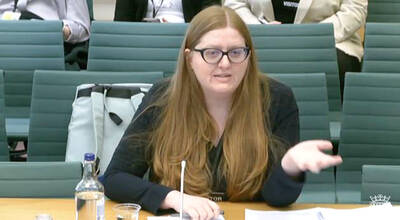
CONDITIONAL: The PRC imposes secret requirements that the funding it provides cannot be spent in states with diplomatic relations with Taiwan, Emma Reilly said China has been bribing UN officials to obtain “special benefits” and to block funding from countries that have diplomatic ties with Taiwan, a former UN employee told the British House of Commons on Tuesday. At a House of Commons Foreign Affairs Committee hearing into “international relations within the multilateral system,” former Office of the UN High Commissioner for Human Rights (OHCHR) employee Emma Reilly said in a written statement that “Beijing paid bribes to the two successive Presidents of the [UN] General Assembly” during the two-year negotiation of the Sustainable Development Goals. Another way China exercises influence within the UN Secretariat is

LANDSLIDES POSSIBLE: The agency advised the public to avoid visiting mountainous regions due to more expected aftershocks and rainfall from a series of weather fronts A series of earthquakes over the past few days were likely aftershocks of the April 3 earthquake in Hualien County, with further aftershocks to be expected for up to a year, the Central Weather Administration (CWA) said yesterday. Based on the nation’s experience after the quake on Sept. 21, 1999, more aftershocks are possible over the next six months to a year, the agency said. A total of 103 earthquakes of magnitude 4 on the local magnitude scale or higher hit Hualien County from 5:08pm on Monday to 10:27am yesterday, with 27 of them exceeding magnitude 5. They included two, of magnitude

Taiwan’s first drag queen to compete on the internationally acclaimed RuPaul’s Drag Race, Nymphia Wind (妮妃雅), was on Friday crowned the “Next Drag Superstar.” Dressed in a sparkling banana dress, Nymphia Wind swept onto the stage for the final, and stole the show. “Taiwan this is for you,” she said right after show host RuPaul announced her as the winner. “To those who feel like they don’t belong, just remember to live fearlessly and to live their truth,” she said on stage. One of the frontrunners for the past 15 episodes, the 28-year-old breezed through to the final after weeks of showcasing her unique


 RSS
RSS