


Most politicians nominated to head their government by four voters out of five probably wouldn't sequester themselves thousands of kilometers from the seat of power and retreat into meditation.
But then Samdhong Rinpoche is no typical politician, and the administration he is likely to lead -- the Tibetan government in exile -- is no average polity. It could change vastly, too, during Samdhong's tenure as Kalon Tripa, or prime minister.
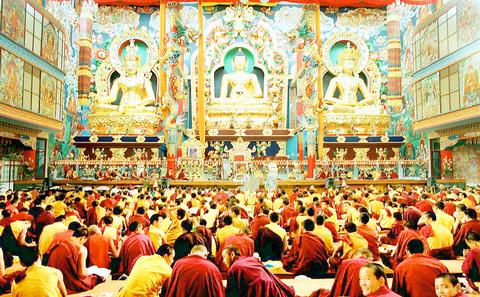
PHOTO: AFP
The Buddhist monk is in Bangalore, almost the length of India away from the exile government's headquarters in Dharmsala.
Associates say he probably will remain outside the political loop until next month -- after the final round of voting today should have confirmed him as the next head of the Cabinet, the executive body of the Dalai Lama's government in exile.
His retreat is a surprising response from a man many expect to bring greater transparency and a new dynamism to the post.
But his absence is unlikely to harm his chances. In the first poll in May -- when voters were asked to simply write in their preferred nominee -- the results were overwhelming. Samdhong got 81 percent, or 31,444 of the 38,793 votes cast, a record turnout.
Samdhong shouldn't face any serious challenge in the final balloting by registered voters in Tibetan settlements across India, Nepal and Bhutan, and as far afield as the US, Europe and Australia.
It is the first time the prime minister will be elected directly rather than nominated by the Dalai Lama. The change, like many reforms in Tibet's fledgling democracy, came at the Dalai Lama's initiative. The Dalai Lama, 66, said he wanted to hand over the everyday running of his administration to the prime minister.
"His Holiness wanted to have a system whereby people at least have someone to lead them. Right now everything is on His Holiness. As long as he's there it's well and good, but the day is bound to happen that he's no more with us," said Assistant Election Commissioner Lobsang Tsultrim.
But exactly how much power the Dalai Lama will cede to the prime minister is uncertain.
"His Holiness and the Kalon Tripa would need to sit down and discuss in detail the division of their responsibility," said Thubten Samphel, secretary of the Department of Information and International Relations. "The post of the Kalon Tripa is ... going to be much more critical and much more influential than the present Kalon Tripa."
One power the Dalai Lama has ceded is the nomination of the Cabinet, which will be subject to approval by the exile parliament, the Assembly of Tibetan People's Deputies.
Tibetans retain an immense faith in the Dalai Lama's leadership, and some commentators doubt the prime minister will enjoy much real power until he has held office for some time.
"Ultimately there will be a day His Holiness will impose that kind of duty on him. In the coming five-year term I don't think that he will proceed like that," says Tseten Norbu, president of the Tibetan Youth Congress, the radical arm of the Tibetan freedom movement.
Samdhong, 61, is expected to bring a change of style to the office. Unlike the incumbent, Sonam Topgyal, he has a high profile and is fluent in Hindi and English. He has forged links with the Indian community and served as the Dalai Lama's representative on overseas missions.
Tibetans believe that Samdhong, like the Dalai Lama, is a reincarnated, high-ranking monk. He also has a strong background in government, having been chairman of the parliament and vice chairman of the commission that drafted the government's constitution. He is credited with opening parliament's proceedings to the public and with making the Cabinet accountable to the parliament.
"He believes in democracy, and that in itself is a plus point," says Norbu.
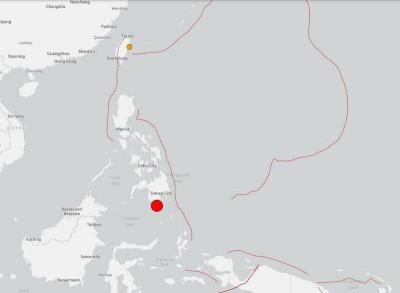
A magnitude 7.8 earthquake struck off the southern coast of Mindanao in the Philippines at 7:38am today, prompting the US Tsunami Warning System to issue an alert for neighboring countries, including Taiwan. The system issued a purple alert indicating a "tsunami threat." The potential threat zone includes Taiwan, the Philippines, Papua New Guinea, Yap and Palau. Philippine authorities were assessing the damage from the quake, with the office of civil defense seeking to verifying initial reports that 15 people had been killed and 129 injured in the region, mostly from falling debris. Arlene Hollero, disaster chief of Maasim town in the Philippines' Sarangani Province,

‘GRAY ZONE’ PRESSURE: Beijing’s activities are intended to create the deceitful impression that China has jurisdiction over the area around Taiwan, the CGA said Taiwan’s rights over its territorial waters and exclusive economic zone must not be violated by any country, the Mainland Affairs Council said yesterday, adding that it will not accept any unprovoked actions. The council issued the remarks in response to the China Coast Guard conducting maritime enforcement drills near eastern Taiwan and claiming to fully exercise China’s maritime administrative law enforcement authority. The Coast Guard Administration (CGA) has been closely monitoring the situation and is taking concrete steps to defend the nation’s sovereignty and secure its waters, the council said. China has no sovereign rights over the waters off eastern

RESILIENCE: Taiwan plays a key role in semiconductors, energy, information infrastructure and advanced manufacturing, AIT Director Raymond Greene said Taiwan’s continued investment in deterrence and resilience remains vital, especially in uncrewed systems and other emerging technologies, American Institute in Taiwan (AIT) Director Raymond Greene said yesterday. Greene made the remarks at the annual National Strategic Summit on Supply Chain Resilience held by the Research Institute for Democracy, Society and Emerging Technology (DSET), a government-backed think tank. As Taiwan last year became the US’ fourth-largest trading partner and supply chain security is becoming more important, cooperation in emerging technologies continues to deepen between the two countries, he said. The US is committed to accelerating innovation, building key infrastructure, strengthening cooperation

RIGHT DIRECTION: Taiwan’s efforts to prevent forced labor include a proposal to ‘fully prohibit’ employers from withholding workers’ documents, an official said Taiwan is to establish a mechanism to restrict imports of goods linked to forced labor, the Executive Yuan said yesterday, after the US proposed imposing additional tariffs on Taiwanese goods over labor concerns. “The Ministry of Labor and the Ministry of Economic Affairs are to establish an interministerial review procedure,” Executive Yuan spokesperson Michelle Lee (李慧芝) said at a news briefing in Taipei. “The government is to use the Foreign Trade Act [貿易法] as the legal basis to restrict imports of goods produced with forced labor” and bring its supply chain governance more in line with international standards on human rights, resilience


 RSS
RSS