


The demolition of 68 illegal smelting factories beside the heavily polluted Erjen River (二仁溪) in Tainan County finally began yesterday, as Environmental Protection Agency (EPA) chief Hau Lung-bin (郝龍斌) sought to keep the promise he made when he took office.
After suffering over 20 years of pollution from smelting -- melting and separating the different ores in scrap metal -- the Erjen River is finally seeing the end of the practice.
By 1987, there were over 100 illegal smelting factories located along the Erjen River. Pollution from the factories has greatly damaged the air quality in the area and adversely affected local wildlife.
Hau traveled to Tainan County yesterday in order to oversee the beginning of the demolition of the factories.
The Erjen River has been a constant headache for Hau, who vowed to clean it up at the beginning of his tenure as EPA head last year.
Between then and May of this year, Hau has received 147 letters from residents asking for the smelting factories to be closed.
In May, with the EPA planning to build a final depository for industrial waste in Tainan County's Kueijen township (
For the demolition of the smelting factories yesterday, Hau received wide support from Tainan residents. Not total support, however.
In opposition were the 450 factory workers who were put out of work by the factories' closure.
The workers shouted at Hau, accusing him of not giving them enough time before closing the factories. In one incident some even tried to punch him, but hit Tainan County EPA head Lee Mu-Sheng (
In addition Wang Hsing-nan (王幸男), a DPP legislator from Tainan County, spoke for himself and three other Tainan legislators in expressing disapproval of Hau's actions.
Accusing Hau of acting "too impulsively" and "without compassion," Wang denounced him for allegedly going back on a promise to give factory workers six months' notice prior to demolishing the factories.
Hau remained firm in his decision saying that he made it clear in April that the factories would be removed by the end of June and that 2 months is ample notice.
The first efforts to remove the factories began in 1997. Since then there have been 2 additional attempts to remove them but all failed.
An estimated total of NT$150 million has been spent on the efforts thus far.
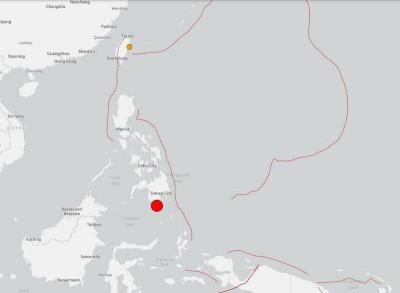
A magnitude 7.8 earthquake struck off the southern coast of Mindanao in the Philippines at 7:38am today, prompting the US Tsunami Warning System to issue an alert for neighboring countries, including Taiwan. The system issued a purple alert indicating a "tsunami threat." The potential threat zone includes Taiwan, the Philippines, Papua New Guinea, Yap and Palau. Philippine authorities were assessing the damage from the quake, with the office of civil defense seeking to verifying initial reports that 15 people had been killed and 129 injured in the region, mostly from falling debris. Arlene Hollero, disaster chief of Maasim town in the Philippines' Sarangani Province,

‘GRAY ZONE’ PRESSURE: Beijing’s activities are intended to create the deceitful impression that China has jurisdiction over the area around Taiwan, the CGA said Taiwan’s rights over its territorial waters and exclusive economic zone must not be violated by any country, the Mainland Affairs Council said yesterday, adding that it will not accept any unprovoked actions. The council issued the remarks in response to the China Coast Guard conducting maritime enforcement drills near eastern Taiwan and claiming to fully exercise China’s maritime administrative law enforcement authority. The Coast Guard Administration (CGA) has been closely monitoring the situation and is taking concrete steps to defend the nation’s sovereignty and secure its waters, the council said. China has no sovereign rights over the waters off eastern

RESILIENCE: Taiwan plays a key role in semiconductors, energy, information infrastructure and advanced manufacturing, AIT Director Raymond Greene said Taiwan’s continued investment in deterrence and resilience remains vital, especially in uncrewed systems and other emerging technologies, American Institute in Taiwan (AIT) Director Raymond Greene said yesterday. Greene made the remarks at the annual National Strategic Summit on Supply Chain Resilience held by the Research Institute for Democracy, Society and Emerging Technology (DSET), a government-backed think tank. As Taiwan last year became the US’ fourth-largest trading partner and supply chain security is becoming more important, cooperation in emerging technologies continues to deepen between the two countries, he said. The US is committed to accelerating innovation, building key infrastructure, strengthening cooperation

RIGHT DIRECTION: Taiwan’s efforts to prevent forced labor include a proposal to ‘fully prohibit’ employers from withholding workers’ documents, an official said Taiwan is to establish a mechanism to restrict imports of goods linked to forced labor, the Executive Yuan said yesterday, after the US proposed imposing additional tariffs on Taiwanese goods over labor concerns. “The Ministry of Labor and the Ministry of Economic Affairs are to establish an interministerial review procedure,” Executive Yuan spokesperson Michelle Lee (李慧芝) said at a news briefing in Taipei. “The government is to use the Foreign Trade Act [貿易法] as the legal basis to restrict imports of goods produced with forced labor” and bring its supply chain governance more in line with international standards on human rights, resilience


 RSS
RSS