


Leading Indonesian politicians met at a Jakarta mosque Friday for what media reports said were talks on dumping President Abdurrahman Wahid and shifting support to Vice President Megawati Sukarnoputri.
But the politicians, who included arch-Wahid foe and national assembly speaker Amien Rais, all made it clear they were not planning a coup, but seeking a constitutional change of leadership, the SCTV private broadcaster said yesterday.
Wahid, who has been under fire since being censored by parliament on Feb. 1 over his alleged role in two corruption cases, is on a Haj pilgrimage in Saudi Arabia. He is due back in Jakarta on Tuesday.
At Friday's meeting in Jakarta's Al Azhar mosque, the "unspoken conclusion" was that any change of leadership should be constitutional, Rais was quoted as saying by the Jakarta Post.
"People ... should mentally prepare themselves to face another change of leadership," Rais said.
Present at the mosque talks were Megawati's husband, businessman Taufik Kiemas, and leaders of her Indonesian Democracy Party Struggle (PDIP), the Muslim-oriented United Development Party (PPP) and the Golkar Party.
The PDIP and the Golkar Party hold the largest and second-largest blocks of seats in parliament and the national assembly.
Wahid became Indonesia's first democratically-elected president in October of 1999, but his popularity has since nose-dived.
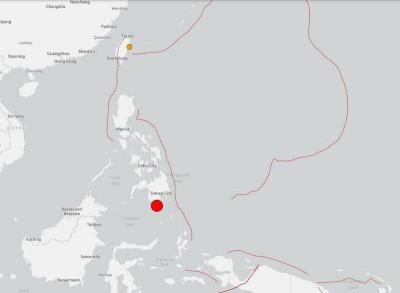
A magnitude 7.8 earthquake struck off the southern coast of Mindanao in the Philippines at 7:38am today, prompting the US Tsunami Warning System to issue an alert for neighboring countries, including Taiwan. The system issued a purple alert indicating a "tsunami threat." The potential threat zone includes Taiwan, the Philippines, Papua New Guinea, Yap and Palau. Philippine authorities were assessing the damage from the quake, with the office of civil defense seeking to verifying initial reports that 15 people had been killed and 129 injured in the region, mostly from falling debris. Arlene Hollero, disaster chief of Maasim town in the Philippines' Sarangani Province,

‘GRAY ZONE’ PRESSURE: Beijing’s activities are intended to create the deceitful impression that China has jurisdiction over the area around Taiwan, the CGA said Taiwan’s rights over its territorial waters and exclusive economic zone must not be violated by any country, the Mainland Affairs Council said yesterday, adding that it will not accept any unprovoked actions. The council issued the remarks in response to the China Coast Guard conducting maritime enforcement drills near eastern Taiwan and claiming to fully exercise China’s maritime administrative law enforcement authority. The Coast Guard Administration (CGA) has been closely monitoring the situation and is taking concrete steps to defend the nation’s sovereignty and secure its waters, the council said. China has no sovereign rights over the waters off eastern

RESILIENCE: Taiwan plays a key role in semiconductors, energy, information infrastructure and advanced manufacturing, AIT Director Raymond Greene said Taiwan’s continued investment in deterrence and resilience remains vital, especially in uncrewed systems and other emerging technologies, American Institute in Taiwan (AIT) Director Raymond Greene said yesterday. Greene made the remarks at the annual National Strategic Summit on Supply Chain Resilience held by the Research Institute for Democracy, Society and Emerging Technology (DSET), a government-backed think tank. As Taiwan last year became the US’ fourth-largest trading partner and supply chain security is becoming more important, cooperation in emerging technologies continues to deepen between the two countries, he said. The US is committed to accelerating innovation, building key infrastructure, strengthening cooperation

RIGHT DIRECTION: Taiwan’s efforts to prevent forced labor include a proposal to ‘fully prohibit’ employers from withholding workers’ documents, an official said Taiwan is to establish a mechanism to restrict imports of goods linked to forced labor, the Executive Yuan said yesterday, after the US proposed imposing additional tariffs on Taiwanese goods over labor concerns. “The Ministry of Labor and the Ministry of Economic Affairs are to establish an interministerial review procedure,” Executive Yuan spokesperson Michelle Lee (李慧芝) said at a news briefing in Taipei. “The government is to use the Foreign Trade Act [貿易法] as the legal basis to restrict imports of goods produced with forced labor” and bring its supply chain governance more in line with international standards on human rights, resilience


 RSS
RSS