


Premier Chang Chun-hsiung (張俊雄) said yesterday that the Executive Yuan is "cautiously weighing" the possibility of holding a non-binding referendum on the Fourth Nuclear Power Plant (
Chang made the remark during a courtesy call to the legislature yesterday, responding to questions from opposition legislators who were concerned about the DPP's intention to push for a public referendum in December to seek a "final" solution to the controversial project.
While a referendum law is unlikely to pass without support from opposition lawmakers, the anti-nuclear DPP has argued that a referendum on the project could still be held without a law.
"Without a legal basis, a referendum will be no more than an alternative opinion poll. This will be for reference purposes only and won't have any legal effect," Chang said.
"Because of this concern, the Executive Yuan is still studying [the possibility of holding such a referendum] and at the same time proposing to negotiate with the opposition parties on the enactment of a referendum law," Chang added.
During the visit, Chang presented to the legislators a list of 17 priority bills and amendments that the Executive Yuan wishes to pass in this legislative session, topped by the referendum law.
Chang said that the lack of an institutional measure to solve a public policy dispute was responsible for the 20-year debate over the plant, during which Taiwan had paid a heavy price.
"If we don't seize this opportunity to set up a permanent system, the price we have paid will be worthless," Chang said.
On the legislators' question as to whether the plant issue will be put to a referendum under the new law, Chang did not offer a definite answer.
"This will depend on how the rules are set after the legislature passes the law," Chang said.
Opposition lawmakers have insisted that a public policy that is already in place should be excluded from a referendum.
Legislative Yuan speaker Wang Jin-pyng
"It will cause a lot of problems and suspicion that the Executive Yuan is trying to interfere with the elections," Wang said.
Hwang Yih-jiau
"The ruling party, based on campaign considerations, may see a need to split the 23 million people into two extremes -- anti-nuclear and pro-nuclear camps -- so as to gain an advantageous position. But as the nation's top executive, the premier should perform his duty according to the law," Hwang said.
It is generally believed that the DPP may be able to secure support from traditional, anti-nuclear DPP voters, who constitute around 30 percent of the electorate, if the plant becomes a major issue in the year-end elections.
In this scenario, the three major opposition parties, including the KMT, PFP and New Party, would be forced to vie for the 50 percent of the electorate who support the plant project.
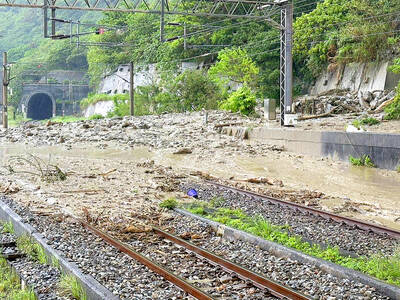
ROLLER-COASTER RIDE: More than five earthquakes ranging from magnitude 4.4 to 5.5 on the Richter scale shook eastern Taiwan in rapid succession yesterday afternoon Back-to-back weather fronts are forecast to hit Taiwan this week, resulting in rain across the nation in the coming days, the Central Weather Administration said yesterday, as it also warned residents in mountainous regions to be wary of landslides and rockfalls. As the first front approached, sporadic rainfall began in central and northern parts of Taiwan yesterday, the agency said, adding that rain is forecast to intensify in those regions today, while brief showers would also affect other parts of the nation. A second weather system is forecast to arrive on Thursday, bringing additional rain to the whole nation until Sunday, it

CONDITIONAL: The PRC imposes secret requirements that the funding it provides cannot be spent in states with diplomatic relations with Taiwan, Emma Reilly said China has been bribing UN officials to obtain “special benefits” and to block funding from countries that have diplomatic ties with Taiwan, a former UN employee told the British House of Commons on Tuesday. At a House of Commons Foreign Affairs Committee hearing into “international relations within the multilateral system,” former Office of the UN High Commissioner for Human Rights (OHCHR) employee Emma Reilly said in a written statement that “Beijing paid bribes to the two successive Presidents of the [UN] General Assembly” during the two-year negotiation of the Sustainable Development Goals. Another way China exercises influence within the UN Secretariat is

LANDSLIDES POSSIBLE: The agency advised the public to avoid visiting mountainous regions due to more expected aftershocks and rainfall from a series of weather fronts A series of earthquakes over the past few days were likely aftershocks of the April 3 earthquake in Hualien County, with further aftershocks to be expected for up to a year, the Central Weather Administration (CWA) said yesterday. Based on the nation’s experience after the quake on Sept. 21, 1999, more aftershocks are possible over the next six months to a year, the agency said. A total of 103 earthquakes of magnitude 4 on the local magnitude scale or higher hit Hualien County from 5:08pm on Monday to 10:27am yesterday, with 27 of them exceeding magnitude 5. They included two, of magnitude

Taiwan’s first drag queen to compete on the internationally acclaimed RuPaul’s Drag Race, Nymphia Wind (妮妃雅), was on Friday crowned the “Next Drag Superstar.” Dressed in a sparkling banana dress, Nymphia Wind swept onto the stage for the final, and stole the show. “Taiwan this is for you,” she said right after show host RuPaul announced her as the winner. “To those who feel like they don’t belong, just remember to live fearlessly and to live their truth,” she said on stage. One of the frontrunners for the past 15 episodes, the 28-year-old breezed through to the final after weeks of showcasing her unique


 RSS
RSS