


The Taiwan Power Company (Taipower,
Taipower cannot afford to let even a few of the contractors -- irked over the extended suspension of work -- to cut their losses and walk. If this happens, finding replacements could take up to a year, seriously hobbling efforts to revive construction and compounding the NT$500 million Taipower has already lost since the project was halted.
Hoping to avoid this outcome, Taipower yesterday met with 12 major local contractors at the Kungliao (貢寮) site to "request they temporarily hold off from annulling their contracts," said Lin Ju-wan (林居萬), director of Taipower's Lungmen Construction Office at the plant's site in Kungliao.
Under the terms of the agreement with Taipower, domestic contractors have the right to annul their contracts and seek compensation if the project is delayed for more than three months.
Jan. 27 will mark three months to the day that Premier Chang Chun-hsiung (張俊雄) ordered the plant be cancelled and local builders will be eligible to exercise their right to compensation.
Lin said there was no sign from any of the contractors on what their intentions would be after next week.
Foremost in the minds of contractors will be the losses endured during the delay and the chances of a speedy resolution to the stand-off over the matter between the Cabinet, which axed the plant, and the largely pro-nuclear opposition parties which dominate the legislature.
But according to Chuang Shih-ming (
Although the legislature has slated a provisional session on Feb. 2 in an effort to resolve the matter and consider a compromise offer extended by the administration yesterday, Chuang said that "After Lunar New Year, it's war."
This would certainly trouble Chu Tai-sheng (
"My subcontractors have said if the government can't settle it in the short-term, then they may have to cancel," said Chu, who emphasized the cooperative nature of work carried out by contractors at the site.
"If, for example, my concrete supplier pulled out, how could we continue to build?" said Chu.
A pull-out of any of the other main contractors at Kungliao would hamper the ability of other companies to complete their work during the time it would take to replace them, said Chu.
"Construction of the utility is about teamwork," said Chu. "If other contractors can't work, we can't either -- even if we wanted to -- because we have to collaborate with each other," he added.
According to Hsu Yung-hua (徐永華), project engineer at Taipower's Department of Nuclear and Fossil Power Projects, finding companies to replace those that pull out would take a "very long time."
"The original bidding process was conducted in two stages because of the size of the project and took two years to complete," Hsu said. "It would take at least six months and perhaps as long as one year to complete the process again now," he added.
Other Taipower executives stressed the difficulties that would be encountered by a new company picking up a project, which in some cases may already be half finished.
"There are specific regulations governing the construction of nuclear plants ... ensuring a smooth continuation of construction of partially completed facilities is extremely important ... and it is not a simple undertaking," he said.
Besides urging the companies to stay on, Taipower can only hope for a speedy decision by the cabinet to avert a wholesale collapse of the construction team and further spectacular losses from compensation payouts.
"Regardless of whether the decision favors completion or cancellation, it must be made quickly," said Huang Shou-ching (
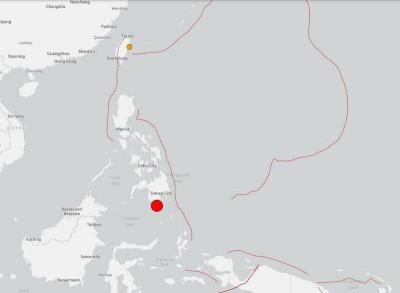
A magnitude 7.8 earthquake struck off the southern coast of Mindanao in the Philippines at 7:38am today, prompting the US Tsunami Warning System to issue an alert for neighboring countries, including Taiwan. The system issued a purple alert indicating a "tsunami threat." The potential threat zone includes Taiwan, the Philippines, Papua New Guinea, Yap and Palau. Philippine authorities were assessing the damage from the quake, with the office of civil defense seeking to verifying initial reports that 15 people had been killed and 129 injured in the region, mostly from falling debris. Arlene Hollero, disaster chief of Maasim town in the Philippines' Sarangani Province,

‘GRAY ZONE’ PRESSURE: Beijing’s activities are intended to create the deceitful impression that China has jurisdiction over the area around Taiwan, the CGA said Taiwan’s rights over its territorial waters and exclusive economic zone must not be violated by any country, the Mainland Affairs Council said yesterday, adding that it will not accept any unprovoked actions. The council issued the remarks in response to the China Coast Guard conducting maritime enforcement drills near eastern Taiwan and claiming to fully exercise China’s maritime administrative law enforcement authority. The Coast Guard Administration (CGA) has been closely monitoring the situation and is taking concrete steps to defend the nation’s sovereignty and secure its waters, the council said. China has no sovereign rights over the waters off eastern

RESILIENCE: Taiwan plays a key role in semiconductors, energy, information infrastructure and advanced manufacturing, AIT Director Raymond Greene said Taiwan’s continued investment in deterrence and resilience remains vital, especially in uncrewed systems and other emerging technologies, American Institute in Taiwan (AIT) Director Raymond Greene said yesterday. Greene made the remarks at the annual National Strategic Summit on Supply Chain Resilience held by the Research Institute for Democracy, Society and Emerging Technology (DSET), a government-backed think tank. As Taiwan last year became the US’ fourth-largest trading partner and supply chain security is becoming more important, cooperation in emerging technologies continues to deepen between the two countries, he said. The US is committed to accelerating innovation, building key infrastructure, strengthening cooperation

RIGHT DIRECTION: Taiwan’s efforts to prevent forced labor include a proposal to ‘fully prohibit’ employers from withholding workers’ documents, an official said Taiwan is to establish a mechanism to restrict imports of goods linked to forced labor, the Executive Yuan said yesterday, after the US proposed imposing additional tariffs on Taiwanese goods over labor concerns. “The Ministry of Labor and the Ministry of Economic Affairs are to establish an interministerial review procedure,” Executive Yuan spokesperson Michelle Lee (李慧芝) said at a news briefing in Taipei. “The government is to use the Foreign Trade Act [貿易法] as the legal basis to restrict imports of goods produced with forced labor” and bring its supply chain governance more in line with international standards on human rights, resilience


 RSS
RSS