


Controversial tycoon Thaksin Shinawatra won easily in Thailand's general election and may even have secured the country's first ever absolute majority, unofficial results showed yesterday.
But Thaksin's victory does not mean the end of the political uncertainty gripping Thailand -- the 51-year-old telecoms billionaire faces an anxious wait to see whether he is banned from politics over allegations of graft.
Unofficial results from Thai television networks yesterday predicted Thaksin's Thai Rak Thai [Thais Love Thais] Party would win about 257 of the 500 seats in the lower house of parliament.
Its nearest rival, the Democrat Party of veteran Prime Minister Chuan Leekpai, was projected to win just 127 seats.
The iTV television station projected Thaksin would get around 51 percent of the popular vote, an unprecedented figure.
The final official result might not be announced for several weeks as re-votes would be held in four constituencies due to voting irregularities, officials from Thailand's Election Commission said.
Chuan said in his home town in southern Thailand that it was clear Thaksin had won.
"I believe one single party can almost form the government by itself. Therefore, there is no question that others may try to challenge it by setting up another coalition," he told reporters.
"I believe the people have freely made their choice and we respect that decision."
The election does not mark the end of Thaksin's struggle.
Thailand's anti-corruption watchdog ruled last month that he had failed to declare some of his wealth. Thaksin denies wrongdoing, but if the Constitutional Court upholds the ruling he would be barred from politics for five years.
Court deliberations could take months, however, and given the size of the vote for Thaksin, Thailand's fragile democracy could face a crisis if he were suddenly removed from office.
In a front-page editorial, the Bangkok Post urged Thaksin to wait for the court's verdict before becoming prime minister.
"With the economy still in a bad shape, the country needs political stability to inspire confidence, especially among foreign investors," it said.
"How can a leader whose future in politics still hangs in the balance inspire confidence?"
But the scale of Thaksin's landslide was likely to be welcomed by Thai financial markets, which have been among the worst performing in the world over the last year, analysts said.
One of the big fears among investors before the election had been of an indecisive result, which could have left a political vacuum in Thailand and government policies in doubt.
"The market reaction tomorrow should be positive given the higher than expected votes for Thai Rak Thai," said Kongkiat Opaswongkarn, chief executive of Asset Plus Securities.
"Thais have given Thai Rak Thai a clear mandate," he said.
Saturday's election was the first under a new constitution introduced in 1997 which was designed to stamp out corruption.
Thailand's Election Commission now has powers to disqualify poll cheats and call re-votes. It said the election was the dirtiest ever, with a record number of complaints of vote fraud. The turnout, estimated at over 70 percent, was also a record.
Even if Thaksin wins an outright majority, he is likely to form an alliance with one or two smaller parties, to build a coalition that can command around 320 seats.
"I think three parties would be enough and that will make 320 seats," Thaksin said.
Thaksin's likely choices for coalition partners are the New Aspiration Party of former prime minister Chavalit Yongchaiyudh and the Chart Thai party of ex-premier Banharn Silpa-archa.
Thaksin acknowledged that it could be months before his government was in place, due to the need for re-votes and negotiations with other parties. "The whole process will probably take about two months to complete," he told reporters.
The Nation daily said Thaksin's victory marked a new era for Thai politics.
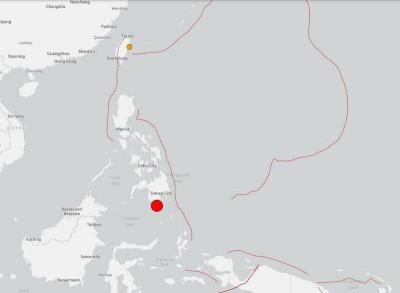
A magnitude 7.8 earthquake struck off the southern coast of Mindanao in the Philippines at 7:38am today, prompting the US Tsunami Warning System to issue an alert for neighboring countries, including Taiwan. The system issued a purple alert indicating a "tsunami threat." The potential threat zone includes Taiwan, the Philippines, Papua New Guinea, Yap and Palau. Philippine authorities were assessing the damage from the quake, with the office of civil defense seeking to verifying initial reports that 15 people had been killed and 129 injured in the region, mostly from falling debris. Arlene Hollero, disaster chief of Maasim town in the Philippines' Sarangani Province,

‘GRAY ZONE’ PRESSURE: Beijing’s activities are intended to create the deceitful impression that China has jurisdiction over the area around Taiwan, the CGA said Taiwan’s rights over its territorial waters and exclusive economic zone must not be violated by any country, the Mainland Affairs Council said yesterday, adding that it will not accept any unprovoked actions. The council issued the remarks in response to the China Coast Guard conducting maritime enforcement drills near eastern Taiwan and claiming to fully exercise China’s maritime administrative law enforcement authority. The Coast Guard Administration (CGA) has been closely monitoring the situation and is taking concrete steps to defend the nation’s sovereignty and secure its waters, the council said. China has no sovereign rights over the waters off eastern

RESILIENCE: Taiwan plays a key role in semiconductors, energy, information infrastructure and advanced manufacturing, AIT Director Raymond Greene said Taiwan’s continued investment in deterrence and resilience remains vital, especially in uncrewed systems and other emerging technologies, American Institute in Taiwan (AIT) Director Raymond Greene said yesterday. Greene made the remarks at the annual National Strategic Summit on Supply Chain Resilience held by the Research Institute for Democracy, Society and Emerging Technology (DSET), a government-backed think tank. As Taiwan last year became the US’ fourth-largest trading partner and supply chain security is becoming more important, cooperation in emerging technologies continues to deepen between the two countries, he said. The US is committed to accelerating innovation, building key infrastructure, strengthening cooperation

RIGHT DIRECTION: Taiwan’s efforts to prevent forced labor include a proposal to ‘fully prohibit’ employers from withholding workers’ documents, an official said Taiwan is to establish a mechanism to restrict imports of goods linked to forced labor, the Executive Yuan said yesterday, after the US proposed imposing additional tariffs on Taiwanese goods over labor concerns. “The Ministry of Labor and the Ministry of Economic Affairs are to establish an interministerial review procedure,” Executive Yuan spokesperson Michelle Lee (李慧芝) said at a news briefing in Taipei. “The government is to use the Foreign Trade Act [貿易法] as the legal basis to restrict imports of goods produced with forced labor” and bring its supply chain governance more in line with international standards on human rights, resilience


 RSS
RSS