


A congressional report released yesterday says that although much attention has been paid to China's procurement of Sovremenny-class destroyers armed with SS-N-22 missiles, "the four quiet Kilo SS submarines might represent a greater threat to naval forces in Asia."
The Pentagon announced yesterday that Secretary of the Navy Richard Danzig departed on Oct. 10 for a one-week visit to China where he would meet with Chinese military leaders in Shanghai, Nanjing and Beijing. Danzing hopes to build upon a renewed sense of goodwill and cooperation between the countries that has been fostered by recent reciprocal naval port visits.
However, many lawmakers on Capital Hill worry that the continuing modernization of the PLA, especially arms procurements from Russia, may have significant implications for US security interests.
The report also says, however, that China poses a greater threat to Asia countries, including Taiwan, especially with China's Kilo SS submarines.
According to a statement issued in 1997 by Rear Admiral Michael Cramer, director of naval intelligence, China's current conventional submarine force is mostly obsolete, being composed of vessels of 1950s era design and technology.
China's old diesel submarines are being phased out in favor of the indigenously produced Song SS. The Song is the first Chinese submarine equipped with a submerged-launch anti-ship cruise missile. China will upgrade two of the four Russian Kilo SS subs with improved quieting and sonar technology.
Cramer writes that the Kilos are among the quietest conventional submarines in the world, and coupled with the Song SS, provides a generational leap in China's conventional submarine technology.
The Russian SS-N-22s are supersonic, low-altitude missiles capable of over-the-horizon missions and can carry a 200-kiloton nuclear warhead. Sovremenny destroyers carry eight of these "Sunburn" missiles which are intended to destroy AEGIS defense system-equipped vessels guarding carrier battle groups.
Senator Daniel Kahikina Akaka, ranking member of the Subcommittee on International Security, Proliferation, and Federal Services of the Governmental Affairs Committee who requested the congressional report, said that "the United States should not be complacent." He said "the Chinese are, for the first time in modern history, developing the capability to project air and naval forces beyond their coastal areas. The US needs to seek ways to address any threat to American interests."
According to the analysis, the catalyst for PLA modernization has been China's view that its top security problem was preventing Taiwan's permanent separation and securing unification under its definition of "one China."
The report points out that during the period between 1992 to 1999, China ranked fourth in arms transfer agreements with a total value of US$10.9 billion. During the same period, China received US$5.9 billion in arms deliveries. Russia has been the primary source of China's arms.
However, the report says that Taiwan has seven times the number of modern fighter aircraft than China. Generally, attackers tend to require greater numbers than defenders, a 3:1 ratio is traditionally considered the minimum required for success. The numerical inequity between China's modern fighters (48) and Taiwan's modern air force (340) brings into question the Chinese Air Force's ability to mount effective offensive action.
The report concludes that the operational significance of China's conventional arms acquisitions will also depend on the PLA's ability to conduct effective joint military operations that integrate its air force and navy, as well as weapons systems and other assets. This, says the report, will determine the effectiveness of any military confrontation with Taiwan in the future.
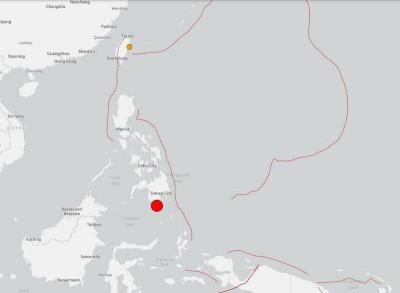
A magnitude 7.8 earthquake struck off the southern coast of Mindanao in the Philippines at 7:38am today, prompting the US Tsunami Warning System to issue an alert for neighboring countries, including Taiwan. The system issued a purple alert indicating a "tsunami threat." The potential threat zone includes Taiwan, the Philippines, Papua New Guinea, Yap and Palau. Philippine authorities were assessing the damage from the quake, with the office of civil defense seeking to verifying initial reports that 15 people had been killed and 129 injured in the region, mostly from falling debris. Arlene Hollero, disaster chief of Maasim town in the Philippines' Sarangani Province,
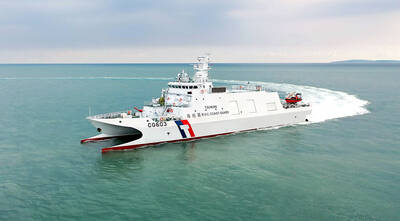
‘GRAY ZONE’ PRESSURE: Beijing’s activities are intended to create the deceitful impression that China has jurisdiction over the area around Taiwan, the CGA said Taiwan’s rights over its territorial waters and exclusive economic zone must not be violated by any country, the Mainland Affairs Council said yesterday, adding that it will not accept any unprovoked actions. The council issued the remarks in response to the China Coast Guard conducting maritime enforcement drills near eastern Taiwan and claiming to fully exercise China’s maritime administrative law enforcement authority. The Coast Guard Administration (CGA) has been closely monitoring the situation and is taking concrete steps to defend the nation’s sovereignty and secure its waters, the council said. China has no sovereign rights over the waters off eastern
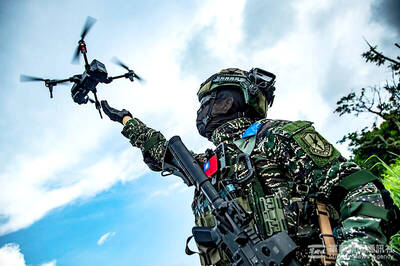
RESILIENCE: Taiwan plays a key role in semiconductors, energy, information infrastructure and advanced manufacturing, AIT Director Raymond Greene said Taiwan’s continued investment in deterrence and resilience remains vital, especially in uncrewed systems and other emerging technologies, American Institute in Taiwan (AIT) Director Raymond Greene said yesterday. Greene made the remarks at the annual National Strategic Summit on Supply Chain Resilience held by the Research Institute for Democracy, Society and Emerging Technology (DSET), a government-backed think tank. As Taiwan last year became the US’ fourth-largest trading partner and supply chain security is becoming more important, cooperation in emerging technologies continues to deepen between the two countries, he said. The US is committed to accelerating innovation, building key infrastructure, strengthening cooperation

RIGHT DIRECTION: Taiwan’s efforts to prevent forced labor include a proposal to ‘fully prohibit’ employers from withholding workers’ documents, an official said Taiwan is to establish a mechanism to restrict imports of goods linked to forced labor, the Executive Yuan said yesterday, after the US proposed imposing additional tariffs on Taiwanese goods over labor concerns. “The Ministry of Labor and the Ministry of Economic Affairs are to establish an interministerial review procedure,” Executive Yuan spokesperson Michelle Lee (李慧芝) said at a news briefing in Taipei. “The government is to use the Foreign Trade Act [貿易法] as the legal basis to restrict imports of goods produced with forced labor” and bring its supply chain governance more in line with international standards on human rights, resilience


 RSS
RSS