


Cabinet spokeswoman Chun Chin (鍾琴) yesterday revived the idea of a "national security" tax (國家安全捐) on Taiwanese investment in China.
The idea of such a tax was first proposed last month by the new vice governor of the central bank, Chen Shih-meng (陳師孟), but was derided by former Cabinet officials and non-DPP politicians as "proposing an exercise, which can only be suitable in a classroom" as well as "setting up more obstacles with an anti-China ideology."
Chun, director of the Government Information Office and also a senior research fellow on cross-strait economic issues at the Chung Hua Institution for Economic Research, defended Chen's idea as being "the mainstream of academic opinion."
Chun said such a measure may be adopted as government policy for regulating a new cross-strait trade relationship.
Chun stressed that the previous government's "no haste, be patient" (
"Chen's [security tax] idea is more compatible with economic liberalization than the old policy," Chun said. "His goal is that the government can directly control such investment by its costs, thereby solving the problem of external costs [which include such expenditures as Taiwan's national defense budget]."
Chun stressed that the security tax had not been discussed by the Cabinet.
"However, this does not mean that the government will exclude this measure," she said.
Chen, formerly a Taiwan University professor, suggested on May 10 that a national security duty could be implemented if direct transportation and trade links were established.
In justifying the proposal, Chen said Taiwanese investment in China could pose a threat to national security, and that businesses operating there should contribute to the nation's defense budget.
In addition, Chen said the new administration could levy a tax on cross-strait freight. The funds would be used for local construction projects and also for national security purposes.
Responding to a reporter's question about the proposed tax, Chun yesterday supported Chen saying that such a tax could also deliver the message that "Taiwan is an independent, sovereignty country."
"The name of this tax could be changed, if it caused a negative reaction," Chun added.
Chun also said that the tax would serve an economic purpose beyond subsidizing Taiwan's defense budget, in that it would help drive out weaker companies.
"In the past, the investments were regulated on the basis of their scale and type, but now through this tax, the government will use the concept of `price control' (
"Businessmen should not be worried about this tax, all they need to do is to promote their [companies'] efficiency."
Chun admitted, however, that levying such a tax might be seen as violating the principle of "anti-discrimination" and other regulations to enter the WTO.
"But we can explain to the international community that the cross-strait relationship is not totally normalized," Chun said.
Chun's statement yesterday brought a swift, negative response from many quarters.
"This tax can neither increase government tax revenues nor improve the cross-strait relationship," said KMT legislative caucus leader Lin Chien-jung (林建榮).
"Taiwan's businessmen have suffered in the bad investment environment in China, and now they have to be exploited by our government for purely political considerations," said PFP legislative caucus leader Chiu Chuang-liang (
The DPP legislative caucus has not come out in support of the tax but has urged the government to draw up concrete measures for protecting investments in China.
"If investing in China is dangerous, the government should clearly limit businessmen," said Cheng Pao-chin (
Other government officials, particularly those involved in China affairs, denied that imposing a national security tax was a set policy for the government.
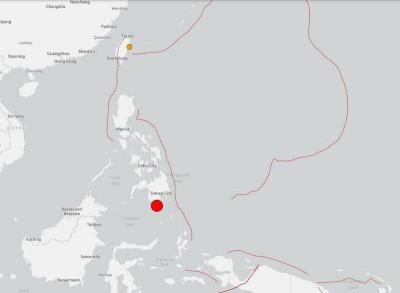
A magnitude 7.8 earthquake struck off the southern coast of Mindanao in the Philippines at 7:38am today, prompting the US Tsunami Warning System to issue an alert for neighboring countries, including Taiwan. The system issued a purple alert indicating a "tsunami threat." The potential threat zone includes Taiwan, the Philippines, Papua New Guinea, Yap and Palau. Philippine authorities were assessing the damage from the quake, with the office of civil defense seeking to verifying initial reports that 15 people had been killed and 129 injured in the region, mostly from falling debris. Arlene Hollero, disaster chief of Maasim town in the Philippines' Sarangani Province,
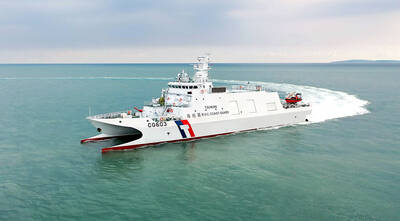
‘GRAY ZONE’ PRESSURE: Beijing’s activities are intended to create the deceitful impression that China has jurisdiction over the area around Taiwan, the CGA said Taiwan’s rights over its territorial waters and exclusive economic zone must not be violated by any country, the Mainland Affairs Council said yesterday, adding that it will not accept any unprovoked actions. The council issued the remarks in response to the China Coast Guard conducting maritime enforcement drills near eastern Taiwan and claiming to fully exercise China’s maritime administrative law enforcement authority. The Coast Guard Administration (CGA) has been closely monitoring the situation and is taking concrete steps to defend the nation’s sovereignty and secure its waters, the council said. China has no sovereign rights over the waters off eastern
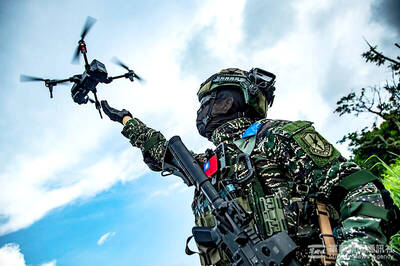
RESILIENCE: Taiwan plays a key role in semiconductors, energy, information infrastructure and advanced manufacturing, AIT Director Raymond Greene said Taiwan’s continued investment in deterrence and resilience remains vital, especially in uncrewed systems and other emerging technologies, American Institute in Taiwan (AIT) Director Raymond Greene said yesterday. Greene made the remarks at the annual National Strategic Summit on Supply Chain Resilience held by the Research Institute for Democracy, Society and Emerging Technology (DSET), a government-backed think tank. As Taiwan last year became the US’ fourth-largest trading partner and supply chain security is becoming more important, cooperation in emerging technologies continues to deepen between the two countries, he said. The US is committed to accelerating innovation, building key infrastructure, strengthening cooperation

RIGHT DIRECTION: Taiwan’s efforts to prevent forced labor include a proposal to ‘fully prohibit’ employers from withholding workers’ documents, an official said Taiwan is to establish a mechanism to restrict imports of goods linked to forced labor, the Executive Yuan said yesterday, after the US proposed imposing additional tariffs on Taiwanese goods over labor concerns. “The Ministry of Labor and the Ministry of Economic Affairs are to establish an interministerial review procedure,” Executive Yuan spokesperson Michelle Lee (李慧芝) said at a news briefing in Taipei. “The government is to use the Foreign Trade Act [貿易法] as the legal basis to restrict imports of goods produced with forced labor” and bring its supply chain governance more in line with international standards on human rights, resilience


 RSS
RSS