


For the first 42 years of her/his life, Hiker Chiu (丘愛芝) didn’t know who she or he was. Born and raised a girl, Chiu liked to play with dolls and dreamed of getting married and having babies. Then at the age of 10, her body stopped growing. While other girls reached puberty, Chiu waited for her first period, which never came. And her breasts didn’t develop as her classmates.
“My world collapsed. I was living in fear, not knowing what I would become,” Chiu says.
Being a person whose body doesn’t easily fit in with what is considered standard for female or male, Chiu felt alone. The unexplained scar on her/his belly only deepened a sense of secrecy and shame.
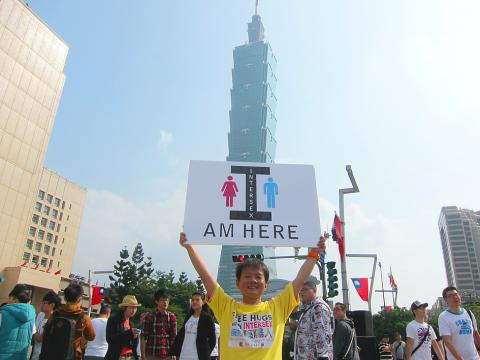
Photo courtesy of Yeh Hsiao-chi
It wasn’t until decades later when s/he came across XXY, an Argentinian movie about a 15-year-old intersex person, in 2008 that Chiu began to understand who s/he really is. In 2010, Chiu made the debut public appearance as an intersex person at the LGBT Pride Parade in Taipei, becoming the country’s first and so far only openly intersex advocate.
“It started out simply: I want to find others like me,” the 47-year-old Chiu says.
GENETIC VARIATIONS
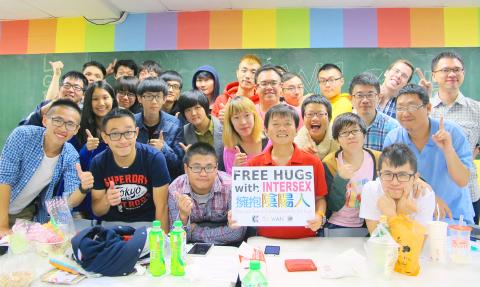
Photo courtesy of Yeh Hsiao-chi
Intersex is a term used to describe people whose biological sex is ambiguous. There are a range of variations in sexual characteristics including chromosomes, gonads, genitals and internal reproductive organs that don’t allow an individual to be clearly identified as male or female. For example, if a person with male chromosomes does not respond to androgens in the usual way, the result is a feminine appearance ranging from ambiguous genitalia to the development of breasts, vagina and clitoris.
Chiu, on the other hand, is a genetic female whose body produces high level of androgens, resulting in an enlarged clitoris and absence of puberty. The various degrees of intersexuality are not medical conditions but parts of the natural continuum of anatomical and genetic variations, says Chiu.
“The LGBT movement has taught us that gender is a spectrum. What people don’t realize is that sex is also a spectrum, and each one of us is a variation in between the two ends,” s/he explains.
In reality, however, our society operates on the principle that there were only two sex categories – male and female – and nothing in between. Intersex infants are assigned a sex at birth, and surgical operations may follow in order to conform their physical sex characteristics to that assignment. When s/he was a six-year-old, Chiu’s clitoris was surgically reduced to a “proper” size. Growing up, Chiu had a vague memory of her lying on an operating table, but the procedure was never mentioned again in Chiu’s household.
“When I was little, I could sense my parents’ feeling of guilt toward me without knowing why. I thought there must be something wrong with me to make them feel that way. I felt something was hidden, and it was shameful and should be silenced,” Chiu says.
ANATOMICAL SELF-DETERMINATION
Many intersex individuals, however, are not aware that they are intersex as their genital variations were “corrected” through “normalizing” surgeries typically performed at birth. Chiu says the practice was introduced to the US in the early 1950s and soon spread to Taiwan, where the first intersex person was discovered and “cured” in 1953.
Over the years, the advent of intersex activism, which started in the US in the early 1990s, has expanded the knowledge about intersex people. Yet, in the eyes of intersex activists like Chiu, progress has been too slow to put an end to surgery without consent of the intersex person. Intersex advocates and experts have long criticised the necessity of early interventions, urging surgery on an intersex individual should wait until that person can make an informed decision so as to ensure the right of bodily integrity and self-determination.
Chiu gives an example of one of his/her American friends, who was born a baby boy with a micro-penis. The doctor decided to remove the atypical genitalia and made him into a girl. But the friend never felt right about himself until he found out about his intersexuality later in life.
“He began the transition to become the male he was born to be when he was 29 years old. For years, he has gradually put his life back together. It has been a long, painful process,” Chiu says.
“It is believed that as long as a baby is raised as a certain gender, he or she will live up to that gender. But it is not that simple. Otherwise, there won’t be any transgender people.”
“We want to keep our whole, complete bodies so we can decide what to do because we are the ones who have to live with our bodies. Not doctors, not anyone else… Isn’t it a basic right that should be enjoyed by all human beings?” s/he adds.
WHO AM I?
Chiu says the notion and expression of gender are never natural and self-explanatory. For most of her/his life, Chiu felt split, unable to completely fit into the world of either girls/women nor boys/men. Now in her/his late 40s, Chiu retains a physical appearance of a teenage boy.
“To me, having a unisex look is the safest choice. Putting on dresses in accordance to the sex category indicated on my ID card has always been one of my biggest fears. I will look like a man in women’s cloth, and that is ridiculed and condemned by society,” Chiu explains.
The intersex advocate says that s/he wasn’t harassed too much growing up, but most people have a hard time knowing how to act toward her/him. Confusion often arises when people don’t know whether to call Chiu “mister” or “miss,” and having her/his passport checked at the airport is always an awkward matter. Moreover, as society doesn’t recognize the needs of those who go beyond the sexual binary, Chiu is sometimes asked to leave when trying to use the women’s restroom.
“The need to fit into a certain box is a source of anguish… Are we a mistake just because we don’t look standard enough?” Chiu asks.
Gender-wise, people born with atypical sex anatomies grow up to have different kinds of gender identities. Some identify themselves as exclusively female or male; some have experiences of gender other than the two categories. And when it comes to sexual orientation, intersex individuals, like the non-intersex majority, may be straight, lesbian, gay or bisexual.
Chiu, in particular, has a double-queer view on love, identifying her/himself as a gay person attracted to both men and women. In other words, Chiu thinks of her/himself as a gay man when in a relationship with a male, and a lesbian when with a woman.
In her/his 10-year relationship with a gay woman who is a “tomboy” (a term often used by the lesbian community to refer to a woman with strong masculine characteristics) but whose physical appearance is more feminine than hers/his, Chiu was expected to be gentle and womanly, while her/his partner took up the traditional male role of a protector and caretaker.
“It was a weird feeling for me, as if I was going through a transition to become a female, which I genetically am. But it literally took me a year to make that mental transition,” Chiu says.
They eventually broke up, and one of the reasons his/her partner gave Chiu was that s/he was “too much like a man.”
“It made me feel that I had an unqualified body and that I couldn’t be a gay woman because I wasn’t really a woman. When I found the lesbian community, I thought ‘finally, here is a place for me in the world.’ But then I felt nowhere to go again,” Chiu says.
SELF-DISCOVERY
Then s/he saw the movie in 2008, which led her/him to the Organization Intersex International (OII), a global advocacy group for people with intersex variations.
“I knew right away that I had finally found what I had been searching for,” the activist says. In the same year, Chiu quietly set up the Organization Intersex International — Chinese (OII-Chinese, 國際陰陽人組織 — 中文版). By using the derogatory, archaic Chinese term Yinyangren (陰陽人, literally: hermaphrodite) for the intersex people, Chiu hopes to draw attention to and reverse the negative association with being abnormal and a shame to one’s family, and highlight the sense of fluidity connoted in the idea of yin and yang that transcends the male-female binary.
“We are traditionally known as yinyangren, and we have suffered as a result of that labeling. So how do we recognize our own kind if we call ourselves another name?” says Chiu, who is currently a doctoral candidate at Shu-te University’s Graduate school of Human Sexuality.
In 2010, Chiu visited several intersex advocates while in the US, including OII founder Curtis Hinkle and Hida Viloria, director of the OII-USA. It turned out to be an empowering experience. Upon returning to Taiwan, Chiu decided it was time for her/him to go public and launched the ongoing Free Hugs campaign at the LGBT Pride Parade in Taipei to make the non-intersex majority open their mind and eyes to the existence of intersex people, in an effort to raise awareness and promote acceptance.
“To us, to love and be loved doesn’t come easily. People think we are abnormal; we are kept hidden by our parents,” Chiu says.
“Many of us are afraid to get into a relationship because we are afraid to show our bodies, to be seen as freaks.”
REACHING OUT
In Taiwan, Chiu’s coming out in the public eye in 2010 marks the beginning of the country’s intersex movement. So far, less than 10 intersex individuals have joined her/his organization, and Chiu’s campaign remains largely a one-person operation. It comes as little surprise to the activist since intersex individuals probably have little understanding of their intersexuality or are reluctant to be labeled as intersex in an unaccepting society.
Nevertheless, Chiu has continued to hold lectures, talks and other events across the country in the hope of increasing the knowledge about the human rights and social situations of intersex people.
Wang Hsiu-yun (王秀雲), an associate professor at National Cheng Kung University’s Department of Medicine, echoes Chiu’s sentiment, stressing that facilitating understanding is the first step in eliminating harmful assumptions and biases.
“Intersexuality needs to be articulated. As long as it remains hidden, we don’t know how to address it. Neither can we tackle the problems because we don’t even know what they are and where to begin,” says Wang, whose academic studies focus on gender and medicine.
As the only Asian representative to attend the international intersex forum organized annually by the International Lesbian, Gay, Bisexual, Trans and Intersex Association (ILGA), one of the world’s biggest LGBTI organizations, Chiu has attempted to reach out to people like her/himself in Asian, countries including Hong Kong, Thailand, Malaysia and the Philippines, through online communities. S/he has also set up a private online group in China, off-limit to non-intersex people since the stigma and discrimination intersex individuals face are much severer there than in Taiwan.
To the advocate, visibility is essential if intersex individuals are to stop living in isolation.
“We are just beginning to understand who we are. If we don’t find others, don’t know how others live, how are we going to have our own stories, our own voices,” Chiu says.
“The Taiwanese society is relatively friendly, and we have a relatively strong LGBT movement…. I feel I am ready to share my experiences with others, to seek out and look after my people.”

Taiwan’s overtaking of South Korea in GDP per capita is not a temporary anomaly, but the result of deeper structural problems in the South Korean economy says Chang Young-chul, the former CEO of Korea Asset Management Corp. Chang says that while it reflects Taiwan’s own gains, it also highlights weakening growth momentum in South Korea. As design and foundry capabilities become more important in the AI era, Seoul risks losing competitiveness if it relies too heavily on memory chips. IMF forecasts showing Taiwan widening its lead over South Korea have fueled debate in Seoul over memory chip dependence, industrial policy and
“China wants to unify with Taiwan at the lowest possible cost, and it currently believes that unification will become easier and less costly as time passes,” wrote Amanda Hsiao (蕭嫣然) and Bonnie Glaser in Foreign Affairs (“Why China Waits”) this month, describing how the People’s Republic of China (PRC) is playing the long game in its quest to seize Taiwan. This has been a favorite claim of many writers over the years, easy to argue because it is so trite. Very obviously, if the PRC isn’t attacking Taiwan, it is waiting. But for what? Hsiao and Glaser’s main point is trivial,

And so, in the wake of US President Donald Trump’s trip to the People’s Republic of China (PRC), all the experts on the Strait of Hormuz suddenly became experts on US-China-Taiwan relations. The Internet has certainly expanded human knowledge. Lots of these sudden experts made noise this week about Trump’s words after the meeting with PRC dictator Xi Jin-ping (習近平). Trump is going to sell out Taiwan! Longtime Taiwan commentator J. Michael Cole summed the situation up neatly in the Guardian: “We need to keep in mind that he has a tendency to say many things — sometimes contradicting himself within

It took 12 years and months of standing in the same mountain location for director Liang Chieh-te (梁皆得) to capture a few seconds of footage: Taiwan’s largest resident raptor locking talons with its mate and spinning through the air in a courtship ritual. With only about 1,000 left in the wild and very short flight windows, the mountain hawk-eagle remains among Taiwan’s most elusive birds. The species generally produces only one offspring per year. Using forest cameras, the film crew and research teams document the arduous process the monogamous pairs go through for the chick to hatch and grow up, weathering


 RSS
RSS