


Identifying the precise moment when the fall from grace began for Lance Armstrong, once the world’s greatest cyclist, is not easy.
Did the fatal moment occur two years ago, when Floyd Landis — disgraced 2006 Tour de France winner and Armstrong’s former team-mate — met a special agent of the US Food and Drugs Administration, Jeff Novitzky, to describe how he had seen the seven-times Tour champion doping in his own apartment?
Or were the seeds of his downfall sown far earlier than that — in 1999, the year of Armstrong’s first Tour win, when he is said to have “bullied” a young French cyclist, Christophe Bassons, telling him “he would be better off going home” after Bassons criticized doping on the Tour, effectively ending his career?
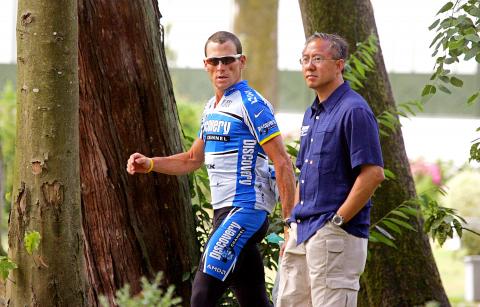
Photo: AFP
Or was it eight years ago, when the French anti-doping laboratory decided to conduct retrospective research using its new test for the blood agent erythropoietin (EPO) on samples taken from riders during the 1999 Tour? The lab identified six positive results from a batch of 15 that the sports newspaper L’Equipe matched to blood-sample records Armstrong and the world cycling federation had agreed to supply to the newspaper.
Its subsequent article — “The Armstrong Lie” — would set in train a sequence of events that culminated on Aug. 24 with the decision by the United States Anti-Doping Agency (USADA) to ban the Texan for life and recommend the stripping of all his awards, after Armstrong refused to defend himself against allegations of cheating.
The suspicion had always been there — alluded to in the French media, and made explicit by Pierre Ballester and David Walsh in their French-published book LA Confidentiel, which baldly asserted that Armstrong was a cheat.
Now Armstrong has been found guilty by virtue of a “non-analytical positive” — not a blood test, but the testimony of witnesses: the same way that former US sprint champion Marion Jones was stripped of her medals.
Now a competition that, through its long history, has been tainted with substance-abuse scandals — from the brandy and strychnine taken by early riders to the steroids and complex compounds of later times — is in the spotlight again.
Drug cheats
Since the scandalous 2007 Tour, the UCI, cycling’s ruling body, has made stronger efforts to tackle drugs cheats. That year saw the entire Astana and Cofidis teams withdraw after pre-race favorite Alexander Vinokourov (who won gold in the London 2012 road race), was caught blood doping, and Bradley Wiggins’s Italian teammate Cristian Moreni was arrested after testing positive for elevated levels of testosterone. And despite Armstrong’s repeated claims of innocence, it was during the 1990s and 2000s — the most notorious period in cycling for doping — that he ruled the sport.
The reality — as Walsh told the BBC in an interview last week — is that many had suspected for years that something was rotten at the very heart of cycling: a rottenness in which not only cyclists and team managers were complicit, but the administrators themselves.
In the end, it appears the unraveling of the Armstrong myth, and the uncovering of what some have called the greatest doping conspiracy in sport, occurred because USADA had accumulated so much testimony — including from 10 former team-mates, some unsullied by accusations of cheating.
The extent of Armstrong’s surrender is underlined by the knowledge of what he has previously said about the “guiding principles” taught to him by his single mother Linda: that “to give up was to give in.” Armstrong reiterated that view in his first autobiography, It’s Not About the Bike, written in 2000. “Pain is temporary,” he wrote then. “If I quit, however, it lasts forever.” And quit is what Armstrong did on Friday.
As World Anti-Doping Agency chief John Fahey said on the day it happened, Armstrong’s decision added up to nothing less than an admission of guilt.
While it is still not clear what pressure was brought to bear on those former teammates who gave evidence to USADA investigators — after a US federal case examining whether Armstrong’s US Postal Service (USPS) team had “misused federal funds” was dropped — it has been suggested that some faced threats of perjury proceedings if they did not speak.
Perhaps what has been most extraordinary about the whole saga is the extent to which suspicions about the American champion had been documented for so long yet never properly investigated, as Armstrong used the force of his personality — and legal challenges — to shut down all criticism.
That included even the testimony of those such as Armstrong’s team masseuse — a woman with no real axe to grind — who insisted that she had heard team officials discussing how to get round Armstrong’s positive test for steroids, and described how she was asked to travel to Spain to deliver “material” across the French border.
But it has been the USADA finding that has been the most damaging, not least because it stands unchallenged by a man who has long insisted that he is the victim of a witch-hunt.
USADA said its evidence came from more than a dozen witnesses “who agreed to testify and provide evidence about their first-hand experience and/or knowledge of the doping activity of those involved in the USPS conspiracy.”
The unidentified witnesses said they knew or had been told by Armstrong himself that he had “used EPO, blood transfusions, testosterone and cortisone” from before 1998 until 2005, the year of his seventh and final Tour victory, and that he had previously used EPO, testosterone and human growth hormone until 1996, USADA said. Armstrong also allegedly handed out doping products, encouraged banned methods — and, USADA says, even used “blood manipulation including EPO or blood transfusions” during his 2009 Tour comeback.
For his part, Armstrong has tried to characterize the investigative process against him as tantamount to bribery — offering those willing to give evidence the promise of more lenient sanctions if they admitted their part.
Certainly in the last two years the net has tightened very quickly around Armstrong. After Landis’s meeting with federal investigators, they spoke to Tyler Hamilton, another former teammate, who has admitted to doping.
Turning a blind eye?
George Hincapie, Armstrong’s most loyal domestique, who had never tested positive for drugs on 17 Tours and was the only rider at Armstrong’s side for all his Tour victories, was also a witness for the prosecution.
“It really wasn’t until the last few months [that] we were able to reach out to all the witnesses we believed had information,” said Travis Tygart, USADA’s chief executive. “They all agreed to testify truthfully.”
In a separate interview, Tygart added: “I think Mr Armstrong also knows the truth and decided that instead of a fact-by-fact, piece-by-piece coming-out in open court under oath, he decided his better move at this stage was just not to contest and hold on to baseless soundbites about witch hunts and vendettas.”
All of which leaves some serious questions still unanswered: such as whether cycling’s administrators turned a blind eye to Armstrong’s behavior, particularly when he was patron of the Tour, its leader by virtue of his victories.
That is the view of Italian rider Filippo Simeoni, who clashed with Armstrong in the 2004 Tour after giving evidence in an Italian court that Armstrong’s trainer, Dr Michele Ferrari — also named in the USADA doping allegations — had advised the Italian to take EPO and testosterone in the late 1990s.
“When I protested, [Armstrong] was in charge of cycling and nothing was done,” he told an Italian radio station. “I paid for things that weren’t just. I only told the truth.”
There will be more fights and scandal ahead. Others accused in the affair have opted — unlike Armstrong — to fight their case in the Court of Arbitration for Sport. The UCI has also not yet accepted USADA’s judgment, and its own officials may take up cudgels for Armstrong’s cries of “injustice.”

In late October of 1873 the government of Japan decided against sending a military expedition to Korea to force that nation to open trade relations. Across the government supporters of the expedition resigned immediately. The spectacle of revolt by disaffected samurai began to loom over Japanese politics. In January of 1874 disaffected samurai attacked a senior minister in Tokyo. A month later, a group of pro-Korea expedition and anti-foreign elements from Saga prefecture in Kyushu revolted, driven in part by high food prices stemming from poor harvests. Their leader, according to Edward Drea’s classic Japan’s Imperial Army, was a samurai

The following three paragraphs are just some of what the local Chinese-language press is reporting on breathlessly and following every twist and turn with the eagerness of a soap opera fan. For many English-language readers, it probably comes across as incomprehensibly opaque, so bear with me briefly dear reader: To the surprise of many, former pop singer and Democratic Progressive Party (DPP) ex-lawmaker Yu Tien (余天) of the Taiwan Normal Country Promotion Association (TNCPA) at the last minute dropped out of the running for committee chair of the DPP’s New Taipei City chapter, paving the way for DPP legislator Su
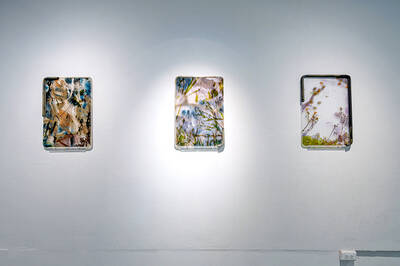
Located down a sideroad in old Wanhua District (萬華區), Waley Art (水谷藝術) has an established reputation for curating some of the more provocative indie art exhibitions in Taipei. And this month is no exception. Beyond the innocuous facade of a shophouse, the full three stories of the gallery space (including the basement) have been taken over by photographs, installation videos and abstract images courtesy of two creatives who hail from the opposite ends of the earth, Taiwan’s Hsu Yi-ting (許懿婷) and Germany’s Benjamin Janzen. “In 2019, I had an art residency in Europe,” Hsu says. “I met Benjamin in the lobby
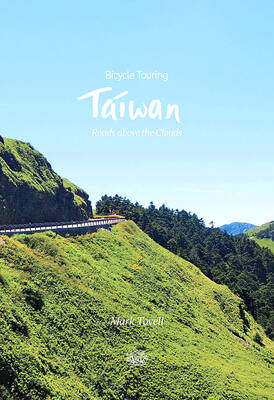
It’s hard to know where to begin with Mark Tovell’s Taiwan: Roads Above the Clouds. Having published a travelogue myself, as well as having contributed to several guidebooks, at first glance Tovell’s book appears to inhabit a middle ground — the kind of hard-to-sell nowheresville publishers detest. Leaf through the pages and you’ll find them suffuse with the purple prose best associated with travel literature: “When the sun is low on a warm, clear morning, and with the heat already rising, we stand at the riverside bike path leading south from Sanxia’s old cobble streets.” Hardly the stuff of your


 RSS
RSS