


No, this is not a manual — by which I mean that it’s not a book that’s meant to be read with one hand. Despite its pink wrapper and the cover photograph of a naked young man with a flap-happy wrist, it’s a solemn pedagogical production, derived from an undergraduate course taught by Halperin, who is WH Auden distinguished university professor of the theory and history of sexuality at an address somewhere in the American cornbelt. Out there on the dreary plains, Halperin instructs students who could be his grandsons in irony, archness, melodramatic flouncing, the worship of Judy Garland and all the other queeny foibles and fetishes that most of us thought had been discarded when gay men marched out of the closet and asserted their right to respect and acceptance. Bobs, bangs and military buzzcuts probably feature in the curriculum: Halperin has an earnest interpretative interest in “what a hairstyle is ‘about.’”
The course, when first offered, created a local scandal, because a state university was expending public money on what Halperin enticingly called “an experiment in the very process of initiation.” Affronted legislators wondered what kind of homework was required of the inductees. I’m curious myself, since Halperin on one occasion addresses the reader of this book as “darling.” He relished the outrage of the puritans: he was used to it, having been accused of sexual harassment while teaching at Massachusetts Institute of Technology in the early 1990s. That charge was dropped, and MIT sent him off on study leave for a couple of years; his next academic appointment, however, was in faraway Australia, where he can’t have made many friends if he imperialistically announced, as he does in his book, that “being gay is like being American” and presented himself as the proselytizing agent of “total, global queerness.” Now repatriated to the US, he is assiduously milking the fuss about his course, which has enabled him, as he reports with a hoot of triumph, to increase his lecture fee.
Halperin’s first efforts to profess “gay male studies” were half-cocked. He made the mistake of expecting his mid-western students to read books, which bored them; they spent his classes covering the attendance sheet he circulated with doodles of themselves in drag, preening under the hair-dryer in a beauty salon. Revamping the course as “How to Be Gay,” Halperin eased the strain on their bubbly brains by dispensing with a bibliography and instead prescribing excerpts from a few campy movies. His book devotes literally hundreds of pages to the obsessive analysis of a catfight between Joan Crawford and her bitchy daughter in the film noir Mildred Pierce, with footnotes on Faye Dunaway’s maenadic impersonation of Crawford on the rampage with a coat-hanger in Mommie Dearest and Sofia Coppola — the distinguished professor, incidentally, misspells her name — lewdly mimicking both Crawford and Dunaway in a music video for Sonic Youth.

The abusive encounter between Crawford and Ann Blyth in Mildred Pierce is, for Halperin, a Freudian primal scene, an authoritative primer from which gay men can learn how to be ersatz women, suffering with grandiloquent flair while rolling their eyes and spitting epigrammatic put-downs at each other. I’m glad that he mostly stays away from literature (which, as he found, gave his students headaches), since he describes Melville’s Christ-like Billy Budd as the apotheosis of rough trade, a pick-up whose naval pants obligingly unbutton in the rear, and his only reference to Auden, in whose honor the professorship he holds was endowed, refers to the old boy’s quaint habit of referring to himself not as “I” but as “Your mother.” Halperin is more at ease when enthusing over curiosities like To the Last Man, a porno western in which cowboys wearing very snug jeans gun down their bunkmates and are ineffectually reproved by a preacher who lisps “I’m tired of getting blood on my dog collar.”
If you can tune out Halperin’s shrillness and grope though his pseudo-philosophical miasma (“Every thing is a ‘thing’,” he tells us at one point), you may be able to trace an argument I happen to consider reactionary and disreputable. By teaching the young to adore old-time divas like Crawford and Garland, Halperin hopes to persuade them that gayness is about culture not sex, about solitary, subjective taste not shared identity. In his nostalgia for the heyday of giddy effeminacy, he denounces the campaign for marriage rights as a concession to “heteronormative” society; political protests about discrimination are waved away by his silly insistence that “camp is a form of resistance to power” or his astonishing notion that maleness is a mode of “terroristic surveillance and enforcement,” a symptom of the “lethal dose of unironised masculine histrionics that the world has had to absorb since September 11, 2001.” This swishing makes me wonder whether al-Qaida’s fanatics may have a point about the decadence of the west.
Back in the 1960s, Susan Sontag — whose Notes on Camp articulated in a few fleet aphorisms most of what Halperin spends more than 500 pages paraphrasing — welcomed a new gay formalist style in criticism by declaring: “In place of a hermeneutics we need an erotics of art.”

In late October of 1873 the government of Japan decided against sending a military expedition to Korea to force that nation to open trade relations. Across the government supporters of the expedition resigned immediately. The spectacle of revolt by disaffected samurai began to loom over Japanese politics. In January of 1874 disaffected samurai attacked a senior minister in Tokyo. A month later, a group of pro-Korea expedition and anti-foreign elements from Saga prefecture in Kyushu revolted, driven in part by high food prices stemming from poor harvests. Their leader, according to Edward Drea’s classic Japan’s Imperial Army, was a samurai

Located down a sideroad in old Wanhua District (萬華區), Waley Art (水谷藝術) has an established reputation for curating some of the more provocative indie art exhibitions in Taipei. And this month is no exception. Beyond the innocuous facade of a shophouse, the full three stories of the gallery space (including the basement) have been taken over by photographs, installation videos and abstract images courtesy of two creatives who hail from the opposite ends of the earth, Taiwan’s Hsu Yi-ting (許懿婷) and Germany’s Benjamin Janzen. “In 2019, I had an art residency in Europe,” Hsu says. “I met Benjamin in the lobby
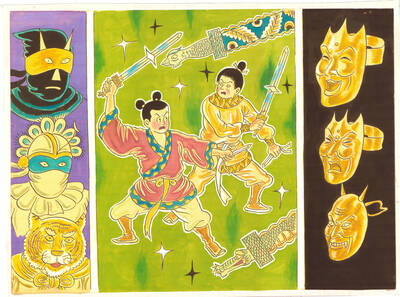
April 22 to April 28 The true identity of the mastermind behind the Demon Gang (魔鬼黨) was undoubtedly on the minds of countless schoolchildren in late 1958. In the days leading up to the big reveal, more than 10,000 guesses were sent to Ta Hwa Publishing Co (大華文化社) for a chance to win prizes. The smash success of the comic series Great Battle Against the Demon Gang (大戰魔鬼黨) came as a surprise to author Yeh Hung-chia (葉宏甲), who had long given up on his dream after being jailed for 10 months in 1947 over political cartoons. Protagonist

Peter Brighton was amazed when he found the giant jackfruit. He had been watching it grow on his farm in far north Queensland, and when it came time to pick it from the tree, it was so heavy it needed two people to do the job. “I was surprised when we cut it off and felt how heavy it was,” he says. “I grabbed it and my wife cut it — couldn’t do it by myself, it took two of us.” Weighing in at 45 kilograms, it is the heaviest jackfruit that Brighton has ever grown on his tropical fruit farm, located


 RSS
RSS