


It’s a pleasure to look at Alex Katz’s paintings, and at the people and places in them; the people can show a restrained kind of pleasure themselves, though they don’t often look back at you. Instead they look aloof, sometimes through sunglasses, dressed for summer; we can try to enjoy their company, imagine ourselves moving carefully into the bright shapes and the hard light of their world. Sometimes the people are poets, or else dancers whose poise suggests runway fashion: Katz studied fashion in high school, worked with a dance company for decades, and spent a great deal of time, early in his career, with the exuberantly informal, intellectually playful poets known now as the New York school (John Ashbery, Frank O’Hara, James Schuyler and so on). At other times the people in the paintings turn out to be the same person, Katz’s wife of 50-odd years, Ada, depicted with admiration and reserve.
As for those places, they’re comfortable, often outdoors: vacation spots, with seashores, piers and pine trees. They might be in Maine, where Katz lives for part of each year, or else they are other holiday spots for the denizens of New York’s Upper East Side, a long way from Katz’s own childhood as a Russian Jewish immigrant, born in 1927 and raised in Brooklyn and Queens. From there he attended Cooper Union, the famously selective Manhattan art college, and in 1949 the Skowhegan School in Maine: there, Katz has said, he found his vocation in figures and landscapes, attracted to the coastal light.
Katz in the early 1950s had trouble making his way into a gallery scene dominated by heroic abstractions such as those of Jackson Pollock. Rather than change course, he found friends and allies in poets — O’Hara, Schuyler, the dance critic Edwin Denby — and other painters, such as Larry Rivers, who had also returned to figuration. By the end of that decade his reputation was set: he has moved easily among New York writers and galleries ever since. While Katz has tilted back and forth among genres — one year brought a series of head-only portraits of poets, another a seascape — his sense of clean outlines and big colors has remained at the base of his style.

Photo: Bloomberg
Katz favors bright, uniform planes, put together to make up faces and bodies, with just enough depth to keep up an illusion. Behind the people, and when there are no people, he offers solid lines, flat skies, landscapes that are almost abstractions, as in Matisse: Katz often seems to be thinking about Matisse, or else about other friendly modernist models for his not-quite-realist homage to how the world looks. (Katz’s memoir, Invented Symbols, says that “the only art book I had for twenty years” was a collection of pictures by Henri Rousseau.) The people themselves in Katz’s paintings can look almost flat too, like people on posters, in four-color printing, or in old comic books. They are almost cartoons, but not quite: not even the outsized Black Hat (Bettina) (2010), whose subject looks out from a wide hat and black sunglasses with scarlet lips in a slight smile, as if from an old cigarette ad.
There are jokes about flatness, jokes against doctrinaire abstraction, all over Katz’s work. In Ada on Red Diamond (1959) the painter’s wife and muse emerges enigmatically from a red diamond on a brown square, a background borrowed perhaps from a Russian Suprematist: she’s smiling, too, as she gives life to what would otherwise be an empty frame. Red Sails (1958), a collage of colored paper, could be an abstract experiment with asymmetrical fields of two colors, juniper on tangerine, except for the tiny red triangles in the middle: they’re sails, so that orange-red field must be a sea.
Older conventions of representational painting appear, too, and Katz takes them seriously: full-length portraits, head studies and profiles, boating scenes, cloud studies like John Constable’s, even an odalisque. Recent landscapes and seascapes invoke East Asian practice, using single brushstrokes to connote harmony as well as immediacy: the whitecaps in Grey Marine (2000) come close to calligraphy. Katz gets compared at times to Pierre Bonnard, for his colors (bright orange! bright green!), and for those portraits of his wife. Whether she’s facing out at us, just head and shoulders, or in a bathing suit, the paintings show respect: it looks as if she has chosen to be there. Bonnard also stands behind some of Katz’s flowers, whose red-orange and bright-yellow petals curl in close-up views like enormous match flames.
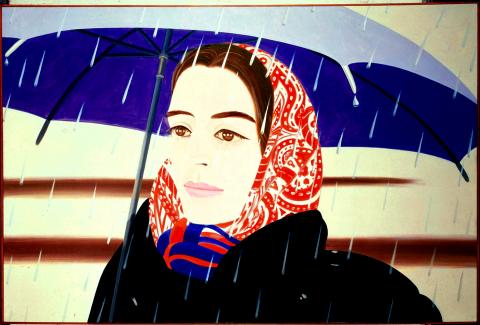
Photo: Bloomberg
Katz’s people and places seem content with the present moment; they are not likely to lose themselves in memories. “The real excitement in art,” Katz has written, “is somehow being in the contemporary world.” He shared this desire to be absolutely contemporary with his poet friends of four and five decades ago. Katz painted or drew O’Hara several times — “O’Hara is my hero,” he once said; there’s a fine double portrait with Bill Berkson where both poets appear as uniformed sailors, with come-hither looks — but none of those portraits has made it to St Ives, where the selection concentrates on land- and seascapes, outdoor portraits and pictures of Maine. We do, though, get one full-length portrait of Schuyler, the subtlest and most musical of the New York school poets, slightly lost and lonely in his drab black suit.
Besides easel paintings and prints, Katz became famous during the 1960s for flat, life-sized, painted figures made out of plywood or aluminum, which stand on the floor like genuine people, or sculptures: they are not quite sculpture, but “flat” paintings you can walk all the way around. These works suggest the relative “flatness” of real people’s real identities, the way that we fit our acquaintances into types, and the pseudo-acquaintance we have with celebrities: we know about them, but we don’t know them for real, we can’t know what goes on inside.
Such flat people, easy to meet but quite hard to know well, reappear in Katz’s paintings of multiple, repeated figures: his series of bathers, whose gaudy caps look like glass beads, or the six women (one woman six times?) in The Black Dress (1960). Three have the same skeptical expression; one frowns, her brow creased. Behind the women, Katz has placed a picture of a picture — his portrait of Schuyler: none of the women is looking at it. It’s a rare note of frustration.
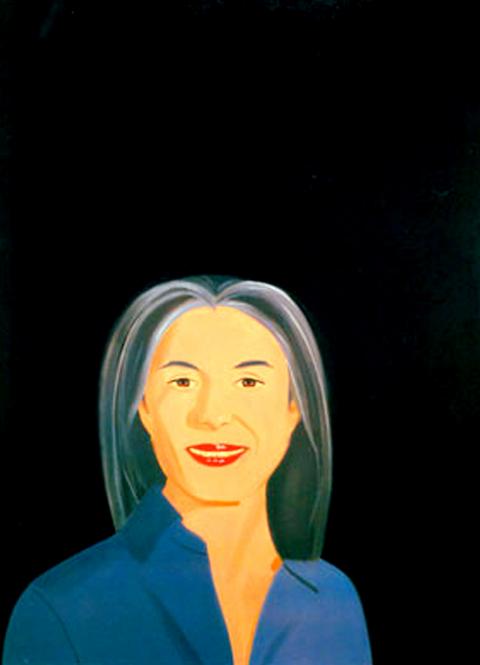
Photo: Bloomberg
As Katz’s paintings got bigger, the people in them — when they had people in them — got odder, though they were still having fun, still hard to get to know. Five people on the beach in Round Hill (1977) look past one another, away from one another, through sunglasses or half-closed eyes. One of them, sprawled on one elbow, reads Troilus and Cressida, Shakespeare’s most cynical play. Haute bourgeois relaxation there seems hollow, but elsewhere it’s attractive. In Isleboro Ferry Slip (1976), almost 2m2, a young man and a young androgynous figure stride forward across a pier, their backs to the sea. Wind plays with their hair, and both seem to look for us; one scowls, one smiles, as if they were trying to star in two different films.
It’s hard to see Katz without thinking of David Hockney: the large scales, bright lines, flat surfaces and unapologetic delight in the simplest pleasures of sun, sea and sociability all unite the Englishman in California with the Russian immigrants’ son in New York and Maine. As with Hockney, the paintings dare you to attack them as self-satisfied: the moment you do, they turn uncanny, or troublesome.
If you like 1960s pop art, too, you’ll like Katz, but you probably should not call Katz “pop”; Katz himself wouldn’t. For one thing, he started earlier and kept going afterwards, and for another, even his flattest, brightest, most media-saturated work seems quieter, subtler, friendlier than Andy Warhol or Richard Hamilton often allow. (O’Hara wished, in one of his last prose essays, that “Pop artists had paid closer attention to what Rivers and Katz ... were doing.”) “I wanted to make paintings you could hang up in Times Square,” Katz once declared, and he has literally done so, designing a billboard in 1977; this show takes its name — Give Me Tomorrow — from a later billboard, shown in New York in 2005.
Katz makes some paintings big even when they are not billboards — so big that the size itself has aesthetic effect. Beige Ocean, 4m wide, is a blown-up close-up, its foamy whitecaps larger than life; Green Reflections 3, 2.5m by 3m, gives us individual spatters of white paint on ultramarine ground, like magnified snow on the sea. “All the successful painters are good decorators,” Katz has said; these large paintings without people make their decorative patterns into puzzles. Where should the eye start to follow them? Where should it stop?
These salient patterns benefit from the way in which Katz often works, first making preparatory sketches, then using something called a pouncing tool to project a charcoal sketch on to the canvas. After such care, Katz then paints in the outlines quite fast, at times in a single sitting. Unsympathetic viewers say the results look like color by numbers: more patient ones might notice that these are techniques akin to, but never identical to, those of reproducible commercial art, just as the people and places in Katz are akin to, but never identical to, the pretty illusions of advertisements and big screens.
Everything in Katz — all places, all people — looks stylized, simplified, cut to please the eye, and yet none of it looks trivial. Instead, the paintings, and the cut-outs and the collages, from the 1950s to the 2000s, exist on an edge: an edge between pop and depth; between a love for individual characters and places and an attraction to simplified, repeated patterns; between a realist sense that there are people and things in the world that can be known, and a modernist attention to layers and brushstrokes, and the flatness of paint.
It’s an edge, but not a cutting edge. The works, like the people they show, delight or unsettle but will never provoke shock or rage: and why should they? At his best, Katz the portraitist, Katz the maker of big and small scenes, Katz the painter and printmaker, and maker of stand-up cut-outs does justice to pleasure, on a human scale, and to what the eye seeks when freed from grander demands; it would be churlish to ask him for anything more.
Alex Katz: Give Me Tomorrow is at Tate St Ives, Cornwall, England, from May 19 to Sept. 23. On the Net: www.tate.org.uk/visit/tate-st-ives

In late October of 1873 the government of Japan decided against sending a military expedition to Korea to force that nation to open trade relations. Across the government supporters of the expedition resigned immediately. The spectacle of revolt by disaffected samurai began to loom over Japanese politics. In January of 1874 disaffected samurai attacked a senior minister in Tokyo. A month later, a group of pro-Korea expedition and anti-foreign elements from Saga prefecture in Kyushu revolted, driven in part by high food prices stemming from poor harvests. Their leader, according to Edward Drea’s classic Japan’s Imperial Army, was a samurai

The following three paragraphs are just some of what the local Chinese-language press is reporting on breathlessly and following every twist and turn with the eagerness of a soap opera fan. For many English-language readers, it probably comes across as incomprehensibly opaque, so bear with me briefly dear reader: To the surprise of many, former pop singer and Democratic Progressive Party (DPP) ex-lawmaker Yu Tien (余天) of the Taiwan Normal Country Promotion Association (TNCPA) at the last minute dropped out of the running for committee chair of the DPP’s New Taipei City chapter, paving the way for DPP legislator Su

Located down a sideroad in old Wanhua District (萬華區), Waley Art (水谷藝術) has an established reputation for curating some of the more provocative indie art exhibitions in Taipei. And this month is no exception. Beyond the innocuous facade of a shophouse, the full three stories of the gallery space (including the basement) have been taken over by photographs, installation videos and abstract images courtesy of two creatives who hail from the opposite ends of the earth, Taiwan’s Hsu Yi-ting (許懿婷) and Germany’s Benjamin Janzen. “In 2019, I had an art residency in Europe,” Hsu says. “I met Benjamin in the lobby

It’s hard to know where to begin with Mark Tovell’s Taiwan: Roads Above the Clouds. Having published a travelogue myself, as well as having contributed to several guidebooks, at first glance Tovell’s book appears to inhabit a middle ground — the kind of hard-to-sell nowheresville publishers detest. Leaf through the pages and you’ll find them suffuse with the purple prose best associated with travel literature: “When the sun is low on a warm, clear morning, and with the heat already rising, we stand at the riverside bike path leading south from Sanxia’s old cobble streets.” Hardly the stuff of your


 RSS
RSS