


Mark Jarrett, director and cowriter of The Taiwan Oyster (台灣牡蠣), was living in Taichung when the 921 Earthquake struck. Ever since, he has written, “Taiwan has been tattooed on my psyche.” The terrifying tragedy also cemented several friendships.
“I call it the foxhole phenomena,” Jarrett told the Taipei Times. “It’s like you go through a war with somebody — [they are] your army buddies. We were all in the shit.”
Though the temblor didn’t directly influence the plot of Jarrett’s first feature-length production, which debuted last month to generally positive reviews at South by Southwest (SXSW), the theme of friendship formed in the wake of a tragic event permeates the entire film. Part noir road movie, part coming-of-age existential angst flick, The Taiwan Oyster is a captivating and visually stunning indie film that ponders the idea of death. It will be shown on Sunday as part of the Urban Nomad Film Festival.
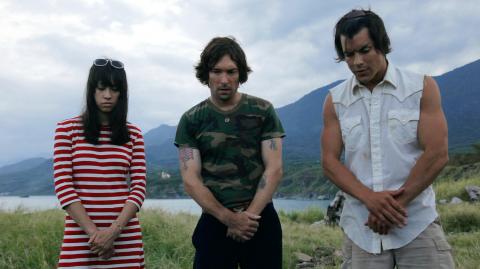
Photo Courtesy of Urban Nomad and Paul Knaus
Set in Taiwan soon after the 921 Earthquake, The Taiwan Oyster follows the boozy adventures of Simon (Billy Harvey) and Darin (Jeff Palmiotti), two buddies from the US who steal the corpse of their “countryman” Jeb (Will Mounger) after he dies because of a silly accident. They strike out from Taipei, traveling south to find him a final resting place. Along the way they meet up with Nikita (Leonora Lim), a Taiwanese woman who serves as a kind of foil to their expat excesses.
The Taipei Times spoke with Jarrett about the making of the movie, expat life in Taiwan and putting together an independent film on a shoestring budget.
Taipei Times: The Taiwan Oyster is a road movie within a road movie. Not only are the characters far from their native US, they are also leaving Taipei to bury their countryman in southern Taiwan. Why set the movie in Taiwan as opposed to, say, Texas?
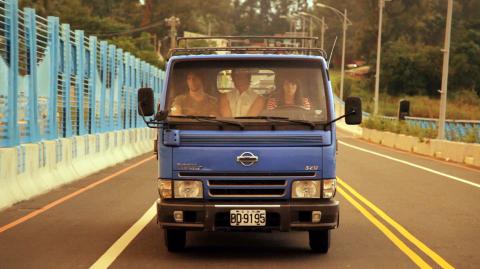
Photo Courtesy of Urban Nomad and Paul Knaus
Mark Jarrett: I was thinking of some of my favorite directors and how a fair amount of them started out with a road movie. We were trying to think of a way to write a script that we could actually make, even with very little money.
And my cowriter Jordan [Heimer] and I thought: “Why not Taiwan?” I had all these stories from the years of living there. We didn’t really end up using any of [my stories]. But it is a [place] that is very important to me … And the idea of an American-style road movie in another country — it’s been done, like The Darjeeling Limited. But we thought that it would give us extra bang for our buck to offer this common motif story to American audiences, but set in a completely foreign backdrop.
The idea of the body came out of As I Lay Dying by William Faulkner, which I was reading at the time.
TT: Filming your movie in Taiwan opens up all sorts of questions about what brings people here, their motivations, their habits and their behavior, which, within the context of your film, tends towards the alcoholic.
Why is that an important element?
MJ: Well, the drinking to me is a part (pause) … I was not a good foreigner when I lived [in Taiwan]. And I feel somewhat guilty about, well, not somewhat guilty, I feel guilty about it. And I remember telling a good friend of mine that this film in a sense is my apology to Taiwan. I’m not sure if I want you to print that because I don’t know how it will be interpreted. But [Taiwan] formed me and shaped me in so many ways. But I was 22, 23, 24, and I was just a maniac, which mellowed by the time I left.
It started out with me just thinking that I was going to be there for six months. Then the earthquake happened and all of a sudden six months turned into a year and a half before I pulled my head out of my ass and started taking Chinese classes and started really trying to live there in a community versus just kind of playing over there.
Another theme that I had running for a while that fell to the wayside too was the sons of veterans. It’s a world of men. These are kids that had grown up the children of the Vietnam [War] era — playing with guns and they are living in this world with a skewed version of what a rite of passage is. And that was a theme that is still loosely present in their dialogue, and Simon wearing the [camouflage] shirt.
The idea was that they create their own adventures through alcohol and in that world there are no dramatic good-byes. It’s like the Mad Men world: Hey, we are men. You did this, I did this. We’re cool now. I’ll see you later. And that’s what’s going on at the beginning of the film. By the end, at least [Simon] has decided that he’s either going to leave or his lifestyle is going to change dramatically.
TT: And Jeb’s death is the catalyst for that.
MJ: Yeah, it’s not working for him anymore. It’s like a wake-up call for him — there is that one line where he says a timer has started ticking for him. It’s like when you have that first sense of, OK, this isn’t just going to go on forever. I gotta start making choices in my life and these choices are going to influence things, and I might make the wrong one and I might make the right one, but choices are going to be made and there is a time limit.
TT: Simon is the brooding introspective, whereas Darin is outgoing and brash and seems motivated by the first thing that comes into his mind. Do you see yourself in either or both of those characters?
MJ: I think it’s a combo. But they became their own thing because we had not only my brother [Mitchell Jarrett] writing on it, but also Jordan, who has never been to Taiwan.
TT: And Nikita serves as the mediator, a kind of foil, between the excesses of Darin and Simon’s inability to deal with those excesses.
MJ: I think she plays a nice balance. I often consider Simon and Nikita to be a witness to Darin’s story. He’s trying to craft and develop. Nikita, I know, is not a typical Taiwanese gal. But she is a lens that the audience can look through to see these guys. And I think her spirituality brings an extra layer to the film.
Nikita’s quest is twofold. She talks about the existence of ghosts, she brings them to the Qingming Festival (清明節, also known as Tomb Sweeping Day), and she’s a very introspective thinker. On a [lower] level, she’s going through a rebellious pattern of her own. She leaves her job and takes these two guys to her father’s house even though she knows they’ll irritate him. As soon as she leaves [her father’s house], though, the romance of it has sort of gone for her.
TT: What are the differences in your experiences of living in Taiwan from 1999 to 2001 versus when you came back to film the movie?
MJ: There’s a big difference. There weren’t nearly as many foreigners [when I first came to teach]. We came on our first scouting trip in 2009, so it was eight years. And one thing that was nice was most of the friends that I had hung out with are now married with kids and have these normal, really cool, lifestyles. And our script changed a lot with that scouting trip because it was like, wait a second, things have changed a lot and I want to show this side of things too.
There is still a certain amount of freedom, but the people I run with now don’t abuse it in any way. It’s more like this is where we like to live and this is who we like to hang out with. This is our country and our family.
There is an undefined je ne sais quoi about Taiwan. I remember when I went back for the second scouting trip. I would ask people what makes Taiwan Taiwan for you? And you can get all sorts of insane, different answers. And I realized that it is so individualized and personalized, but at the same time tapping into this universal bubble — almost like a Venn diagram, but double. You can’t point at one thing directly.
(Jarrett used Kickstarter, a crowd funding Web site, to make the project happen. Touted as the “world’s largest funding platform for creative projects,” Kickstarter links up creative individuals in film, theater, art, food and video games, with people who have an extra few bucks to invest in their projects.)
TT: What was raising funds with Kickstarter like?
MJ: At the time [Kickstarter] was still a fledgling operation, so we had to run a campaign. We had one stranger give us money — whereas now it would probably be 20 percent. It was a hard-fought campaign — a hundred US dollars here, a hundred US dollars there. But Kickstarter is a great thing. It was helpful, and I would almost venture to say now it would be a more helpful tool than it was then. US$15,000 was our goal and I ended up putting a US$1,000 cherry on it. So we earned US$14,000, and that’s nothing to sneeze at.
I think there is a movement going on right now, which we are a part of. There are a lot more no-budget indie films now than three years ago. Instead of it being the one-set horror movie or the one-set talking heads movie, you can actually tell a bigger story because the equipment is available, and because the equipment is cheaper you can put your money towards other resources. You can get together a band of rogues and leave and go pound it out with willpower and skin.
TT: I’ve read that you call yourself punk rock filmmakers — is that coproducer Sean Scanlan’s phrase?
MJ: Kenton Harmer, another Taiwan
ex-refugee like myself, coined that term. It’s the idea of having a story and not being limited by budget restraints, putting together a bunch of people who are like-minded and willing to sort of live rough for a month. It’s passion and it’s pain, but it’s willpower too. That’s it: Shooting for the moon with limited expectations.
This interview has been edited and condensed.

Last week Joseph Nye, the well-known China scholar, wrote on the Australian Strategic Policy Institute’s website about how war over Taiwan might be averted. He noted that years ago he was on a team that met with then-president Chen Shui-bian (陳水扁), “whose previous ‘unofficial’ visit to the US had caused a crisis in which China fired missiles into the sea and the US deployed carriers off the coast of Taiwan.” Yes, that’s right, mighty Chen caused that crisis all by himself. Neither the US nor the People’s Republic of China (PRC) exercised any agency. Nye then nostalgically invoked the comical specter
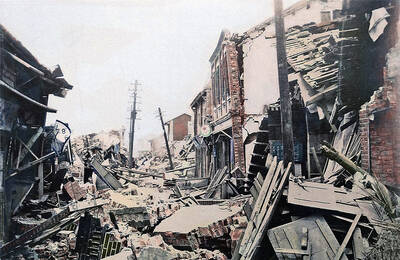
April 15 to April 21 Yang Kui (楊逵) was horrified as he drove past trucks, oxcarts and trolleys loaded with coffins on his way to Tuntzechiao (屯子腳), which he heard had been completely destroyed. The friend he came to check on was safe, but most residents were suffering in the town hit the hardest by the 7.1-magnitude Hsinchu-Taichung Earthquake on April 21, 1935. It remains the deadliest in Taiwan’s recorded history, claiming around 3,300 lives and injuring nearly 12,000. The disaster completely flattened roughly 18,000 houses and damaged countless more. The social activist and

Over the course of former President Ma Ying-jeou’s (馬英九) 11-day trip to China that included a meeting with Chinese Communist Party (CCP) leader Xi Jinping (習近平) a surprising number of people commented that the former president was now “irrelevant.” Upon reflection, it became apparent that these comments were coming from pro-Taiwan, pan-green supporters and they were expressing what they hoped was the case, rather than the reality. Ma’s ideology is so pro-China (read: deep blue) and controversial that many in his own Chinese Nationalist Party (KMT) hope he retires quickly, or at least refrains from speaking on some subjects. Regardless

Approaching her mid-30s, Xiong Yidan reckons that most of her friends are on to their second or even third babies. But Xiong has more than a dozen. There is Lucky, the street dog from Bangkok who jumped into a taxi with her and never left. There is Sophie and Ben, sibling geese, who honk from morning to night. Boop and Pan, both goats, are romantically involved. Dumpling the hedgehog enjoys a belly rub from time to time. The list goes on. Xiong nurtures her brood from her 8,000 square meter farm in Chiang Dao, a mountainous district in northern Thailand’s


 RSS
RSS