


Of the 12 animals of the Chinese zodiac, the dragon has by far the highest status, a fact emphasized by the predication, reported in the Liberty Times earlier this month, that there will likely be a 5 percent increase in the birthrate because of parents eager to have “dragon” babies. Chinese dragons, as mythical beasts, have had many varied qualities ascribed to them (mostly positive ones), and it will be noted immediately that the dragon in Asia is a very different beast to the one that inhabits the Western imagination.
In Europe, the dragon, while undoubtedly a symbol of power, is fatally tarred with the brush of evil. In the Book of Revelations, Satan takes the form of a “red dragon with seven heads and 10 horns,” and ever since then, from the iconography of St George and the Dragon to the character of Smaug, the vicious dragon that is outwitted by Bilbo Baggins in The Hobbit, not much good has been ascribed to dragons in the West. If not outright evil, then they are at least bestial, greedy, selfish and generally not very good company.
In Asia on the other hand, the dragon is a creature that may well be feared, but is also looked upon as the king of beasts, and is the symbol that China’s emperor took unto himself, a representation of his divine status, his heavenly wisdom and the almost infinite reach of his power. Many of the mythical emperors of China, including Fuxi (伏羲) and Nuwa (女媧), the founders of the human race, are depicted as dragons in some incarnations. All subsequent emperors have sought to establish a link with this divine imperial beast.
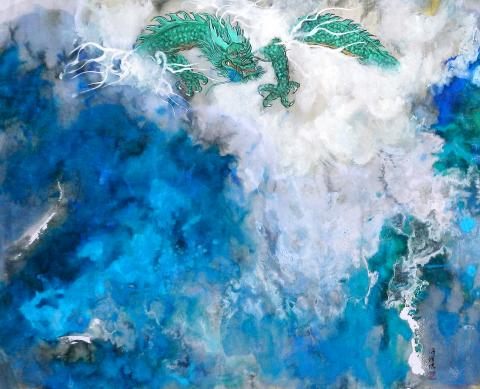
In modern times, the dragon’s importance as an ethnic Chinese icon was consolidated by a ballad by Richard Hou (侯德健), a Taiwanese lyricist. The song, Descendants of the Dragon (龍的傳人), is a tremendous piece of nationalistic propaganda. Written in the late 1970s, it is filled with a passionate sense of despair informed by a disastrous century for the Chinese people, and its massive aspirations for the future. The lyrics, “The sound of guns and cannons split the silent night, we fight surrounded on all sides by Western swords” (槍砲聲敲碎了寧靜的夜/四面楚歌是洋人的劍), give an impression of the Asian dragon brought to bay (the reference to “Western swords” has been altered to a more neutral phrasing in later renditions).
More recently, dragons have been seen as symbols of economic hope, as with the four Asian dragons — Hong Kong, Singapore, South Korea and Taiwan — which led the rise of Asia as an economic force to be reckoned with in the late 20th century. These four Asian dragons have hit the same hard times as most of the rest of the world in the early 21st century, but the belief that the descendants of the dragon will rise up and dominate the world is still very much part of the popular imagination in Asia. Whether this is for better or for worse remains to be seen.
It is, after all, well known that while the dragon is a prodigious beast, he is not altogether dependable, and his actions are not always comprehensible to mere morals. There is a phrase in common use: “The dragon is a mystical creature; when its head is revealed, its tail is hidden” (神龍見首不見尾). This phrase, originally used to describe poetry by Qing Dynasty commentator Zhao Zhixin (趙執信), is now most commonly used to describe inscrutable personalities who cannot be easily pigeonholed.
“Poetry is like the dragon,” Zhao wrote, “when you see the head, you miss the tail, within the clouds you catch a glimpse of a claw or a scale.”
This might also be the case with the inner circle of China’s government, or with successful business leaders, but clearly the dragon is a creature of mystery and power, and that on the whole seems to be regarded as a desirable thing among women wishing to have children.
But what exactly does a Chinese dragon look like? According to legend it is something of a conglomeration of the animal kingdom: the eyes of a prawn (think District 9), the horns of a deer, the mouth of a ox, the nose of a dog, the whiskers of a catfish, the mane of a lion, the tail of a snake, the scales of a fish, and the claws of an eagle. It seems distinctly hard to imagine, and that of course might be the idea in the first place.
Looks are clearly not what really matters about the dragon in any case. It is colorful and playful, as represented in the dragon dance so popular during the New Year, but not really being part of the mundane world, it can easily ascend to heavenly heights after the fun and games are over. Much has already been made of the fact that Wang Lee-hom (王力宏) was born in the Year of the Dragon (1976). He has recorded his own (truly dreadful) version of Descendants of the Dragon and his career is currently making a credible leap toward international stardom. Wang is the poster child for this Year of the Dragon, and will doubtless be cursed by thousands of kids who never hit the big time.
The moral of the tale is: don’t get too hung up on the mythical beast that doesn’t look like anything you’ve ever seen. It’s one in a million who rise to the heavenly heights of super stardom, and for the rest, Year of the Dragon kids have still got to make their way in a very un-heavenly world.
Having put the dragon in perspective, the Taipei Times wishes all our readers, and everyone else, a very happy, prosperous and successful Year of the Dragon.

Last week Joseph Nye, the well-known China scholar, wrote on the Australian Strategic Policy Institute’s website about how war over Taiwan might be averted. He noted that years ago he was on a team that met with then-president Chen Shui-bian (陳水扁), “whose previous ‘unofficial’ visit to the US had caused a crisis in which China fired missiles into the sea and the US deployed carriers off the coast of Taiwan.” Yes, that’s right, mighty Chen caused that crisis all by himself. Neither the US nor the People’s Republic of China (PRC) exercised any agency. Nye then nostalgically invoked the comical specter
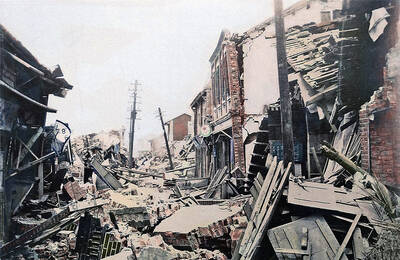
April 15 to April 21 Yang Kui (楊逵) was horrified as he drove past trucks, oxcarts and trolleys loaded with coffins on his way to Tuntzechiao (屯子腳), which he heard had been completely destroyed. The friend he came to check on was safe, but most residents were suffering in the town hit the hardest by the 7.1-magnitude Hsinchu-Taichung Earthquake on April 21, 1935. It remains the deadliest in Taiwan’s recorded history, claiming around 3,300 lives and injuring nearly 12,000. The disaster completely flattened roughly 18,000 houses and damaged countless more. The social activist and

Over the course of former President Ma Ying-jeou’s (馬英九) 11-day trip to China that included a meeting with Chinese Communist Party (CCP) leader Xi Jinping (習近平) a surprising number of people commented that the former president was now “irrelevant.” Upon reflection, it became apparent that these comments were coming from pro-Taiwan, pan-green supporters and they were expressing what they hoped was the case, rather than the reality. Ma’s ideology is so pro-China (read: deep blue) and controversial that many in his own Chinese Nationalist Party (KMT) hope he retires quickly, or at least refrains from speaking on some subjects. Regardless

Approaching her mid-30s, Xiong Yidan reckons that most of her friends are on to their second or even third babies. But Xiong has more than a dozen. There is Lucky, the street dog from Bangkok who jumped into a taxi with her and never left. There is Sophie and Ben, sibling geese, who honk from morning to night. Boop and Pan, both goats, are romantically involved. Dumpling the hedgehog enjoys a belly rub from time to time. The list goes on. Xiong nurtures her brood from her 8,000 square meter farm in Chiang Dao, a mountainous district in northern Thailand’s


 RSS
RSS