


Carmen Callil withdrew from the judging panel of the Man Booker International prize when the other judges decided to give its award to Philip Roth. The American writer, she said, “goes on and on and on about the same subject in almost every single book. It’s as though he’s sitting on your face and you can’t breathe.” Which was a funny thing to say, not just for the obvious reasons, but because the subject of breathlessness comes up quite frequently in his latest novel — first published in the UK some seven months before Callil made her intemperate remarks.
The breathlessness in question comes as a result of polio, an epidemic of which strikes Newark, New Jersey, in the baking summer of 1944. This is surpassed only by death as the worst thing that can happen when polio strikes; that, and the fact that its victims are chiefly children. The novel’s chief protagonist, 23-year-old Bucky Cantor, an athletic young man declared unfit for military service due to his poor eyesight, agonizes about the appalling fates that await the victims: He’s a playground director, God-like in the eyes of his young charges, a source of unimpeachable rectitude and kindness. But he can do nothing to prevent the spread of the disease. And as someone supremely active and fit, he can think of no worse existence than that of being trapped inside an iron lung.
Now, as for going on and on about the same thing, you could argue that once again, Roth is going on about death, but that doesn’t quite sound right here. What Roth is going on about in this book — and I would like to express this as tentatively as possible, because this is not an easy novel to second-guess, or, if you like, reverse-engineer — is the malicious capriciousness of fate, or the fallibility of God.

This is, and is not, classic Roth. It is, in the sense that here he has returned to the scene of his childhood. Were the author’s name not anywhere on or in the book, the setting — among the Jewish families of Newark in 1944 — would be pretty much a giveaway. It’s Roth’s turf, and he owns it almost aggressively. However, what he’s getting up to is not as obvious as it has been hitherto. Lately in his career, it could be broadly summed up by the Rolling Stones’ line: “what a drag it is getting old.” But here we have something similar to the counter-factual approach in his magnificently terrifying The Plot Against America. Only the threat is more ambiguous, more existential. (It is not lazy association to compare this with Camus’ La Peste.) In one early scene, Cantor stands up, one against 10, to a menacing group of Italians who have come, they say, to give everyone polio; they spit all over the tarmac, and once Cantor’s seen them off, he scrubs the spots clean.
But as another character says: “You washed the spit away but you didn’t wash the polio away. You can’t wash the polio away. You can’t see it. It gets in the air and you open your mouth and you breathe it in and the next thing you got the polio.”
And the character — a hot-dog vendor who himself has been accused of spreading the disease — adds, almost bathetically: “It’s got nothing to do with hot dogs.”
It is tempting, at this point, to think that there is something allegorical here: that polio is anti-Semitism, perhaps. But this is too reductive for such a superbly managed novel. It may not be long, but it’s full, complete. For one thing, as the above quotation should show you, Roth’s ear has never been better, and there is an almost unbelievable mastery of technique in the way that the prose slips between narrative and speech. This is unputdownable, and although it is one of my jobs to show you how authors do this kind of thing, I can’t here, except by invoking some kind of magical talent on Roth’s part.
I won’t tell you what happens, because that might dilute the full effect of the tragedy. (The better a man Cantor is portrayed as, the worse, you come to fear, his fate will be.) Suffice it to say that you know something awful is going to happen. The clue is in the title.

In late October of 1873 the government of Japan decided against sending a military expedition to Korea to force that nation to open trade relations. Across the government supporters of the expedition resigned immediately. The spectacle of revolt by disaffected samurai began to loom over Japanese politics. In January of 1874 disaffected samurai attacked a senior minister in Tokyo. A month later, a group of pro-Korea expedition and anti-foreign elements from Saga prefecture in Kyushu revolted, driven in part by high food prices stemming from poor harvests. Their leader, according to Edward Drea’s classic Japan’s Imperial Army, was a samurai

Located down a sideroad in old Wanhua District (萬華區), Waley Art (水谷藝術) has an established reputation for curating some of the more provocative indie art exhibitions in Taipei. And this month is no exception. Beyond the innocuous facade of a shophouse, the full three stories of the gallery space (including the basement) have been taken over by photographs, installation videos and abstract images courtesy of two creatives who hail from the opposite ends of the earth, Taiwan’s Hsu Yi-ting (許懿婷) and Germany’s Benjamin Janzen. “In 2019, I had an art residency in Europe,” Hsu says. “I met Benjamin in the lobby
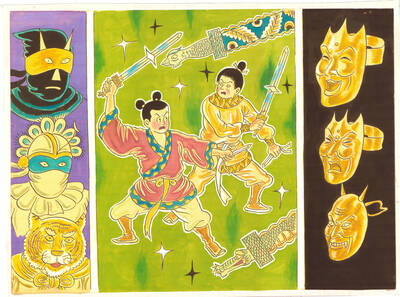
April 22 to April 28 The true identity of the mastermind behind the Demon Gang (魔鬼黨) was undoubtedly on the minds of countless schoolchildren in late 1958. In the days leading up to the big reveal, more than 10,000 guesses were sent to Ta Hwa Publishing Co (大華文化社) for a chance to win prizes. The smash success of the comic series Great Battle Against the Demon Gang (大戰魔鬼黨) came as a surprise to author Yeh Hung-chia (葉宏甲), who had long given up on his dream after being jailed for 10 months in 1947 over political cartoons. Protagonist

Peter Brighton was amazed when he found the giant jackfruit. He had been watching it grow on his farm in far north Queensland, and when it came time to pick it from the tree, it was so heavy it needed two people to do the job. “I was surprised when we cut it off and felt how heavy it was,” he says. “I grabbed it and my wife cut it — couldn’t do it by myself, it took two of us.” Weighing in at 45 kilograms, it is the heaviest jackfruit that Brighton has ever grown on his tropical fruit farm, located


 RSS
RSS