


Biaugust’s (兩個八月) home accessories mix looks and practicality with a big dose of social commentary. Items designed by Owen Chuang (莊瑞豪) and Cloud Lu (盧袗雲) are simple and versatile enough to fit into many interiors, but each carries a distinct message.
Named after the birth month of both creators, Biaugust was founded in 2000 after Chuang and Lu returned from studying in Tokyo.
After six years of graphic design work, the duo made their first professional venture into product design when they were invited by NSK Global to participate in an exhibition marking the anniversary of the Japanese manufacturer. The two were asked to find a way to make NSK Global’s ball bearings exciting to the average consumer.
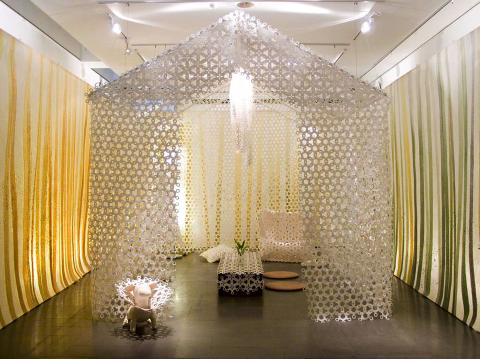
Photo courtesy of Biaugust
Biaugust’s creation, a two-piece saucer with a revolving platform and border of tiny horses reflected in a mirrored cup, creating a merry-go-round effect, was a hit and the company began producing the set, which was meant as a one-off item, for sale. Encouraged, Chuang and Lu began to create more home accessories and art installations. Biaugust still operates its graphic design business, which gives its founders the luxury of coming up with their own projects whenever inspiration hits.
“We can wait until we have a concept we are happy with, so we can afford to be more idealistic,” Chuang says.
“We think of our message first and then we try to figure out how to translate that into something practical, what material we will use and what function it will serve,” Lu says.
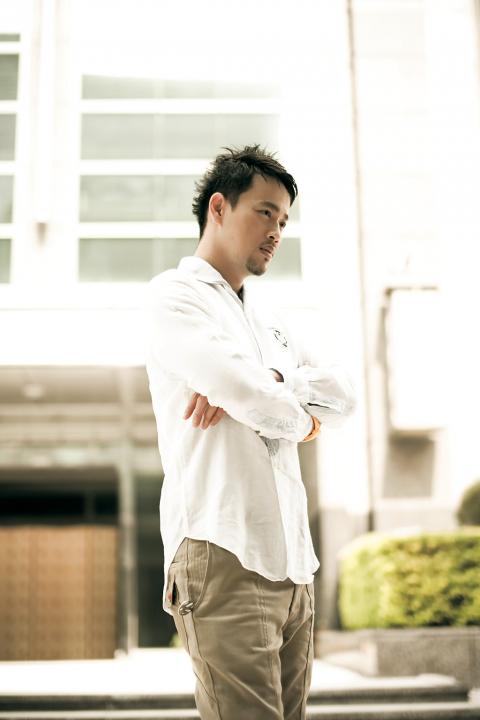
Photo courtesy of Biaugust
Their Love and Peace series of ceramic home accessories riffs on war iconography and includes a coin bank in the shape of a hand grenade. In order to retrieve his or her change, the user has to smash the “grenade,” ideally by tossing it.
“The act of throwing a hand grenade usually brings death and destruction, but with a piggy bank, you have dreams and plans for each coin you save,” Chuang says. “When you finally throw our grenade, it doesn’t cause harm. It brings fulfillment instead.”
Several Biaugust creations spotlight environmental conservation. The Non-Life Zoo, which began as an art installation created for a Japanese competition, features plush toys and illustrations of different animals standing erect on their hind legs. Ghostly skulls superimposed on each face temper their cuddly cuteness.
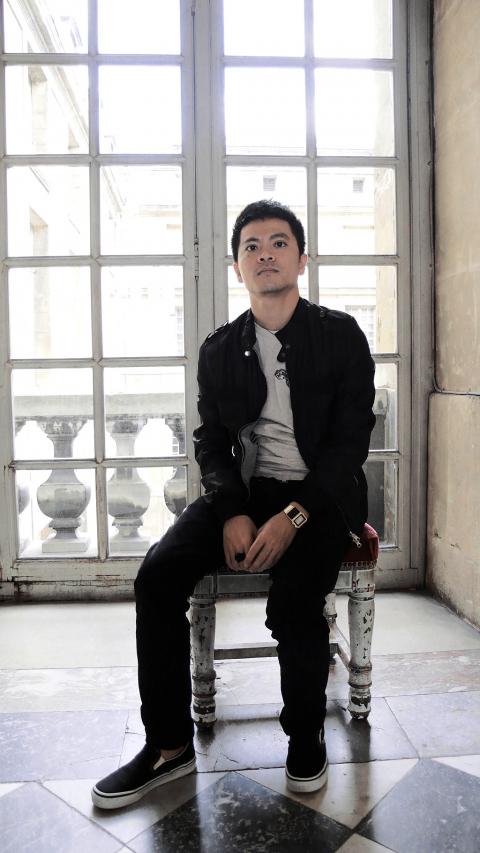
Photo courtesy of Biaugust
“We anthromorphized the animals because we want viewers to consider the relationships human beings have with different species,” Chuang says of the designs, which are currently available as graphic T-shirts in Net clothing stores.
Other pieces make use of repurposed or recycled materials. For the 2008 Taiwan Designers’ Week, (台灣設計師週), Chuang and Lu created a restaurant interior constructed entirely out of disposable biandang (便當), or lunchbox, containers and utensils. Luxurious-looking chandeliers were arranged from dozens of flimsy soupspoons, rubber bands were woven into chair covers and tightly stacked disposable wooden chopsticks made a surprisingly sturdy dining table. Waxed cardboard biandang boxes were cut into six-petal disks that can be linked together into endless configurations, including curtains, lampshades and vases.
Manufactuered in paper and polypropylene versions, the disks are now Biaugust’s best-selling item.
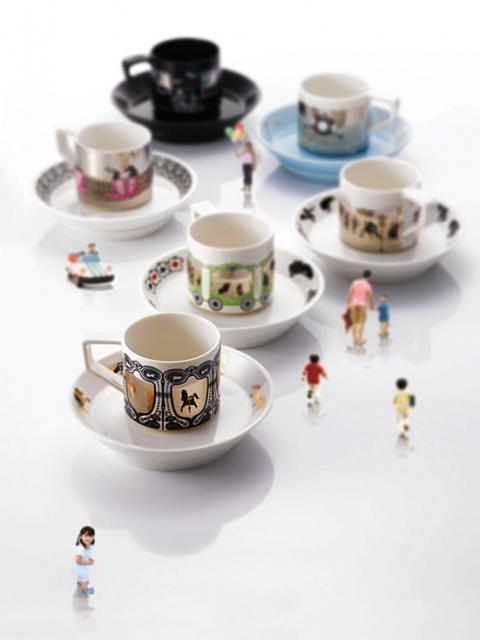
Photo courtesy of Biaugust
“Consumer habits are now about constantly wanting new things and throwing old items out, but [the disks] are something that users can use over and over again in many different ways,” Lu says.
“We think every person has a responsibility to society,” he adds. “As designers, we can use design to address environmental, anti-war or educational issues. We want to take our idealism and turn it into something practical.”
For more information about Biaugust products, art exhibits and retailers, visit www.biaugust.com
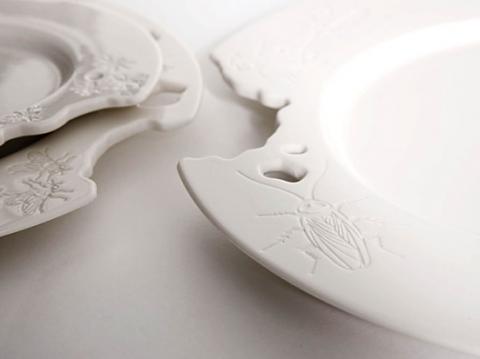
Photo courtesy of Biaugust
PRACTICAL DREAMER
A Little Round Round Land
When NSK Global invited the Biaugust team to create an item that used ball bearings in an innovative and entertaining way, Lu and Chuang immediately thought of amusement parks and rides like rollercoasters and merry-go-rounds. The A Little Round Round Land set features a two-piece saucer with a discreet revolving platform supported by a hidden ball bearing and a row of carousel horses painted along its border. When the matching teacup is placed on the platform and spun, the reflected horses seem to race on its gilt surface. After its positive reception, Chuang and Lu had the ball bearing reengineered so the saucer would be easier to wash and began producing the set for sale. It is available at Eslite stores and through US design collective Molla Space (www.mollaspace.com).

Photo courtesy of Biaugust
Bitten Plates
The company’s latest series of dishware has bite marks on the edges and delicately etched cockroaches, ants and flies. The designs are meant to draw attention to food waste. (Bitten Plates is not yet available for purchase.)
Animal by BiaugustXHermes
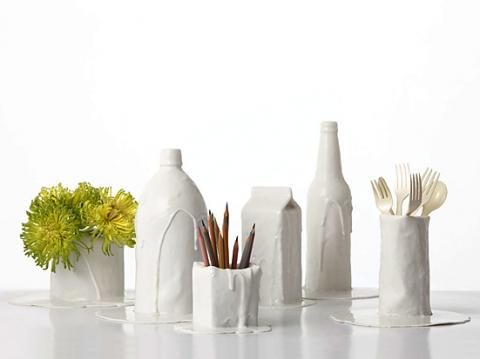
Photo courtesy of Biaugust
Biaugust’s recent collaboration with Hermes made use of flawed silk scarves that were unsuitable for retail. Chuang and Lu turned the fabric into upholstery for a series of wooden furniture crafted to look like different animals.
Draining Away
Meant as a comment on the link between single-use containers and global warming, Draining Away consists of white bottles that appear to be melting, but are actually made of white silicone. Each vessel can be folded down and turned into a storage container or vase.
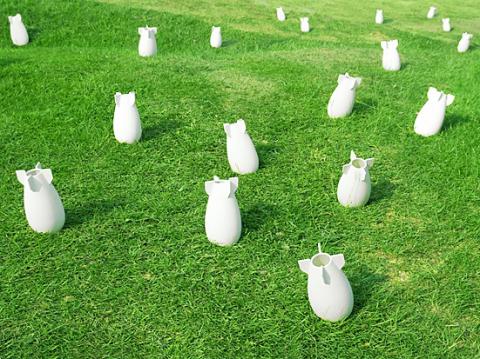
Photo courtesy of Biaugust
Love and Peace
Weapons and symbols of combat, including a hand grenade, bomb, artillery tank and soldier’s helmet, are transformed into playful but practical ceramic objects. The grenade is a coin bank, the bomb doubles as vase, the tank turns into a pencil sharpener and the helmet with a chunk blown out of it can be flipped over and used to gather coins, trinkets and other items.

Last week Joseph Nye, the well-known China scholar, wrote on the Australian Strategic Policy Institute’s website about how war over Taiwan might be averted. He noted that years ago he was on a team that met with then-president Chen Shui-bian (陳水扁), “whose previous ‘unofficial’ visit to the US had caused a crisis in which China fired missiles into the sea and the US deployed carriers off the coast of Taiwan.” Yes, that’s right, mighty Chen caused that crisis all by himself. Neither the US nor the People’s Republic of China (PRC) exercised any agency. Nye then nostalgically invoked the comical specter

Relations between Taiwan and the Czech Republic have flourished in recent years. However, not everyone is pleased about the growing friendship between the two countries. Last month, an incident involving a Chinese diplomat tailing the car of vice president-elect Hsiao Bi-khim (蕭美琴) in Prague, drew public attention to the People’s Republic of China’s (PRC) operations to undermine Taiwan overseas. The trip was not Hsiao’s first visit to the Central European country. It was meant to be low-key, a chance to meet with local academics and politicians, until her police escort noticed a car was tailing her through the Czech capital. The
April 15 to April 21 Yang Kui (楊逵) was horrified as he drove past trucks, oxcarts and trolleys loaded with coffins on his way to Tuntzechiao (屯子腳), which he heard had been completely destroyed. The friend he came to check on was safe, but most residents were suffering in the town hit the hardest by the 7.1-magnitude Hsinchu-Taichung Earthquake on April 21, 1935. It remains the deadliest in Taiwan’s recorded history, claiming around 3,300 lives and injuring nearly 12,000. The disaster completely flattened roughly 18,000 houses and damaged countless more. The social activist and

Over the course of former President Ma Ying-jeou’s (馬英九) 11-day trip to China that included a meeting with Chinese Communist Party (CCP) leader Xi Jinping (習近平) a surprising number of people commented that the former president was now “irrelevant.” Upon reflection, it became apparent that these comments were coming from pro-Taiwan, pan-green supporters and they were expressing what they hoped was the case, rather than the reality. Ma’s ideology is so pro-China (read: deep blue) and controversial that many in his own Chinese Nationalist Party (KMT) hope he retires quickly, or at least refrains from speaking on some subjects. Regardless


 RSS
RSS