


Britain’s famed Royal Ballet, which is marking its 80th anniversary this year, arrives in Taipei in just over a week to help the Republic of China celebrate its centennial. It’s visit comes at a key juncture for the company, which announced on Tuesday that administrative director Kevin O’Hare will take over as artistic director when Dame Monica Mason steps down in July next year.
O’Hare was in Taipei in December to sign the tour contracts and do a little promotion, promising the full cadre of 92 dancers and more than 50 technical personnel would becoming to Taipei. While he was not seen as the most exciting of possible contenders to take over the company, his management credentials were considered crucial.
O’Hare, who trained at the Royal Ballet School, joined the Sadlers Wells Royal Ballet upon graduation, which became the Birmingham Royal Ballet in 1990 — the same year he became one of its principal dancers. He began his management career with the Royal Shakespeare Company after retiring from dancing in 2000.
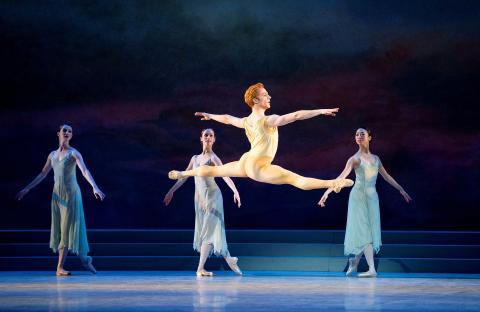
Photo Courtesy of Tristram Kenton, Royal Opera House
One of the first things he announced after being named Mason’s successor was that he had asked choreographers Wayne McGregor and Christopher Wheeldon, both of whom Mason has championed, to be on his senior artistic team. As luck would have it, the Mixed Bill program for the first two shows at the National Theater on June 30 and July 1 includes the first works these two extraordinary and young(ish) choreographers created for the company.
Both McGregor’s cutting-edge Chroma, set to orchestrations of The White Stripes’ music and featuring sets by architect John Pawson, and Wheeldon’s DVG, set to the music of Michael Nyman, debuted on the same program in November 2006. Shortly afterwards, the very cerebral McGregor was named resident choreographer, despite his complete lack of a ballet background.
Both men had been on the media and critics’ shortlist of possible successors to Mason, along with Royal principals Tamara Rojo and Johan Kobborg, who have said they are interested in moving into artistic directorships when they hang up their dancing shoes — which hopefully won’t be for a few more years, considering Rojo is at the height of her powers.
Both Rojo and Kobborg will be dancing in Taipei. The Spanish ballerina, who thrilled Taiwan’s balletomanes in April at the International Ballet Star Gala, will appear in both performances of Chroma, while Kobborg is only on the schedule once, partnering Romanian Alina Cojocaru — who is his off-stage partner as well — in Giselle on the evening of July 2.
The great thing about the company’s trip to Taipei is that local audiences will have the best of both worlds — classic big-story ballet and a variety of modern and post-modern works. The Mixed Bill program that starts the visit will see almost every one of the troupe’s principal dancers and leading soloists on stage, showing the depth and range of the company, while the three performances of Giselle will present some of the leading interpreters of romantic ballets. Cojocaru, especially, is considered one of the top Giselles in recent decades, while Kobborg is thought to be the best actor-dancer of his generation. The leads for the other two performances are Mara Galeazzi and Thiago Soares for the July 2 matinee and Marianela Nunez and Rupert Pennefather — another terrifically classic prince — for the July 3 matinee.
Cojocaru will also dance on the evening of July 3, partnered by Steven McRae, in the leads for Sir Frederick Ashton’s 27-minute Rhapsody, the final work on the Mixed Bill program. Set to Rachmaninoff’s Rhapsody on a Theme of Paganini, the piece is filled with pyrotechnic moves for the male lead (no surprise since it was choreographed for Mikhail Baryshnikov) while still retaining the lyricism Ashton was renowned for. He also gave the six-couple ensemble almost as much to do as the leads. Laura Morera and Sergei Polunin will head the Rhapsody casting on opening night.
One thing that stood out when looking at the cast lists for the four-day run in Taipei is just how international the top ranks of Britain’s top ballet company has become, compared to the days when Manson herself was one of the troupe’s leading ballerinas and most of her contemporaries were either British or Commonwealth citizens. National borders have come down in many of the world’s major dance troupes, allowing talented dancers more opportunities. However, it has come at the expense of what used to be a clearly defined “national style,” perhaps best exemplified by Ashton’s choreography of lyrical, linear beauty and simplicity.
Tickets to the three Giselle shows sold out weeks ago, despite a top price of NT$8,000. There are still some seats available for the two Mixed Bill performances.

If one asks Taiwanese why house prices are so high or why the nation is so built up or why certain policies cannot be carried out, one common answer is that “Taiwan is too small.” This is actually true, though not in the way people think. The National Property Administration (NPA), responsible for tracking and managing the government’s real estate assets, maintains statistics on how much land the government owns. As of the end of last year, land for official use constituted 293,655 hectares, for public use 1,732,513 hectares, for non-public use 216,972 hectares and for state enterprises 34 hectares, yielding

The March/April volume of Foreign Affairs, long a purveyor of pro-China pablum, offered up another irksome Beijing-speak on the issues and solutions for the problems vexing the People’s Republic of China (PRC) and the US: “America and China at the Edge of Ruin: A Last Chance to Step Back From the Brink” rang the provocative title, by David M. Lampton and Wang Jisi (王緝思). If one ever wants to describe what went wrong with US-PRC relations, the career of Wang Jisi is a good place to start. Wang has extensive experience in the US and the West. He was a visiting

The January 2028 presidential election is already stirring to life. In seven or eight months, the primary season will kick into high gear following this November’s local elections. By this point next year, we will likely know the Democratic Progressive Party (DPP) candidate and whether the Taiwan People’s Party (TPP) will be fielding a candidate. Also around this time, the Chinese Nationalist Party (KMT) will either have already completed their primary, or it will be heading into the final stretch. By next summer, the presidential race will be in high gear. The big question is who will be the KMT’s

One of the challenges with the sheer availability of food in today’s world is that lots of us end up spending many of our waking hours eating. Whether it’s full meals, snacks or desserts, scientists have found that it’s not uncommon for us to be mindlessly grazing at some point during all of our 16 or so waking hours. The problem? As soon as this food hits the bloodstream in the form of glucose, it initiates the release of the hormone insulin. This in turn activates a switch present in every one of our cells, which is responsible for driving cell


 RSS
RSS