


Fortune-telling, meditation, tea tasting, Chinese medicine and the philosophy and thought of Confucius are among the courses Taipei Confucius Temple (台北市孔廟) has arranged as part of a free workshop aimed at foreign nationals who want to learn more about the great sage and how big ideas from China’s past influence Taiwan’s present.
Dubbed Experience the Art of Life and Learn the Confucian Spirit (體驗生活藝術心領儒家精神), the three-day workshop will begin Friday at Taipei Confucius Temple, located five minutes on foot from Yuanshan MRT Station (圓山捷運站).
“It’s very intense and you have to pay a lot of attention,” said Charles Hsu (許文俊), director of China Productivity Center (中國生產力中心), the company promoting the workshop.
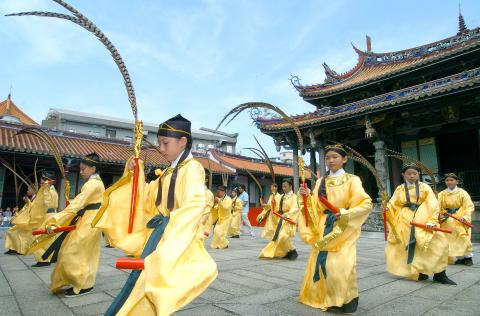
Photo: Taipei Times
He added that the company is targeting “foreign opinion makers such as ambassadors, foreign trade office directors, journalists and English teachers.” Space is limited, Hsu said, and participants are required to attend all three days.
The workshop — conducted in Mandarin with English and Japanese interpretation — includes lunch and all participants will receive a free T-shirt and the chance to win an Apple iPad.
An identical workshop was held in December and saw the participation of 15 expats, among them Leopoldo Sposato, trade director of the Italian Economic, Trade and Cultural Promotion Taipei Office.
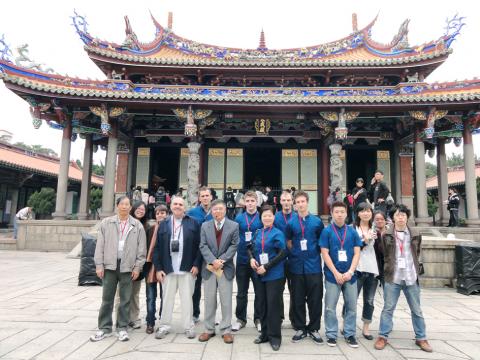
Photo Courtesy of China Productivity Center
“Usually one thinks that a course about some philosopher or thinker might be boring. My discovery, and surprise, was that it was very interesting. It was also very well organized,” Sposato said in a telephone interview.
Sposato said the course adds “a lot to a foreigner’s understanding and helps to bridge our different cultures.”
The first day, which starts at 8:30am, includes an introduction to Confucius’ thought and a tour of the temple grounds with the focus on its architecture. The afternoon consists of an introduction to the notoriously esoteric The Book of Changes (易經), a divination manual also known as the Yi Ching, and ends with fortune-telling using the geomantic text.
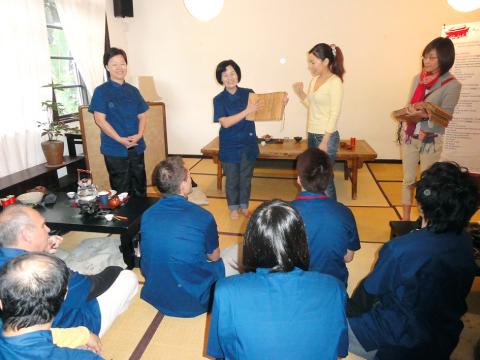
Photo Courtesy of China Productivity Center
When asked about the oddity of presenting Confucius in the morning and fortune-telling in the afternoon, Jasmine Deng (鄧欣潔), a spokeswoman for the temple, said the organizers didn’t want to limit the workshop to Confucian studies.
“We hope the workshop reveals how different aspects of Chinese culture — whether Confucius’ thought or the Yi Ching — manifests itself in today’s [Taiwan],” she said.
The itinerary of the second and third days does exactly that — though focusing on health.
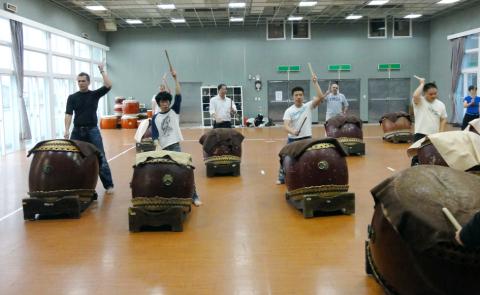
Photo Courtesy of China Productivity Center
Participants will meet at Muzha MRT Station (木柵捷運站) and then proceed to the Performance Arts Studio 36 (表演36房), located in the surrounding mountains. Breathing exercises (qigong, 氣功), meditation and the “Zen of drumming” are among the highlights of the morning.
After lunch, participants will drink “Zen tea,” followed by a high-energy drumming performance by U-Theater (優人神鼓), which is said to instill a sense of well-being in the drummers and audience. The day ends with an “exchange of views.”
The third and final day will find participants back at Taipei Confucius Temple. Morning classes include an introduction to Chinese medicine and the “Chinese way to keep in good health.” Following a “health improving lunch,” the afternoon will be devoted to learning the art of making tea.
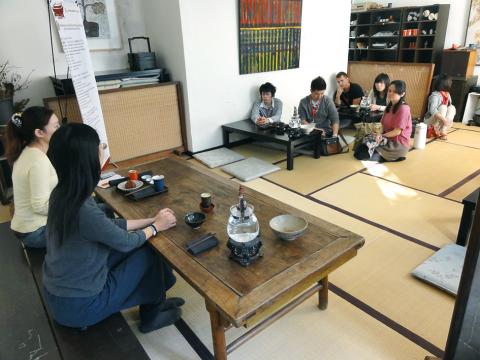
Photo Courtesy of China Productivity Center
On the course’s health benefits, Sposato waxed philosophical. “I’ve been all over the world because of my job. What I’ve discovered about Chinese culture is this, let us say, marriage between [psychological] well-being with physical exercise, the physical participation as well as the mental participation,” he said. “This means that the personal health and feeling of the people is a big consideration in this culture. I’m a little old now, so it will be very important in my future life.”
Deng offered her own perspective on the course. “When in Rome, do as the Romans,” she said.
Taipei Confucius Temple will also hold two-day workshops on May 13 and May 14 and June 4 and 5. These workshops are geared towards foreign students studying in Taiwan and will include courses on Confucian thought and philosophy, calligraphy appreciation, temple rituals and a tour of the historic Dadoacheng (大稻埕) District. Details can be found at: tct101.pixnet.net/blog/post/523946
“Taiwan’s Opposition Leader Comes to US With a Message Straight Out of Beijing” read a May 31 headline in the Wall Street Journal. Top US administration officials and members of Congress almost certainly read the WSJ, and if there was a bullet point takeaway that people in Washington should absorb ahead of Chinese Nationalist Party (KMT) Chair Cheng Li-wun’s (鄭麗文) arrival in DC on June 9, that headline is it. The last few columns have discussed this very topic, and the timing is not coincidental. While those top officials likely do not read the Taipei Times, judging by the number
With weighty, anxiety-inducing geopolitical topics dominating the headlines, checking in on the wild and weird state of local politics can take some of the edge off. This November’s elections will determine who will be in charge of fixing potholes in your neighborhood, not the potholes in Taiwan’s complicated geopolitical space. Recently, after an online interview with a Taipei-based journalist, I commented that Taipei journalists never go further than the MRT can take them. He laughed and agreed. Naturally, the Taipei mayoral race is eating up much of the press attention. TAIPEI CITY Democratic Progressive Party (DPP) candidate Puma Shen (沈伯洋) has
In December of 2008 Lee E-tin (李乙廷), a Miaoli county legislative hopeful, was convicted of vote-buying. Rather than buy votes retail, voter by voter, in the usual manner, Lee had done it wholesale, in a commendably efficient manner: he had visited local temples and made donations to gain their support. Because he did not normally make donations to temples, the court ruled he was attempting to improperly influence voter behavior. The case indicates how important temples are in influencing political life. Both judge and politician appeared to see them in the same way. Beijing sees them that way as well. Democratic Progressive
Audiences in Leicester, Cardiff, London and Sheffield will this month gather to watch a series of black-and-white Taiwanese-language films made more than 70 years ago. On the surface, these screenings commemorate the seventieth anniversary of taiyupian (台語片) — Taiwanese-language cinema. Yet the significance of these events extends far beyond nostalgia or film history. They represent a remarkable chapter in Taiwan’s ongoing effort to recover, preserve and reinterpret a cultural heritage that was once thought to have largely disappeared. The centerpiece of the program is the Ho Chi-ming (何基明) directed Xue Pinggui and Wang Baochuan (薛平貴與王寶釧), a film produced in 1955 and


 RSS
RSS