


To hear analysts talk, Industrial & Commercial Bank of China Ltd is one sizzling stock. Of 43 recommendations on its Hong Kong shares, 88 percent advise “buy” or “outperform.” Not a “sell” in sight.
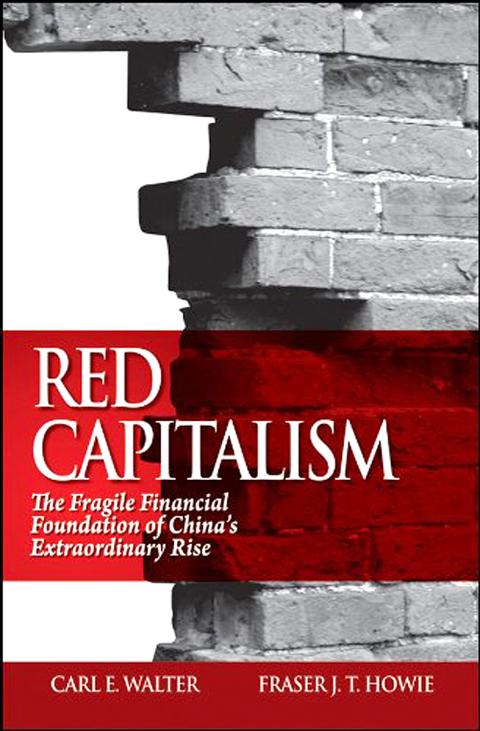
What does a share in China’s largest bank represent, though? Not ownership, let alone control. The government holds some 70 percent of Industrial & Commercial, and its executives obey Communist Party bosses, as Carl E. Walter and Fraser J.T. Howie show in their sobering book, Red Capitalism.
Set aside, for a moment, the vapid chatter about the Chinese “miracle.” Forget that clever clogs at Goldman Sachs Group Inc invested in the bank before it went public.
Recall instead the US$42 billion that investors poured into Industrial & Commercial and two other state banks in initial public offerings. What happened to that money? It cascaded right into the state’s coffers as dividends, the authors say. Call it free cash flow with Chinese characteristics.
“Why wouldn’t international investors keep the cash in the first place?” they ask. The question is especially worth asking now that China has surpassed Japan as the world’s second-largest economy.
Walter and Howie have lived in China for 25 years and worked at banks including JPMorgan Chase & Co and Morgan Stanley. They recognize that the country’s economic resurgence and opening to the world have lifted more than 300 million people out of poverty. They also understand that China’s Party bosses still control the economy, thanks partly to the ministrations of Goldman Sachs and other banks, they say.
“China is a family-run business,” not a market economy, they write. And the families are the political elite.
When most Westerners think about China, they picture the crane-bristling export juggernauts of Guangdong and the Yangtze River Delta. Led by private and foreign-invested companies, these are the regions that earned China’s US$2.85 trillion in foreign-exchange reserves, the authors say.
Yet there’s a parallel economy, a domestic one dominated by state-owned corporations, “national champions” such as PetroChina Co and China Mobile Ltd. That’s what the Party wants to fortify, as this book shows in convincing detail.
The national champs have the trappings of Western corporations — professional lawyers, accountants and bankers. No surprise there: They were created and sold to international fund managers by the likes of Goldman, doing “God’s work,” the authors say.
Red Capitalism is on the dry side. We get no tales of “princelings with their hands in the till,” as the preface cautions, and the text sometimes chokes on abbreviations such as MOF (Ministry of Finance) and PBOC (People’s Bank of China). If you soldier on, though, the book rewards your patience with cogent analysis and muscular conclusions.
Chart by chart, Walter and Howie peel back China’s capitalist veneer to expose the cadre of rapacious oligopolies beneath. The array of data they bring to bear is astonishing, especially given that the numbers come from public sources.
Nothing in China is as it appears, judging from this account. Its bond markets, for example, boast thousands of participants and the paraphernalia of ratings agencies and industry associations.
Yet they lack the engine of normal bond markets — risk and the ability to measure and price it. The state controls the interest-rate framework, and banks hold more than 70 percent of all bonds. So much for financial diversification.
Nor do China’s equity markets operate as arenas for valuing companies and contesting ownership. They’re just slick casinos for gambling on minority stakes in the national champions.
The Western guise serves a purpose. It camouflages what the state sector really is: “a patronage system centered on the Party’s nomenklatura,” the authors explain.
The chairmen and chief executives of the national champions hold ministerial rank and are, in many cases, former ministry bosses. The country’s biggest banks, by contrast, are classified as vice-ministerial entities. Imagine the clout these executives wield over the banks.
“What would the chairman of China’s largest bank do if the chairman of PetroChina asked for a loan? He would say: ‘Thank you very much, how much and for how long.’”
All of which helps explain why new Chinese loans soared to a record US$1.4 trillion in 2009 — and why the banks then scrambled to raise more capital. The Party ordered the banks to lend more money to companies that, by this account, are in no hurry to repay.
That leaves the elite families and their retainers free to plunder China’s vast domestic markets for more profits. Who’s going to stop them?

In late October of 1873 the government of Japan decided against sending a military expedition to Korea to force that nation to open trade relations. Across the government supporters of the expedition resigned immediately. The spectacle of revolt by disaffected samurai began to loom over Japanese politics. In January of 1874 disaffected samurai attacked a senior minister in Tokyo. A month later, a group of pro-Korea expedition and anti-foreign elements from Saga prefecture in Kyushu revolted, driven in part by high food prices stemming from poor harvests. Their leader, according to Edward Drea’s classic Japan’s Imperial Army, was a samurai

Located down a sideroad in old Wanhua District (萬華區), Waley Art (水谷藝術) has an established reputation for curating some of the more provocative indie art exhibitions in Taipei. And this month is no exception. Beyond the innocuous facade of a shophouse, the full three stories of the gallery space (including the basement) have been taken over by photographs, installation videos and abstract images courtesy of two creatives who hail from the opposite ends of the earth, Taiwan’s Hsu Yi-ting (許懿婷) and Germany’s Benjamin Janzen. “In 2019, I had an art residency in Europe,” Hsu says. “I met Benjamin in the lobby
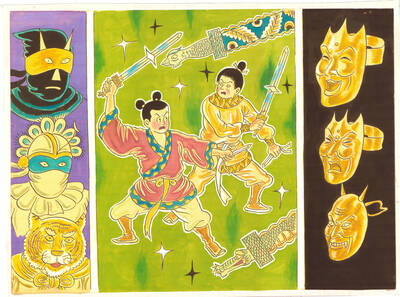
April 22 to April 28 The true identity of the mastermind behind the Demon Gang (魔鬼黨) was undoubtedly on the minds of countless schoolchildren in late 1958. In the days leading up to the big reveal, more than 10,000 guesses were sent to Ta Hwa Publishing Co (大華文化社) for a chance to win prizes. The smash success of the comic series Great Battle Against the Demon Gang (大戰魔鬼黨) came as a surprise to author Yeh Hung-chia (葉宏甲), who had long given up on his dream after being jailed for 10 months in 1947 over political cartoons. Protagonist

Peter Brighton was amazed when he found the giant jackfruit. He had been watching it grow on his farm in far north Queensland, and when it came time to pick it from the tree, it was so heavy it needed two people to do the job. “I was surprised when we cut it off and felt how heavy it was,” he says. “I grabbed it and my wife cut it — couldn’t do it by myself, it took two of us.” Weighing in at 45 kilograms, it is the heaviest jackfruit that Brighton has ever grown on his tropical fruit farm, located


 RSS
RSS