


Despite gloomy, overcast skies and chilly winds, Smile Taiwan lived up to its name on Saturday afternoon. The annual free concert marked its 10th anniversary at Huashan 1914 Creative Park (華山1914) with a stellar lineup that included rock group Wonfu Jr (小旺福, formerly known as Wonfu), Pau-dull (陳建年, better known as Chen Jian-nian), Yan Yung-neng (嚴詠能) and Takaorun (打狗亂歌團) and Beautiful Haiyan (美麗心民謠).
The event spotlights Taiwanese musicians and all the acts were picked to create a feel-good, family-friendly atmosphere. Plenty of toddlers were in attendance with their parents or siblings.
Chen opened the show with an exhilarating rendition of Hen-Hen-Hen, which pays tribute to the singer-songwriter’s heritage with a soaring Puyuma Aboriginal chant. During his set, Chen talked about serving as a policeman in Taitung County, which he continues to balance with his music career. “When I’m out on my beat I often hear kids in schoolyards practicing Puyuma songs,” Chen said. “It really makes me happy.”
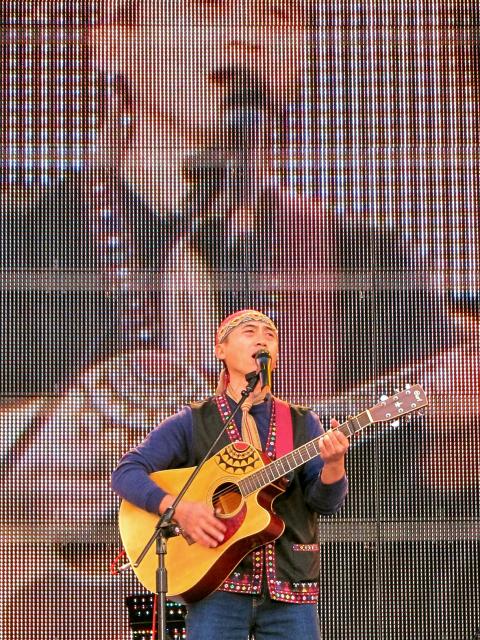
Photo: Catherine Shu, Taipei Times
Organizers live-blogged the entire event on Weibo (微博).
“There’s a lot I’d like to say right now, but I guess I’ll share it later on my blog,” Wonfu Jr lead singer Yao Hsiao-min (姚小民) joked.
The group added the “Jr” to its name ahead of the release last month of its concept album Flying to You, Flying to Me (飛向你飛向我), which features “rock and roll for kids.”
The four members of the group really knew how to get their tiny fans moving.
“Parents, let your kids come up to the stage to dance. Don’t worry, it’s safe!” said the high-spirited Yao. An adorable toddler wearing a pink hair bow took him up on his offer, attracting her own paparazzi as she waved her arms to Little Eyes (小眼睛), a track that samples soundtracks from 1980s video games.
After Wonfu Jr’s set, the crowd began dwindling as the weather grew colder. The organizer’s insistence on honoring sponsors with five- to 10-minute long speeches in between sets also didn’t help the event’s momentum, which is a shame because the last two performances were outstanding.
Yan and his group Takaorun were the surprise winners of the best Taiwanese-language album award at last year’s Golden Melody Awards ceremony for Ta Yuan I Chia Nung Chu Lai (大員一家農出來). Many of their songs are rousing calls for Taiwanese pride, including So Long As Everyone Gathers to Eat Taiwan Rice (只要大家攏吃台灣米).
“Telling your own story is one way to love your country,” said Yan.
A somewhat surreal touch to their performance was the inclusion of two masked performers who were covered in metallic paint and dressed as a farmer and a soldier.
Beautiful Haiyan’s members write songs that pay tribute to their Aboriginal heritage. Languages represented in their lyrics include Amis, Puyuma and Rukai.
Singer Gelresai (陳世川, also known as Chen Shih-chuan) had a hit with his flirty and sassy ballad Come to My Place (來我家), which mixes Mandarin lyrics with a Hoklo (commonly known as Taiwanese) refrain: “I kiss you, I hug you, I love you” (我親你,我抱你,我愛你).
Beautiful Haiyan had the audience on its feet and clapping along for Song of the Shepherd Boy (牧童之歌), which showcased their awe-inspiring yodeling skills. The band gradually increased the pace until it hit a frenetic stride, keeping the crowd warm as the sky grew dark.

“Taiwan’s Opposition Leader Comes to US With a Message Straight Out of Beijing” read a May 31 headline in the Wall Street Journal. Top US administration officials and members of Congress almost certainly read the WSJ, and if there was a bullet point takeaway that people in Washington should absorb ahead of Chinese Nationalist Party (KMT) Chair Cheng Li-wun’s (鄭麗文) arrival in DC on June 9, that headline is it. The last few columns have discussed this very topic, and the timing is not coincidental. While those top officials likely do not read the Taipei Times, judging by the number

With weighty, anxiety-inducing geopolitical topics dominating the headlines, checking in on the wild and weird state of local politics can take some of the edge off. This November’s elections will determine who will be in charge of fixing potholes in your neighborhood, not the potholes in Taiwan’s complicated geopolitical space. Recently, after an online interview with a Taipei-based journalist, I commented that Taipei journalists never go further than the MRT can take them. He laughed and agreed. Naturally, the Taipei mayoral race is eating up much of the press attention. TAIPEI CITY Democratic Progressive Party (DPP) candidate Puma Shen (沈伯洋) has
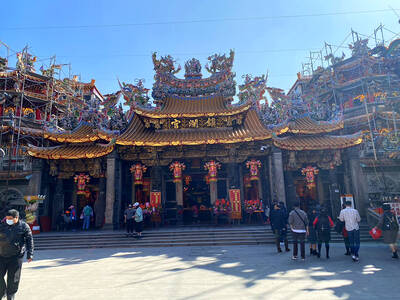
In December of 2008 Lee E-tin (李乙廷), a Miaoli county legislative hopeful, was convicted of vote-buying. Rather than buy votes retail, voter by voter, in the usual manner, Lee had done it wholesale, in a commendably efficient manner: he had visited local temples and made donations to gain their support. Because he did not normally make donations to temples, the court ruled he was attempting to improperly influence voter behavior. The case indicates how important temples are in influencing political life. Both judge and politician appeared to see them in the same way. Beijing sees them that way as well. Democratic Progressive
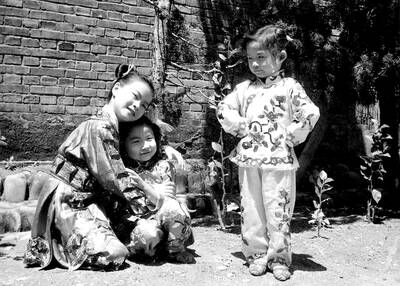
Audiences in Leicester, Cardiff, London and Sheffield will this month gather to watch a series of black-and-white Taiwanese-language films made more than 70 years ago. On the surface, these screenings commemorate the seventieth anniversary of taiyupian (台語片) — Taiwanese-language cinema. Yet the significance of these events extends far beyond nostalgia or film history. They represent a remarkable chapter in Taiwan’s ongoing effort to recover, preserve and reinterpret a cultural heritage that was once thought to have largely disappeared. The centerpiece of the program is the Ho Chi-ming (何基明) directed Xue Pinggui and Wang Baochuan (薛平貴與王寶釧), a film produced in 1955 and


 RSS
RSS