


Museums in Taipei have gone out of their way over the past year to collaborate with their European and American counterparts to mount exhibitions of modern art.
Manet to Picasso: Masterpieces From the Philadelphia Museum of Art, currently on view at TFAM, is a group show of paintings and sculpture from the modern period, beginning in the 1870s and moving up to the 1960s.
The exhibition brings together 53 paintings by masters such as Edgar Degas, Edouard Manet, Vincent van Gogh, Paul Gauguin, Joan Miro, Marcel Duchamp and Georgia O’Keeffe, as well as bronze sculptures by Jacques Lipchitz and Auguste Rodin, Picasso, Degas and Henri Matisse.
Arranged in four sub-themes — Daylight presents landscape painting, Beauties ponders the female form, Shapes exhibits work that reinterprets the still life, and Dreams displays paintings that explore the subconscious — the exhibit offers museumgoers a chronological glimpse of the period’s aesthetic preoccupations and reveals how early landscape painters set the tone for later modernist experiments.
An essay in the exhibit’s catalogue states that the philosophical ideas of positivism (the notion that knowledge can only be verified if derived from sensory experience) developed in the early 19th century and laid the foundations for and had a lasting influence on modern art.
No longer constrained by a visual and textual tradition handed down from the classical period, these artists felt free to rely on their own perceptions to depict the phenomenal world.
Landscape painters did so through two basic motifs: pastoral landscapes associated with leisure, and urban scenes that portray factories and manufacturing. The outlined houses filled in with thick swaths of solid color found in Paul Cezanne’s Quartier Four, Auvers-sur-Oise (Landscape, Auvers — 1873) and Claude Monet’s brilliant lighting effects in Morning at Antibes (1888) are examples of the former, while Camille Pissarro, employing the neo-impressionist pointillism of Georges Seurat to depict a port scene in The Effect of Fog (1888), is an example of the latter.
Artists applied their new aesthetic to the growing participation of women in the period’s public sphere. Mary Stevenson Cassatt’s Woman With a Pearl Necklace in a Loge (1879) is emblematic of this tendency. The play of light and shadow cast by artificial light emphasizes the ravishing beauty of a woman at the theater.
Begun by the early impressionists, optical experiments in still life paintings can be found in Georges Braque’s Basket of Fish (1910), an early cubist work, and Chessboard, Glass and Dish (1917) by Juan Gris, which is composed of overlapping geometrical objects of different visual perspectives.
The curators of Manet to Picasso should not only be commended for mounting an accessible exhibit that gently expounds the thesis that landscape artists kicked off the visual experiments of modernism, but also for picking paintings and sculptures that give a valuable
insight into life in late 19th and early 20th-century Europe.


In late October of 1873 the government of Japan decided against sending a military expedition to Korea to force that nation to open trade relations. Across the government supporters of the expedition resigned immediately. The spectacle of revolt by disaffected samurai began to loom over Japanese politics. In January of 1874 disaffected samurai attacked a senior minister in Tokyo. A month later, a group of pro-Korea expedition and anti-foreign elements from Saga prefecture in Kyushu revolted, driven in part by high food prices stemming from poor harvests. Their leader, according to Edward Drea’s classic Japan’s Imperial Army, was a samurai
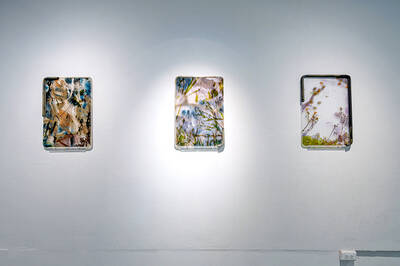
Located down a sideroad in old Wanhua District (萬華區), Waley Art (水谷藝術) has an established reputation for curating some of the more provocative indie art exhibitions in Taipei. And this month is no exception. Beyond the innocuous facade of a shophouse, the full three stories of the gallery space (including the basement) have been taken over by photographs, installation videos and abstract images courtesy of two creatives who hail from the opposite ends of the earth, Taiwan’s Hsu Yi-ting (許懿婷) and Germany’s Benjamin Janzen. “In 2019, I had an art residency in Europe,” Hsu says. “I met Benjamin in the lobby
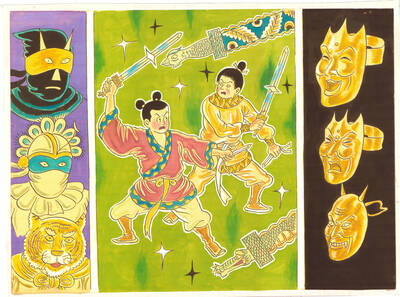
April 22 to April 28 The true identity of the mastermind behind the Demon Gang (魔鬼黨) was undoubtedly on the minds of countless schoolchildren in late 1958. In the days leading up to the big reveal, more than 10,000 guesses were sent to Ta Hwa Publishing Co (大華文化社) for a chance to win prizes. The smash success of the comic series Great Battle Against the Demon Gang (大戰魔鬼黨) came as a surprise to author Yeh Hung-chia (葉宏甲), who had long given up on his dream after being jailed for 10 months in 1947 over political cartoons. Protagonist

A fossil jawbone found by a British girl and her father on a beach in Somerset, England belongs to a gigantic marine reptile dating to 202 million years ago that appears to have been among the largest animals ever on Earth. Researchers said on Wednesday the bone, called a surangular, was from a type of ocean-going reptile called an ichthyosaur. Based on its dimensions compared to the same bone in closely related ichthyosaurs, the researchers estimated that the Triassic Period creature, which they named Ichthyotitan severnensis, was between 22-26 meters long. That would make it perhaps the largest-known marine reptile and would


 RSS
RSS