


In the Kafkaesque world of Chinese political repression, two words stand out as epitomizing continuity and adaptation in the Chinese Communist Party’s (CCP) reliance on incarceration to ensure its survival: lao (勞, labor) and gai (改, reform). Drawing from the Maoist philosophy that work for the betterment of the nation will purify one’s thoughts, the laogai, or “reform through labor,” is a system by which “antisocial” elements are removed from society and “reformed.” Not only are convicts and dissidents detained and “reformed,” but as Laogai: The Machinery of Repression in China shows, the state profits handsomely from the unpaid labor that takes places in those camps.
That system is not only rampant across China, with 909 laogai camps verified by the Laogai Research Foundation, but it is marked with innumerable abuses, including inadequate food and medical care, crowded, unsanitary and oftentimes dangerous work environments and disciplinary cruelty that, in many cases, has left permanent psychological scars on an inmate or resulted in his death.
According to research conducted by the authors, as many as 3 million to 5 million people are currently imprisoned in laogai camps, and between 40 million and 50 million have passed through them since 1949, when the People’s Republic of China (PRC) was born. Other statistics paint a disconcerting picture: Ninety-nine percent of people charged with “endangering state security” in China are found guilty and will likely end up in the laogai system; 500,000 people are believed to be in arbitrary detention across China at any given time; 40 percent of laogai prisoners are sentenced to more than five years of imprisonment, life imprisonment or death.
During the Mao era, convicts — from criminals to political dissidents — swallowed by the laogai system provided unpaid labor for massive infrastructure projects that the PRC simply could not have afforded had it paid for their work. As early as 1954, the Chinese government was stating that “Laogai production must serve the economic construction of the state and be a part of the general plan of production and construction of the state.”
Eventually, as China opened its doors to international trade under Deng Xiaoping’s (鄧小平) guidance, the laogai camp turned into a profitable instrument by which local officials could enrich themselves, by using unpaid labor in the budding factory sector. Throughout the 1990s, laogai enterprises were directly managed by prison officials and expected to meet all the costs of running the camp with the profits from the enterprises. The idea, the authors tell us, was to encourage laogai officials to operate at a profit.
Lax international regulations and weak enforcement of rules, as well as the use of the import-export company system to mask the origin of laogai products, allowed the CCP to get away with “reform through work” for decades. As the book informs us, as many as 314 businesses listed in Dun and Bradstreet databases are clearly linked to laogai camps, which were often situated right next to a factory or use factories as a front (this has now changed somewhat, in that rather than being directly managed by prison officials, laogai enterprises are now physically separated from prisons but are bound by contract). Laogai products documented in the book that have entered our markets include a variety of teas, rubber boots, wrenches, socks, artificial flowers and even sulfuric acid. The more consumers all over the world consume laogai products, the more the Chinese government will continue to profit from the imprisonment and exploitation of prisoners, the book argues. In fact, a case could be made that this could encourage the state to continue imprisoning a large number of Chinese for even minor violations, or for various forms of what the CCP regards as dissent.
Amid the bad publicity engendered by the laogai, Chinese authorities switched from the designation laogai to jianyu (監獄), or prison. But as the book tells us, the new name was not accompanied by a change in policy and served more as a political smokescreen. As the government-sanctioned Beijing Legal Daily wrote in 1995: “Our renaming of the laogai is what our associating with the international community calls for, and it is favorable in our international human rights struggle.
“Henceforth, the word laogai will no longer exist, but the function, character and tasks of our prison administration will remain unchanged.”
They also argue that as prisoners in laojiao (勞教, re-education through labor) camps are under “administrative detention” and therefore not considered convicted criminals under Chinese law, goods produced by inmates do not constitute prison labor goods for the purpose of bilateral agreements reached between China and a number of countries.
Sadly, the book’s title is somewhat misleading, as rather than simply focus on the laogai system, it also contains chapters on the history of human rights (or lack thereof) in China, black prisons, executions, organ harvesting and control of the media. It also adopts what is slowly — and necessarily — becoming the accepted notion: while the PRC has liberalized economically, the CCP has absolutely no intention of relinquishing its grip on power and will continue to use the penal system — including laogai — to ensure its survival. Consequently, all the state-sponsored crimes this book covers are likely to continue, no matter how much Beijing is integrated into the international community and engages in discussions on human rights with the US.
It should be noted that this book comes in a coffee-table format with dozens of excellent, and sometimes very graphic, pictures (many of which were taken surreptitiously by Harry Wu (吳宏達), one of the authors and himself a former laogai prisoner), which, along with biographies of a number of individuals who went through the prison system, adds a personal touch to the text.
This indispensable book is an unforgiving indictment of the many crimes perpetrated by the CCP in the name of development and stability. While today’s China is a better place in some ways than it was during the Cultural Revolution, the indiscriminateness and exploitation that marked Mao’s folly are still very much alive today. A Chinese-language version of this book is also available.



Last week Joseph Nye, the well-known China scholar, wrote on the Australian Strategic Policy Institute’s website about how war over Taiwan might be averted. He noted that years ago he was on a team that met with then-president Chen Shui-bian (陳水扁), “whose previous ‘unofficial’ visit to the US had caused a crisis in which China fired missiles into the sea and the US deployed carriers off the coast of Taiwan.” Yes, that’s right, mighty Chen caused that crisis all by himself. Neither the US nor the People’s Republic of China (PRC) exercised any agency. Nye then nostalgically invoked the comical specter
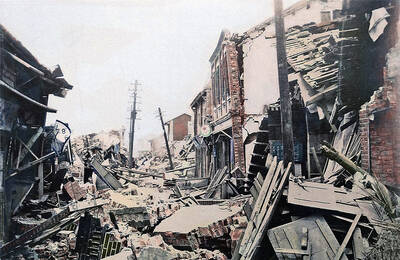
April 15 to April 21 Yang Kui (楊逵) was horrified as he drove past trucks, oxcarts and trolleys loaded with coffins on his way to Tuntzechiao (屯子腳), which he heard had been completely destroyed. The friend he came to check on was safe, but most residents were suffering in the town hit the hardest by the 7.1-magnitude Hsinchu-Taichung Earthquake on April 21, 1935. It remains the deadliest in Taiwan’s recorded history, claiming around 3,300 lives and injuring nearly 12,000. The disaster completely flattened roughly 18,000 houses and damaged countless more. The social activist and

Over the course of former President Ma Ying-jeou’s (馬英九) 11-day trip to China that included a meeting with Chinese Communist Party (CCP) leader Xi Jinping (習近平) a surprising number of people commented that the former president was now “irrelevant.” Upon reflection, it became apparent that these comments were coming from pro-Taiwan, pan-green supporters and they were expressing what they hoped was the case, rather than the reality. Ma’s ideology is so pro-China (read: deep blue) and controversial that many in his own Chinese Nationalist Party (KMT) hope he retires quickly, or at least refrains from speaking on some subjects. Regardless

Approaching her mid-30s, Xiong Yidan reckons that most of her friends are on to their second or even third babies. But Xiong has more than a dozen. There is Lucky, the street dog from Bangkok who jumped into a taxi with her and never left. There is Sophie and Ben, sibling geese, who honk from morning to night. Boop and Pan, both goats, are romantically involved. Dumpling the hedgehog enjoys a belly rub from time to time. The list goes on. Xiong nurtures her brood from her 8,000 square meter farm in Chiang Dao, a mountainous district in northern Thailand’s


 RSS
RSS