


At some point, nearly every gardener has paused over a flower and experienced an epiphany: If I could capture the scent of that jasmine in a bottle, I’d be a millionaire. The next day the petals are gone, and the aroma with them.
Thanks for the memories. See you
next year.

Andrine Olson, however, has a pickle jar in her refrigerator that holds the invigorating scent of jasmine blossoms from her overgrown garden. There are some 60 other scents, too, foraged and assembled from her yard on Vashon Island, Washington, overlooking the Puget Sound.
These tinctures are a highlight of Olson’s creations as a natural perfumer, making scents without any of the synthetic aromas used in commercial perfumery. Each solution comes from a laborious process of steeping plants in 190-proof alcohol, a drink that could drop a horse. Other flowers have been pressed into fats, like palm oil shortening, in an old-fangled process called enfleurage.
There’s a witch hazel tincture from the herb garden that smells curiously sweet, nothing like the drugstore astringents used to punish teenagers with spotty skin. A tincture of smoked clamshells, gathered from the seashore down the hill, recalls a pot of Lapsang Souchong tea. Or the smell of a lover’s T-shirt after a bonfire on the beach. Creating perfumes, soaps and deodorants from her 1.6-hectare grounds has not made Olson a millionaire. Or a thousandaire, for that matter. Which is too bad, because Olson, 47, left her career as a Seattle technical writer for the likes of Boeing and Microsoft, and she has started to worry about losing her home to foreclosure.
Frankly, she wouldn’t mind selling the house, a 93m2, “Band Aid-pink modular home” that she has come to think of as a beached houseboat. She had had a mind to scrap it after she moved to Vashon Island nine years ago. But first her library of antiquarian books took over the second bedroom, and then her perfuming kit colonized the kitchen. The house put down roots, and these days she lacks the energy to dislodge it.
At the end of 2005, Olson suffered “a massive” heart attack — a blockage of the left anterior descending artery that doctors called “a widow-maker,” she said. She survived and decided that “it was time to do something different.”
Since she took up natural perfuming, Olson has discovered a fervent community of other souls exploring the craft. One of her mentors, Anya McCoy, 59, sells her original scents under the name Anya’s Garden (anyasgarden.com), and runs a Yahoo group devoted to natural perfuming. The subscription list has more than tripled since 2005, McCoy said, and currently numbers almost 2,000 members.
The great majority of these perfumers buy all their ingredients from natural scent companies, in stores or on the Web, and then blend them at home. But McCoy also uses a heady variety of homegrown scents from her lush garden in Miami Shores, Florida, a village just north of Miami.
The desire to smell good — without the aura of chemicals — did not seem to wane in the flop sweat of the recent economic panic. McCoy sells her creations at US$60 to US$125 for 15ml — not cheap. Yet “since 2007, I’d say my sales have increased 25 percent every year,” she said.
Mandy Aftel, who helped spur the modern natural perfumery movement with her 2001 book Essence and Alchemy, said she has “observed an absolute explosion
of interest.”
“I’m an artisan, though,” she added, referring to her perfume line, Aftelier. “So an explosion for me isn’t like an explosion for Macy’s!”
Aftel, 62, connects the popularity of natural perfumes to interest in organic gardening and local food. “People are so often in front of their computer screens and detached from the sensual world,” she said.
Synthetic perfumes do a poor job of awakening that connection to green things, according to some natural perfumers. They argue that commercial perfumes can have all the subtlety of the men’s room at Yankee Stadium. And that synthetic fragrances cling indelibly to the body for 12 hours or more, like a one-night stand who demands brunch the next morning.
As Jeanne Rose, 73, a natural perfumer and aromatherapy practitioner in San Francisco who has written on the subject since 1969, puts it: “People are walking around in our Chinatown who smell like fermented watermelons.”
Rose, who teaches classes nationally, and out of her four-story Edwardian home, said the students who enroll do so because “they think people stink.”
That opinion may seem fragrant, but Rose’s spring series of courses on tincturing, distillation and perfuming has been fully subscribed for several years now. She recently added classes in June and October to accommodate more students.
Conventional perfumers, it should be said, would not agree that they are mired in stench. “In the 1980s, perfumes were very potent, over-the-top and long-lasting,” said Mary Ellen Lapsansky, vice president of the Fragrance Foundation, a nonprofit education and trade group in New York. Unlike the commercial perfumes of yesteryear, today’s fine commercial perfumes are “not so
in-your-face,” she said.
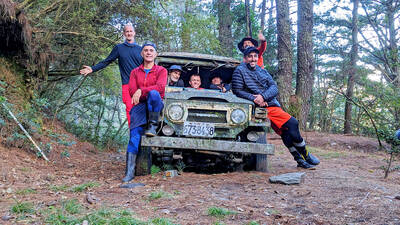
The year was 1991. A Toyota Land Cruiser set out on a 67km journey up the Junda Forest Road (郡大林道) toward an old loggers’ camp, at which point the hikers inside would get out and begin their ascent of Jade Mountain (玉山). Little did they know, they would be the last group of hikers to ever enjoy this shortcut into the mountains. An approaching typhoon soon wiped out the road behind them, trapping the vehicle on the mountain and forever changing the approach to Jade Mountain. THE CONTEMPORARY ROUTE Nowadays, the approach to Jade Mountain from the north side takes an

Last week Joseph Nye, the well-known China scholar, wrote on the Australian Strategic Policy Institute’s website about how war over Taiwan might be averted. He noted that years ago he was on a team that met with then-president Chen Shui-bian (陳水扁), “whose previous ‘unofficial’ visit to the US had caused a crisis in which China fired missiles into the sea and the US deployed carriers off the coast of Taiwan.” Yes, that’s right, mighty Chen caused that crisis all by himself. Neither the US nor the People’s Republic of China (PRC) exercised any agency. Nye then nostalgically invoked the comical specter

Relations between Taiwan and the Czech Republic have flourished in recent years. However, not everyone is pleased about the growing friendship between the two countries. Last month, an incident involving a Chinese diplomat tailing the car of vice president-elect Hsiao Bi-khim (蕭美琴) in Prague, drew public attention to the People’s Republic of China’s (PRC) operations to undermine Taiwan overseas. The trip was not Hsiao’s first visit to the Central European country. It was meant to be low-key, a chance to meet with local academics and politicians, until her police escort noticed a car was tailing her through the Czech capital. The
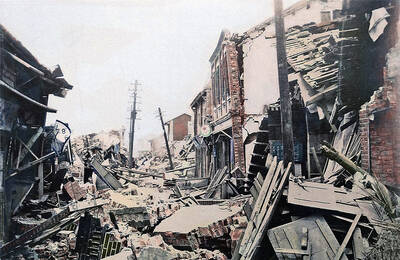
April 15 to April 21 Yang Kui (楊逵) was horrified as he drove past trucks, oxcarts and trolleys loaded with coffins on his way to Tuntzechiao (屯子腳), which he heard had been completely destroyed. The friend he came to check on was safe, but most residents were suffering in the town hit the hardest by the 7.1-magnitude Hsinchu-Taichung Earthquake on April 21, 1935. It remains the deadliest in Taiwan’s recorded history, claiming around 3,300 lives and injuring nearly 12,000. The disaster completely flattened roughly 18,000 houses and damaged countless more. The social activist and


 RSS
RSS