


As a UK general election nears, London newspapers are serving up juicy morsels from a scabrous new book on politics. The extracts, from Andrew Rawnsley’s The End of the Party, brim with men behaving badly behind the walls of the prime minister’s residence at 10 Downing Street.
The book describes how former prime minister Tony Blair held foul-mouthed shouting matches with his chancellor of the Exchequer, Gordon Brown. And how Brown, after becoming prime minister, stalked No. 10 in a black rage, throwing solid objects as well as injurious words at long-suffering aides.
The fact that Rawnsley is a political columnist for the left-leaning Observer makes things worse. Should Labour lose the election, the book could prove a sordid epitaph to 13 years in power, which began with Blair’s landslide victory in 1997.
Leftists at the time viewed Blair as a Christ-like figure sent to banish the satanic era of Margaret Thatcher. Yet he was never a true man of the left, and his conservative instincts soon showed.
In touchy-feely speeches worthy of Princess Diana, he fretted about the chasm between rich and poor but did little to close the gap. Nor was he in any hurry to complete the reform of the House of Lords, a risibly dated institution where ancient bloodstock continue to lord it over humbler citizens.
Like some modish monarch, a tieless and jacketless Blair dispensed decisions from a sofa in No. 10, surrounded by cronies, notably his neurotic press officer, Alastair Campbell. Meanwhile the civil service, an ornament of the British constitution famed for its neutrality, was downgraded and ignored, Rawnsley shows.
Least socialist of all was Blair’s religion — or religiosity, as it has been called. It helped Blair to overcome his horror at the election of US President George W. Bush, inspired a sense of mission in the War on Terror, and enabled him to say he would answer to his Maker for the deaths in Iraq.
The invasion terminally soured the easygoing atmosphere on Downing Street. Brown’s un-sunny disposition didn’t help, creating “a depressive, introverted, dysfunctional coterie,” as one No. 10 official puts it in the book. Brown was seen as a disaster — a gloomy, nail-biting intellectual and master of emotional malapropisms.
“Enjoy the rest of the summer,” the book quotes him as saying while waving goodbye to troops in Afghanistan.
Rawnsley is nonetheless generous on Brown’s role in stabilizing the world economy, as was US President Barack Obama, who spoke of Brown’s “energy, leadership and initiative.” Never mind if the cure meant turning his own principles on their head and spending billions of pounds he didn’t possess.
“The man who put Adam Smith on the banknotes became a born-again Keynesian,” Rawnsley says.
Political junkies will relish this gossipy, entertaining saga. The public will find it less amusing, I suspect. This is a book about British politics that, strangely enough, tells you nothing about Britain. Sexual and other scandals are generously covered, yet mass immigration, which for good or ill has transformed the country, gets less than a page.
Other social issues scarcely feature. After massive new spending on the overstretched health service, deaths from the drug-resistant MRSA superbug remain higher and cancer cures lower than elsewhere in Europe. Expenditure on education has doubled, yet more parents than ever send their children to private schools. As the rise of the old Etonian clique around Conservative leader David Cameron illustrates, social mobility has actually gone into reverse under Labour.
None of this stopped New Labour from echoing Tory boasts that Britain had regained its greatness, with London as the center of the world and its financial district, the City, as the country’s turbocharged engine.
“There’s nothing in the world to rival it,” crowed New Labour’s architect, Peter [now Lord] Mandelson.
And so the national hubris continued. The Conservatives had liberated the City’s energies, and Brown had supposedly abolished boom-and-bust economics, inaugurating a golden era of growth. Warnings about public spending and personal debt were denounced as doom-mongering.
Seldom has a generation of politicians of all persuasions gotten things so stunningly and comprehensively wrong. It’s not just New Labour, but an entire era of national self-delusion that is crashing and grinding to a close.


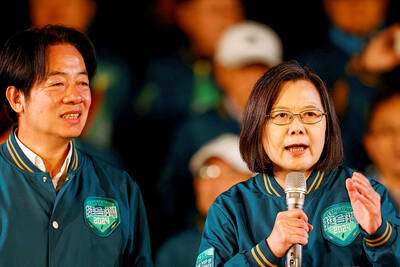
Last week Joseph Nye, the well-known China scholar, wrote on the Australian Strategic Policy Institute’s website about how war over Taiwan might be averted. He noted that years ago he was on a team that met with then-president Chen Shui-bian (陳水扁), “whose previous ‘unofficial’ visit to the US had caused a crisis in which China fired missiles into the sea and the US deployed carriers off the coast of Taiwan.” Yes, that’s right, mighty Chen caused that crisis all by himself. Neither the US nor the People’s Republic of China (PRC) exercised any agency. Nye then nostalgically invoked the comical specter
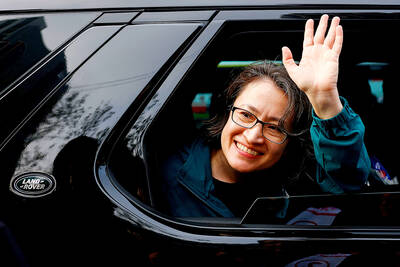
Relations between Taiwan and the Czech Republic have flourished in recent years. However, not everyone is pleased about the growing friendship between the two countries. Last month, an incident involving a Chinese diplomat tailing the car of vice president-elect Hsiao Bi-khim (蕭美琴) in Prague, drew public attention to the People’s Republic of China’s (PRC) operations to undermine Taiwan overseas. The trip was not Hsiao’s first visit to the Central European country. It was meant to be low-key, a chance to meet with local academics and politicians, until her police escort noticed a car was tailing her through the Czech capital. The
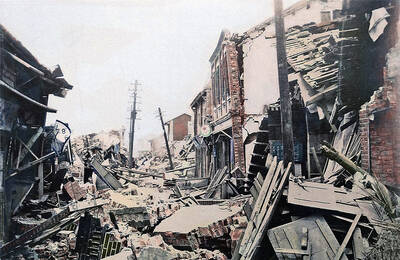
April 15 to April 21 Yang Kui (楊逵) was horrified as he drove past trucks, oxcarts and trolleys loaded with coffins on his way to Tuntzechiao (屯子腳), which he heard had been completely destroyed. The friend he came to check on was safe, but most residents were suffering in the town hit the hardest by the 7.1-magnitude Hsinchu-Taichung Earthquake on April 21, 1935. It remains the deadliest in Taiwan’s recorded history, claiming around 3,300 lives and injuring nearly 12,000. The disaster completely flattened roughly 18,000 houses and damaged countless more. The social activist and

Over the course of former President Ma Ying-jeou’s (馬英九) 11-day trip to China that included a meeting with Chinese Communist Party (CCP) leader Xi Jinping (習近平) a surprising number of people commented that the former president was now “irrelevant.” Upon reflection, it became apparent that these comments were coming from pro-Taiwan, pan-green supporters and they were expressing what they hoped was the case, rather than the reality. Ma’s ideology is so pro-China (read: deep blue) and controversial that many in his own Chinese Nationalist Party (KMT) hope he retires quickly, or at least refrains from speaking on some subjects. Regardless


 RSS
RSS