


at least one amusing new metric, Michelangelo’s unofficial 500-year run at the top of the Italian art charts has ended. Caravaggio, who somehow found time to paint when he wasn’t brawling, scandalizing pooh-bahs, chasing women (and men), murdering a tennis opponent with a dagger to the groin, fleeing police assassins or getting his face mutilated by one of his many enemies, has bumped him from his perch.
That’s according to an art historian at the University of Toronto, Philip Sohm. He has studied the number of writings (books, catalogs and scholarly papers) on both of them during the last 50 years. Sohm has found that Caravaggio has gradually, if unevenly, overtaken Michelangelo.
He has charts to prove it.
The change, most obvious since the
mid-1980s, doesn’t exactly mean Michelangelo has dropped down the memory hole. To judge from the throngs still jamming the Sistine Chapel and lining up outside the Accademia in Florence to check out David, his popularity hasn’t dwindled much.
But, charts or no charts, Sohm has touched on something. Caravaggiomania, as he calls it, implies not just that art history doctoral students may finally be struggling to think up anything fresh to say about Michelangelo. It suggests that the whole classical tradition in which Michelangelo was steeped is becoming ever more foreign and therefore seemingly less germane, even to many educated people. His otherworldly muscle men, casting the damned into hell or straining to emerge from thick blocks of veined marble, aspired to an abstract and bygone ideal of the sublime, grounded in Renaissance rhetoric, which, for postwar generations, now belongs with the poetry of Alexander Pope or plays by Corneille as admirable but culturally remote splendors.
Caravaggio, on the other hand, exemplifies the modern antihero, a hyperrealist whose art is instantly accessible. His doe-eyed, tousle-haired boys with puffy lips and bubble buttocks look as if they’ve just tumbled out of bed, not descended from heaven. Coarse not godly, locked into dark, ambiguous spaces by a strict geometry then picked out of deep shadow by an oracular light, his models come straight off the street. Cupid is clearly a hired urchin on whom Caravaggio strapped a pair of fake wings. The angel in his Annunciation dangles like Chaplin’s tramp on the high wire in The Circus, from what must have been a rope contraption Caravaggio devised.
Rome’s art establishment at the turn of the 17th century, immersed in the mandarin froufrou of Late Mannerism, despised Caravaggio for the filthy, barefoot pilgrims he painted at Mary’s doorstep. Out to “destroy painting,” as Nicolas Poussin, the most high-minded of all French artists, saw it, Caravaggio connected with ordinary people, the ones who themselves arrived barefoot and filthy as pilgrims in Rome. And fortunately for Caravaggio, he also appealed to a string of rich and powerful patrons.
But almost immediately after he died from a fever at 38, in 1610, on the beach at Porto Ercole, north of Rome, his art was written off by critics as a passing fad and neglected for hundreds of years, setting the stage for his modern resurrection. Connoisseurs like Bernard Berenson were still dismissing his work a century ago when Lionello Venturi, Roger Fry and Roberto Longhi, among others, finally revived his reputation as a protomodernist.
Sohm, who announced his findings during a talk at the College Art Association conference in Chicago last month, focused on publications, not tourist revenues or exhibition attendance figures, and his study says nothing about how Michelangelo and Caravaggio stack up against box-office greats like Rembrandt and Van Gogh.
But his research does corroborate evidence plain to anybody in or out of art academe or who has browsed for scarves in Italian airports where motifs of Caravaggio’s Bacchus and head of Goliath have become as ubiquitous as coasters bearing bits of David’s anatomy and mugs with the figure of Adam from the Sistine ceiling. Caravaggios are now used to decorate the cover of Emerging Infectious Diseases, a medical journal, and to advertise a sex shop in London.
“The only way to understand old art is to make it participate in our own artistic life,” is how Venturi phrased it in 1925. That Caravaggio left behind no drawings, no letters, no will or estate record, only police and court records, makes him a perfect Rorschach for our obsessions. He was outed in the 1970s by gender studies scholars, notwithstanding the absence of documents to indicate he was gay. Pop novelists and moviemakers have naturally had a field day with his life. Exhibition organizers cook up any excuse (“Caravaggio-Bacon,” “Caravaggio-Rembrandt”) to capitalize on his bankability. Newly discovered “Caravaggios” test the market every year.
Not long ago, two Caravaggios turned up in the French village of Loches in the Loire Valley, under the organ loft of a local church. Never mind that various Caravaggio experts have since doubted the pictures are by him: Loches is advertising itself as a Caravaggio town.
And officials in Porto Ercole lately said his lost remains had been found in an underground ossuary, pending DNA tests with descendants of his brother, who still live near Milan. The iconoclast is even being turned into a religious icon, it seems: Caravaggio’s “bones” may soon become holy relics for art pilgrims.
Another Caravaggio retrospective has also opened, here at the Quirinale: two dozen paintings, on view through June 13, a blue-chip survey, installed ridiculously in darkened rooms with spotlights, as if his art needed more melodrama. But the pictures are glorious anyway. The exhibition is mobbed.
It happens that a show of Michelangelo’s drawings is at the Courtauld Gallery in London, through May 16. Gifts for a beautiful young Roman nobleman, Tommaso de’ Cavalieri, on whom Michelangelo had developed a crush, the drawings were ostensibly supposed to help Cavalieri learn to draw. Imagine Roger Federer handing you a DVD of himself at Wimbledon, saying “Just do this.” These are drawings of the most arcane refinement, unearthly beautiful.
By contrast, Caravaggio, wrestling art back to the ground, distilled scenes into a theatrical instant at which time seems suddenly stopped. That’s why his pictures can bring to mind movie stills. The art historian Michael Fried, who has just written a book about Caravaggio, notes the quality of the figures’ absorption. Life-size images, they share our space and we theirs, face to face, as another art historian, Catherine Puglisi, has pointed out (something that doesn’t happen with Michelangelo’s enormous sculptures or his frescoed ceiling that we only see from far away). The immediacy somehow dovetails with the tabloid tawdriness of his biography, with the whole modern celebrity drama.
The other afternoon endless scrums of tourists here jostled before the Caravaggios in the Church of San Luigi dei Francesi and the Basilica of Santa Maria del Popolo, feeding pocket change into the boxed light meters. It was probably just coincidental, but in the Church of Santa Maria sopra Minerva, nobody stopped to look at the Michelangelo.


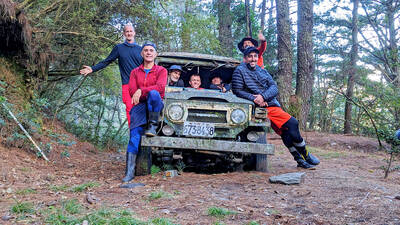
The year was 1991. A Toyota Land Cruiser set out on a 67km journey up the Junda Forest Road (郡大林道) toward an old loggers’ camp, at which point the hikers inside would get out and begin their ascent of Jade Mountain (玉山). Little did they know, they would be the last group of hikers to ever enjoy this shortcut into the mountains. An approaching typhoon soon wiped out the road behind them, trapping the vehicle on the mountain and forever changing the approach to Jade Mountain. THE CONTEMPORARY ROUTE Nowadays, the approach to Jade Mountain from the north side takes an
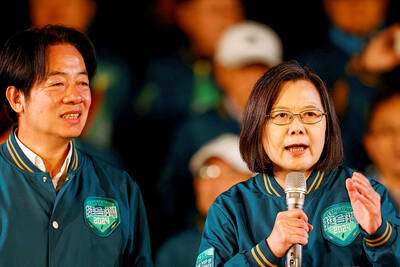
Last week Joseph Nye, the well-known China scholar, wrote on the Australian Strategic Policy Institute’s website about how war over Taiwan might be averted. He noted that years ago he was on a team that met with then-president Chen Shui-bian (陳水扁), “whose previous ‘unofficial’ visit to the US had caused a crisis in which China fired missiles into the sea and the US deployed carriers off the coast of Taiwan.” Yes, that’s right, mighty Chen caused that crisis all by himself. Neither the US nor the People’s Republic of China (PRC) exercised any agency. Nye then nostalgically invoked the comical specter
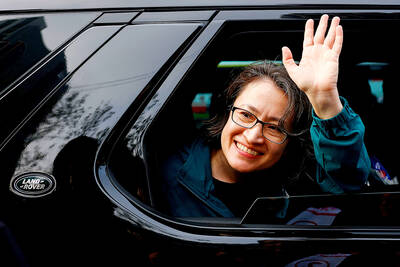
Relations between Taiwan and the Czech Republic have flourished in recent years. However, not everyone is pleased about the growing friendship between the two countries. Last month, an incident involving a Chinese diplomat tailing the car of vice president-elect Hsiao Bi-khim (蕭美琴) in Prague, drew public attention to the People’s Republic of China’s (PRC) operations to undermine Taiwan overseas. The trip was not Hsiao’s first visit to the Central European country. It was meant to be low-key, a chance to meet with local academics and politicians, until her police escort noticed a car was tailing her through the Czech capital. The
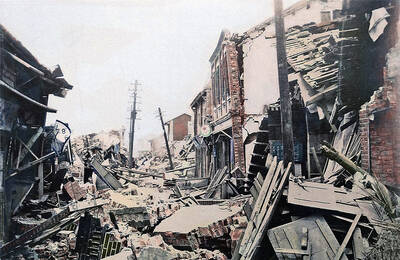
April 15 to April 21 Yang Kui (楊逵) was horrified as he drove past trucks, oxcarts and trolleys loaded with coffins on his way to Tuntzechiao (屯子腳), which he heard had been completely destroyed. The friend he came to check on was safe, but most residents were suffering in the town hit the hardest by the 7.1-magnitude Hsinchu-Taichung Earthquake on April 21, 1935. It remains the deadliest in Taiwan’s recorded history, claiming around 3,300 lives and injuring nearly 12,000. The disaster completely flattened roughly 18,000 houses and damaged countless more. The social activist and


 RSS
RSS