


The global economy needs it. Nations laid their foundations upon it. It has yielded untold riches. But it has also proven a ruinous curse: wars have been declared over it; tyrants and corporate greed have thrived on it; and lives and nature have been ravaged — often irreparably — by it. Oil.
It’s running out, quicker than we thought, New York Times Magazine contributing reporter Peter Maass argues in Crude World. But after reading his expose of the evils, intended or otherwise, of the oil industry, this development might not be such a bad thing.
In this highly entertaining investigation, Maass, whose previous book was about war in the Balkans, takes us from the palatial oil ministries of the Middle East to the heart of darkness in Equatorial Guinea, with stops in the war-ravaged streets of Iraq, the militia-infested jungles of the Niger Delta, a cut-throat, spy-infested hotel in Baku, Azerbaijan, and the environmental catastrophe in Ecuador’s Oriente.
No less fascinating are the individuals we meet who are caught in the unforgiving wheels of the oil industry. We meet jet-setting star attractions like Saudi Oil Minister Ali al-Naimi, who reassures an audience in Washington that Saudi Arabia’s oil reserves are plentiful; and Matthew Simon, a former adviser to former US president George W. Bush who would very much be part of the oil nomenklatura were it not for his belief that “the American dream and the world as we know it are on the verge of falling apart” because Naimi is wrong. Guerrilla leaders, crusading lawyers, oil executives from all the best-known oil giants and ordinary soldiers, all get sucked in by the folly of oil, and Maass provides us an intimate portrait of their motivations. The full spectrum of emotions, from greed to fear, alienation to desire, inhabit this bizarre world; appropriately, they are used as titles for each section. (Interestingly, almost every person we meet is male, which, from a sociological perspective, says
a lot about the
oil sector.)
Page after page, greed is joined at the hip with tragedy and human suffering as dictators like President Teodoro Oniang of Equatorial Guinea — possibly “the most brutalized country on Earth” — plunder their countries, often with the assistance of Big Oil and the West. In Oniang’s case, the plunder (he bought, for US$55 million, a Boeing 737 that comes with gold-plated bathroom fixtures) and laundering was facilitated by an unscrupulous little bank in Washington called
Riggs Bank.
Next on the list is Nigeria, which, though it is the world’s eighth-largest oil exporter, fares little better. Despite more than US$400 billion in oil revenues in recent decades, nine out of 10 Nigerian live on less than US$2 a day and one child out of five dies before the age of five. Eighty percent of oil wealth in Nigeria, the World Bank tells us, has gone to 1 percent of the population. (In Nigeria and elsewhere, oil firms often do not hire locals to do construction or other menial jobs, and import construction material rather than purchase it locally.)
Decades of low-intensity warfare — the result of this criminally inequitable distribution of wealth and severe environmental damage — and tens of thousands of deaths later, the Niger Delta is no closer today to resolution than it was half a century ago. In fact, new, increasingly violent groups such as the Movement for the Emancipation of the Niger Delta (MEND), are emerging and promise decades of nothing but violence.
As Maass argues, if most of the world’s oil reserves were located in developed and stable countries like Norway and Canada, where corruption is low and rule of law well-established, oil would not be such a debilitating commodity. But sadly for its victims — many of whom we meet in this book —
fate, or geography, would have
it otherwise.
In many of the cases explored, oil-rich countries suffer from what has come to be known as the “Dutch disease,” which can be roughly characterized as a country’s over-reliance on a single or a handful of primary resources for its revenues. In other words, even when oil wealth isn’t plundered, the sudden influx of money generated by the discovery oil can, in the long term, turn into a curse (another unfortunate consequence of the Dutch disease is that the large revenue created by the primary resource tends to drive up the currency, which makes locally produced goods more expensive for export and can consequently wipe out other sectors of the economy).
Countries with an over-reliance on oil, such as Saudi Arabia and Venezuela, among others, will often embark on massive and hugely expensive infrastructure projects (or, as in Venezuela’s case, a Bolivarian revolution fueled by oil money). As long as oil prices are relatively high, they will be able to afford it. But as the recent global financial crisis so painfully showed us, when the economy slows down, so does oil consumption and demand, which drives prices down. The result? A fabulous airport in the Saudi desert has turned into a hollow castle in the sand, and schemes similar to ones that foundered years ago are being unleashed by Venezuelan President Hugo Chavez.
Despite the utterly depressing tone of the first 200 pages, Crude World concludes on a more optimistic — if perhaps a little naive — note, with mention of the opportunities created by renewable energy and programs, such as Publish What You Pay, to encourage governments and oil firms to become more transparent. Whether these would be sufficient to diminish our dependence on oil and bring good governance to Big Oil and oil-inebriated governments, however, remains to be seen and will be contingent on human nature’s ability to transcend its most basic desires. Maass’ book does little to convince us that this is possible.
Crude World is a great read, but would have been more complete if it had had a section on the impact that China’s entry in the oil business — especially in Africa — will have on those countries both fortunate and unfortunate enough to have rivers of black gold flowing through their veins.



In late October of 1873 the government of Japan decided against sending a military expedition to Korea to force that nation to open trade relations. Across the government supporters of the expedition resigned immediately. The spectacle of revolt by disaffected samurai began to loom over Japanese politics. In January of 1874 disaffected samurai attacked a senior minister in Tokyo. A month later, a group of pro-Korea expedition and anti-foreign elements from Saga prefecture in Kyushu revolted, driven in part by high food prices stemming from poor harvests. Their leader, according to Edward Drea’s classic Japan’s Imperial Army, was a samurai

Located down a sideroad in old Wanhua District (萬華區), Waley Art (水谷藝術) has an established reputation for curating some of the more provocative indie art exhibitions in Taipei. And this month is no exception. Beyond the innocuous facade of a shophouse, the full three stories of the gallery space (including the basement) have been taken over by photographs, installation videos and abstract images courtesy of two creatives who hail from the opposite ends of the earth, Taiwan’s Hsu Yi-ting (許懿婷) and Germany’s Benjamin Janzen. “In 2019, I had an art residency in Europe,” Hsu says. “I met Benjamin in the lobby
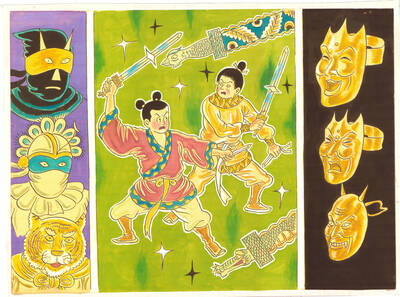
April 22 to April 28 The true identity of the mastermind behind the Demon Gang (魔鬼黨) was undoubtedly on the minds of countless schoolchildren in late 1958. In the days leading up to the big reveal, more than 10,000 guesses were sent to Ta Hwa Publishing Co (大華文化社) for a chance to win prizes. The smash success of the comic series Great Battle Against the Demon Gang (大戰魔鬼黨) came as a surprise to author Yeh Hung-chia (葉宏甲), who had long given up on his dream after being jailed for 10 months in 1947 over political cartoons. Protagonist

Peter Brighton was amazed when he found the giant jackfruit. He had been watching it grow on his farm in far north Queensland, and when it came time to pick it from the tree, it was so heavy it needed two people to do the job. “I was surprised when we cut it off and felt how heavy it was,” he says. “I grabbed it and my wife cut it — couldn’t do it by myself, it took two of us.” Weighing in at 45 kilograms, it is the heaviest jackfruit that Brighton has ever grown on his tropical fruit farm, located


 RSS
RSS