


Jane Goodall, gray in complexion but resplendent in a red shawl, is sitting on the sofa in a dimly lit room in west London. The scientist-turned-environmentalist has just arrived from Bournemouth, on the south coast of England, had a rotten journey, has a hacking cough, but accepts it all stoically, rejecting the suggestion that the heating be turned up.
She is here with her talisman, a stuffed monkey called Mr H, given to her by the blind magician Gary Haun (“the Amazing Haundini”), who thought it was a chimp. Goodall, who has a childlike quality, sees a metaphorical significance in a blind magician able to pull the wool over the eyes of the sighted. The letter H, standing for Hope, also attracts her.
The world seems to divide into people who are besotted with Goodall, and people who have barely heard of her. She is more prominent in the US, where the Jane Goodall Institute (JGI) is headquartered, than in the UK, where she was born in 1934 and where, after half a lifetime spent documenting the lives of chimpanzees in the Gombe Stream National Park overlooking Lake Tanganyika in the far west of Tanzania, she now lives once more, with her sister Judy in their old family home in Bournemouth.
Our meeting, though, takes place at an apartment in Notting Hill, west London, belonging to Mary Lewis, a JGI employee with a cut-glass English accent who appears to run Goodall’s life as if it were a military operation. The trigger is a book Goodall has written with two fellow environmentalists: a collection of stories of survival called Hope for Animals and Their World, the written-by-committee feel of which must of course be forgiven because of its subject matter.
Even I, an intermittent eco-worrier, was moved by the battle to save the California condor, and I feel doubly guilty for criticizing the book because at the end of the interview she insists on signing it for me: “For Stephen. Together we can make this a better world for all. Thank you for helping.” Can is underlined, all is both underlined and capitalized.
These days, in her mid-70s, Goodall is more shaman than scientist. She has set aside a planned companion volume to her seminal study The Chimpanzees of Gombe, and instead tours the world preaching the need for sustainability, harmony and respect for the natural world (this makes me worry about the size of her carbon footprint).
It was in 1986 that, at a conference on chimps, she realized the extent of the crisis affecting them across Africa and determined, overnight it seems, on a life as an environmental evangelist. One journalist who has followed her career likens her to a “peripatetic Mother Teresa,” and it’s a good description: she combines stateliness with a kind of holiness, her religion a predominantly green one.
The message of her new book, with its stories about black-footed ferrets, American crocodiles and whooping cranes, is surprisingly upbeat. “My job seems to have increasingly become giving people hope, so that instead of doing nothing and sinking into depression, they take action,” she tells me. “It’s very clear to me that unless we get a critical mass of people involved in trying to create a better world for our great-grandchildren, we’d better stop having children altogether.”
FIGHTING THE GOOD FIGHT
Goodall has chosen to focus on the heroes fighting — and occasionally winning — individual battles, in the hope of attracting others to participate in a war she does not yet accept is lost. “I’ve seen areas totally despoiled that have been brought back to life. Animals that were almost gone have, with captive breeding or protection in the wild, been given another chance. If we stop now, everything’s going to go. So we have to keep on doing our best for as long as we can, and if we’re going to die, let’s die fighting.” The apocalypse is conjured up in a croaky and curiously detached monotone.
Do governments understand the scale of the crisis? Goodall argues that many are still in hock to “dark forces” — vested interests such as the fossil fuel industry and agribusiness. Politicians, she says, should stop parroting the myth of limitless expansion. “Unlimited economic growth on a planet of finite resources is not possible; it doesn’t make sense. I thought this financial crisis would help people realize that, but it seems very much like, ‘Oh, let’s get back to business as usual.’”
Much of her evangelizing is directed at the young. Her institute — already set up to protect chimps and their habitats almost 10 years before that Damascene moment in 1986 — has a dynamic youth wing called Roots and Shoots, which started in 1991 when 16 young Tanzanians met on the porch of her home in Dar es Salaam to discuss environmental issues affecting their lives. Twenty years later, there are groups in 114 countries, with hundreds of thousands of youngsters involved in community projects. After a slow start, it has taken off in the UK in the past couple of years, with 700 groups now participating. But apart from the HQ in Arlington, Virginia, which has 20-plus staff, most of the JGIs that coordinate these projects are shoestring operations, and the institute has been hit hard by the credit crunch. “We’re in a financial hole in the US because of the downturn,” Goodall admits. “Money that should have come in has been cut.”
The organization had just held a meeting in Belgium to discuss how to dig itself out, and one priority is to recruit an executive director. Is that recognition of a time when someone needs to take over from her? “Of course,” Goodall says. “It will probably be a collection of four people taking over from me.” Despite the holiness, she is not guilty of false modesty.
The institute today is not just concerned with her beloved chimps. “To me, it was obvious to grow from wild chimps to saving their forest to seeing about their conditions in captivity to working with local people and kids,” she says. “You can kill yourself saving forests and chimps, but if new generations aren’t going to be better stewards there’s no point. That’s why I’m so passionate about Roots and Shoots.”
Until the 1986 conference, she had assumed she would spend her life studying chimps. “It was wonderful out in the forest collecting data and analyzing it, giving a few lectures, writing books.” In her 1999 book, Reason For Hope: A Spiritual Journey, she says that as a Bible-reading teenager, she “fantasized about becoming a martyr.” In a way she has achieved that ambition, sacrificing the paradise of Gombe for a succession of airport lounges.
When I ask if she is still a Christian, she gives a somewhat ambiguous answer. “I suppose so; I was raised as a Christian.” She says she sees no contradiction between evolution and a belief in God. Nor does she blame the Bible and the idea in Genesis that man has dominion over plants and animals for our exploitation of the natural world (she says “dominion” is a mistranslation, what is meant is “stewardship”). These might seem academic points, but they may be key to understanding her transition from scientist to eco-evangelist — and the resonance of her message in the more spiritually aware US.
“I realized that my experience in the forest, my understanding of the chimpanzees, had given me a new perspective,” she writes. “I was utterly convinced there was a great spiritual power that we call God, Allah or Brahma, although I knew, equally certainly, that my finite mind could never comprehend its form or nature.”
This year is significant for Goodall and her institute, marking 50 years since she began studying chimps at Gombe. As well as the new book, there will be a BBC documentary in the spring and a German-made film, Jane’s Journey, to be premiered at Cannes, in which Angelina Jolie has a walk-on part. It is indeed a remarkable journey, from a middle-class home in Bournemouth to secretarial work in London and then, thanks to the patronage of paleontologist Louis Leakey, to Gombe and beyond.
“I loved animals as a child, read the Tarzan books, and decided at the age of 11 that I would go to Africa, live with animals and write books about them,” she says. “Everybody laughed at me except my amazing mother, who said, ‘If you work hard and really want something and never give up, you will find a way.’”
In 1957, after earning the money for the boat fare by working as a waitress and a secretary, Goodall went on an extended visit to a schoolfriend in Kenya. Someone suggested she get in touch with Leakey, a formidable figure who was then curator of the Coryndon museum of natural history in Nairobi. He barked at her down the telephone when she called on spec, but she kept her nerve, got an appointment to see him, was given an admin job and, in 1960, was given the chance to move to Gombe to start collecting data on chimps. Leakey also dispatched Dian Fossey to Rwanda to study gorillas and Birute Galdikas to Borneo to observe orangutans; the three women were patronizingly known as Leakey’s angels or Leakey’s trimates, but each made significant contributions to primatology.
LEARNING ON THE JOB
What did Leakey see in Goodall that made him choose her for Gombe? “I think he was amazed that a young girl straight out from England with no university degree knew so much,” she says. “I’d spent hours in the Natural History Museum in London, and could answer most of his questions.”
Goodall had planned to spend only a year in Africa but was there more than 30. She still has a home in Dar es Salaam, and makes the long trek to Gombe when she can. She learned her science in the field, but Leakey was keen for her to get academic training and, in the mid-60s, she did a PhD at Cambridge in ethology, the study of animal behavior. She needed the qualification to counter critics who attacked her approach as unscientific and anthropomorphic — she gave the chimps she studied names, and prided herself on getting to know them as individuals.
“I was told at Cambridge I shouldn’t have named the chimps and that they should have had numbers,” she says. “I wasn’t allowed to talk about them having personalities, and certainly not about them thinking or having emotions. But then I thought back to my childhood teacher who taught me that this wasn’t true — my dog.”
The scale of Goodall’s observational data eventually silenced her critics. She was the first scientist to observe an animal, her favorite chimp David Greybeard, not just using a tool (a stem of grass poked into a termites’ nest to dig out the insects) but fashioning it for that purpose. When she telegraphed a report of what she had seen to Leakey, he replied: “Ah! Now we must redefine man, redefine tool, or accept chimpanzees as human.”
We haven’t quite accepted chimps as human, but the work showed that the distance from one to the other was far less than previously thought. In his introduction to a revised edition of Goodall’s most famous book, In the Shadow of Man, the biologist Stephen Jay Gould called her work “one of the western world’s great scientific achievements.”
In 1964, she married the Dutch-born wildlife photographer Hugo van Lawick, and their son (also called Hugo but known as Grub) was born three years later. In her books there are several sweet pictures of Grub growing up at Gombe, but the relationship of mother and son has not always been smooth. At one point he was engaged in commercial fishing, of which she as a committed vegetarian disapproved, but is now developing an eco-tourist project in Tanzania and they are getting on much better. (Goodall and Van Lawick divorced in 1974 and she married Derek Bryceson, director of national parks in Tanzania who died of cancer in 1980.)
Is she one of those naturalists, as Fossey supposedly was in her dark final years, who prefers animals to people? “I’m not one of those people who says let me go and live with chimps for ever or dogs for ever,” she says. “I certainly prefer a lot of animals to a lot of people, but then I prefer some people to some animals too.”
And does she miss the chimps? “All the chimps I knew so well have gone now,” she says sadly. “Fifi, the last of the real old-timers, died four years ago. It’s not the same as it was.” But she still enjoys returning to Gombe. “When I get up on to my peak where I sat for so long, I can get back into the skin I had and remember what it felt like — the excitement of never quite knowing what you’d see and what you’d find.”



Last week Joseph Nye, the well-known China scholar, wrote on the Australian Strategic Policy Institute’s website about how war over Taiwan might be averted. He noted that years ago he was on a team that met with then-president Chen Shui-bian (陳水扁), “whose previous ‘unofficial’ visit to the US had caused a crisis in which China fired missiles into the sea and the US deployed carriers off the coast of Taiwan.” Yes, that’s right, mighty Chen caused that crisis all by himself. Neither the US nor the People’s Republic of China (PRC) exercised any agency. Nye then nostalgically invoked the comical specter
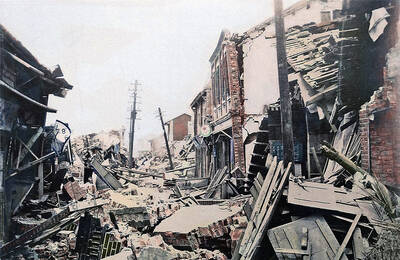
April 15 to April 21 Yang Kui (楊逵) was horrified as he drove past trucks, oxcarts and trolleys loaded with coffins on his way to Tuntzechiao (屯子腳), which he heard had been completely destroyed. The friend he came to check on was safe, but most residents were suffering in the town hit the hardest by the 7.1-magnitude Hsinchu-Taichung Earthquake on April 21, 1935. It remains the deadliest in Taiwan’s recorded history, claiming around 3,300 lives and injuring nearly 12,000. The disaster completely flattened roughly 18,000 houses and damaged countless more. The social activist and

Over the course of former President Ma Ying-jeou’s (馬英九) 11-day trip to China that included a meeting with Chinese Communist Party (CCP) leader Xi Jinping (習近平) a surprising number of people commented that the former president was now “irrelevant.” Upon reflection, it became apparent that these comments were coming from pro-Taiwan, pan-green supporters and they were expressing what they hoped was the case, rather than the reality. Ma’s ideology is so pro-China (read: deep blue) and controversial that many in his own Chinese Nationalist Party (KMT) hope he retires quickly, or at least refrains from speaking on some subjects. Regardless

Approaching her mid-30s, Xiong Yidan reckons that most of her friends are on to their second or even third babies. But Xiong has more than a dozen. There is Lucky, the street dog from Bangkok who jumped into a taxi with her and never left. There is Sophie and Ben, sibling geese, who honk from morning to night. Boop and Pan, both goats, are romantically involved. Dumpling the hedgehog enjoys a belly rub from time to time. The list goes on. Xiong nurtures her brood from her 8,000 square meter farm in Chiang Dao, a mountainous district in northern Thailand’s


 RSS
RSS