


When lawyer Theresa Chu (朱婉琪) and three other Taiwanese filed for a judicial review in 2003 after the immigration authority blocked them from entering Hong Kong, they hoped to prove that the government had discriminated against them on the basis of religion — namely, Falun Gong, the spiritual movement banned in mainland China, but not Hong Kong.
Chu and her co-applicants were among 80 Taiwanese denied entry to Hong Kong in February 2003, when they planned to attend a Falun Gong conference. Although they held valid visas, immigration officers stopped them at Hong Kong International Airport and put them on return flights to Taiwan.
The applicants in Chu Woan-chyi and others v. Director of Immigration believe pressure from China was behind the incident. But under the “one country, two systems” model, Hong Kong’s government agencies should follow Hong Kong law, under which Falun Gong is legal — and discrimination on the basis of religion is not. The immigration authority denies the group’s religious affiliation played a role in its decision, claiming instead that the Taiwanese in question posed “security risks to the HKSAR [Hong Kong Special Administrative Region].”
Six weeks after being denied entry, Chu and three others launched a court battle that lasted six-and-a-half years. On Sept. 4, they lost the latest round and chose not to appeal, having lost hope of a victory.
But they did not lose over the question of whether immigration authorities wrongfully barred their entry. In fact, the Court of Appeal of the High Court of Hong Kong didn’t even answer that question.
Instead, the ruling focused on the legal principle known as the duty of candor.
When the legality of a government action is being tested in court, the government, under the duty of candor, has an obligation to be honest with the court and provide it with the evidence needed to scrutinize its actions. But in Chu Woan-chyi and others v. Director of Immigration, the government breached that duty, the Court of Appeal judges ruled on Sept. 4, and left the court with no evidence to reach a conclusion — something the presiding judge called “a most extraordinary state of affairs.”
The Court of Appeal’s judgment seems at first to be a scathing censure of the government’s behavior in the case — but it is a ruling with a surprise twist that has legal watchdog Hong Kong Human Rights Monitor concerned that the government has ultimately benefited from flouting its obligation.
Chu’s case started at the Court of First Instance of the High Court, directly under the Court of Appeal. To review the Immigration Department’s actions, the court needed documentation detailing why the plaintiffs were repatriated in 2003 — documents it never received. The department cited “security risks” for blocking the plaintiffs’ entry to Hong Kong, but did not provide documents supporting this assertion.
The court nevertheless ruled in the government’s favor, finding that Chu and her fellow plaintiffs failed to prove religious discrimination.
The case took a different turn at the Court of Appeal. The judges, led by Chief Judge Geoffrey Ma (馬道立), said the government had since the case’s outset repeatedly breached its legal duty of candor, which, Ma writes in the Court of Appeal’s judgment, is crucial to “good governance, and proper and transparent administration,” and is rarely violated. Examining this breach of candor therefore became their key task, the judges wrote in their ruling.
Over dozens of pages in the Sept. 4 judgment, Ma dissects the claims made by the government agencies involved in the case — the Immigration Department, the Security Bureau and the Department of Justice — and reveals glaring contradictions.
According to the Sept. 4 judgment, over the course of the judicial review, the defense counsel gave conflicting explanations for failing to produce evidence, variously saying or leading the court to believe: that documents related to the case could not be disclosed because of their sensitivity; that the Department of Immigration had destroyed all related documents but that other government agencies still had related documents; that the other agencies had destroyed their documents as well; or that no other agencies ever had any documents related to the case. (No government officials appeared in court. Their lawyer received instructions from them in writing and at times presented written statements from them.)
In a phone interview, Hong Kong legislator Albert Ho (何俊仁), chairman of the Democratic Party, recounted the requests made by his law firm Ho, Tse, Wai & Partners (which represented Chu and the others at the Court of First Instance) that the government submit evidence in the case — something that should not have been necessary because, as Ma notes in the Court of Appeal’s judgment, “the respondent [government] in such proceedings is expected to, and usually does, discharge its duty of candour.”
“In the Court of First Instance we pressed quite hard for discovery [compulsory disclosure of evidence], but the government did not give a candid answer. In fact, it gave inconsistent explanations,” said Ho, who himself was denied entry to Macau last December for unclear reasons when he planned to observe a demonstration there.
“Sometimes [the defense counsel] said the [evidence] was in files held by the Immigration Department and other government departments, and that this matter [the security risks posed by the plaintiffs] was known to officials at high levels,” Ho said. But when pressed for the documents, the counsel eventually “said the files had all been destroyed.”
At the last hearing at the Court of First Instance on March 8, 2007, the presiding judge expressed dismay and incredulity at the government’s failure to submit hard evidence.
“Is it credible that suddenly all the Government files and papers have been washed clean?” the judge asked.
The answer, according to the defense, was yes.
The defense counsel returned from the lunch break to say he had consulted “the highest level of those responsible,” and that all documents at all government agencies related to the incident had been destroyed four years earlier, before the case had even reached court.
Court of First Instance Judge Michael Hartmann asked: “Why did we have to go through all of this in the first place then? Why not simply have said [back then]: all of this material ... it’s destroyed.”
But, Ma notes in the Court of Appeal’s judgment, officials from the Department of Immigration and the Security Bureau submitted affidavits claiming that the four Taiwanese posed “security risks.” What did they base their knowledge on if not documents, he wonders.
Ma also says the government repeatedly implied documents existed by declining to disclose them without any “intimation of the non-existence of relevant documents.” For example, the court had been told earlier that documents in the case were too sensitive to show the court — a claim called “public interest immunity.”
Even if the documents had been destroyed, as claimed in March 2003, there is cause for concern. In Hong Kong, the legality of a government action may be appealed in court up to three months after that action. This destruction date would mean potential court evidence was eliminated well before the deadline for seeking judicial review.
Ma’s conclusion is straightforward:
“[T]he duty of candour has been breached,” he writes. “Even to this day, over six years since the date the 4 Applicants were denied entry, it is still unclear just what was the basis for this statement [that they posed security risks], nor is it clear as to whether any documents exist to support it. It is a most extraordinary state of affairs.”
Ironically, although the judges ruled that the government breached the duty of candor, they still found in its favor. Yet in Hong Kong’s legal system, if the government breaches the duty of candor, the court is expected to rule against it because it hindered the investigation.
“Normally, where the duty of candour has been breached in such a way in relation to the disclosure and presentation of relevant facts, the consequence in judicial review proceedings [as in other proceedings] is that the court is entitled to draw adverse inferences,” Ma explains in the judgment.
But Ma declines to “draw adverse inferences” in this case. He cites two key reasons for finding in the government’s favor.
Ma says the Taiwanese applicants should have pushed harder for evidence in the case: “If the Applicants had conducted themselves differently by, for example, making the necessary discovery applications or applying for cross-examination of various deponents [the government officials who submitted written statements to the court], these judicial proceedings would have taken a much different course and, depending on what evidence emerged, the court may have been driven to arrive at a quite different result.”
The Taiwanese should have applied to cross-examine Acting Security Bureau Secretary Timothy Tong (湯顯明) at the Court of First Instance, Ma says.
Ma also says Ho, Tse, Wai & Partners should not have narrowed their request for documents from the government in July 2006 from all “relevant documents” to the documents that Tong and Commander of the Airport Division Choy Tak Po relied on to make statements to the court.
However, Ma ordered each side to pay its own court costs rather than making Chu and the other applicants pay the government’s legal fees. Ma says in the ruling that this is because of the government’s breach of candor.
In Hong Kong, which uses a common law system modeled on England’s (in which court precedent, not codified statutes, comprises the bulk of the law), Ma’s judgment could have lasting implications.
Considering the severity of the criticism, the ruling in the government’s favor is surprising, Ho said.
Ho called the ruling “disappointing,” but said the strength of the court’s position on candor in the ruling may still have potential for future judicial reviews.
“We look forward to using this judgment in future proceedings,” Ho said. “The judgment laid down certain benchmarks: The government should at least keep files until a case is complete [and they have] this duty of candor.”
“I hope this is intended to be a final warning to the government that next time they cannot expect to get away so easily,” he said. “But maybe this is just wishful thinking.”
Law Yuk-kai (羅沃啟), director of Hong Kong Human Rights Monitor, said the “court has adopted a very generous approach to the government.”
“It’s clear the government has breached duty of candor and destroyed papers [that could have been evidence in court], or at least lied,” Law said in a phone interview. “In those circumstances, the court is reasonably expected to rule against the government.”
Law said Ma’s reasons constituted a “very small margin” to justify ruling in the government’s favor despite a breach of candor. He had hoped to hear the Court of Final Appeal deliberate the matter: “I think we need a clarification by the higher court.”
Law, whose organization is a non-partisan, non-governmental watchdog with a focus on constitutional and international human rights law, said the government had ultimately benefited by not presenting evidence. “It is very undesirable to have a ruling in which a government party benefits from destroying evidence ... If that is allowed to happen, there may be future cases,” he said.
Law said the judgment has “positive sides” because the judge said that the government has “a responsibility to be frank to the court.” However, Law added, “I think justice could better be served by ruling against the government in this case. It would also help improve our government administration by telling the authorities that they cannot benefit from wrongdoing.”
For Chu and the other Taiwanese, the ruling was disappointing, but not surprising. Chu says Ma’s judgment in this case is misleading. His reasons for finding in the government’s favor were taken out of context, she says.
“Why didn’t we cross-examine [Tong]?” Chu explained. “The legal purpose of cross-examining is to attack the credibility of an affirmation [written statement].” But at the Court of First Instance, the judges were skeptical of Tong’s statement because the documents in the case had allegedly been destroyed years before, she said. “Our counsel said that if we applied to cross-examine, the court would turn it down and tell you, you don’t have to. In the experience of those senior barristers, the judges used very strong wording on the affirmation. It was quite sufficient.”
As for narrowing the request for government documents in 2006, Chu said Ho, Tse, Wai & Partners had “asked the government, the Department of Justice, to disclose all documents” related to the 2003 incident. “They refused, but we didn’t give up.” Instead, they tried different tactics to seek evidence.
Chu and the others have decided not to appeal to the Final Court of Appeal, where they feel there is little chance of victory. If they were to lose, the court could order them to pay the Immigration Department’s legal costs. The respondents were also discouraged by media reports that Ma may become chief justice of the Final Court of Appeal next year, when the current chief justice, Andrew Li (李國能), retires. They feel that with Ma heading the court, the chances of a different ruling would be limited.
Furthermore, the goal of filing a judicial review was obtaining a ruling on the question of religious discrimination. One of Chu’s main concerns is the alleged existence of a “blacklist” of Falun Gong practitioners used by Hong Kong immigration authorities to block them from entry at “sensitive times,” such as when protests or conferences are planned in Hong Kong.
But there was no guarantee that the Final Court of Appeal would have addressed that question. It might have focused on the government’s breach of candor, as the Court of Appeal did.
As Chu sees it, in the end, the government got away both with breaching candor and blocking any investigation into the February 2003 incident and the blacklist.
At the end of his judgment, Ma says the government got off lightly. After dismissing the appeal, he writes: “I conclude this judgment by saying that the Respondent [government] can consider himself extremely fortunate in these proceedings.”
Chu couldn’t agree more.

In late October of 1873 the government of Japan decided against sending a military expedition to Korea to force that nation to open trade relations. Across the government supporters of the expedition resigned immediately. The spectacle of revolt by disaffected samurai began to loom over Japanese politics. In January of 1874 disaffected samurai attacked a senior minister in Tokyo. A month later, a group of pro-Korea expedition and anti-foreign elements from Saga prefecture in Kyushu revolted, driven in part by high food prices stemming from poor harvests. Their leader, according to Edward Drea’s classic Japan’s Imperial Army, was a samurai

The following three paragraphs are just some of what the local Chinese-language press is reporting on breathlessly and following every twist and turn with the eagerness of a soap opera fan. For many English-language readers, it probably comes across as incomprehensibly opaque, so bear with me briefly dear reader: To the surprise of many, former pop singer and Democratic Progressive Party (DPP) ex-lawmaker Yu Tien (余天) of the Taiwan Normal Country Promotion Association (TNCPA) at the last minute dropped out of the running for committee chair of the DPP’s New Taipei City chapter, paving the way for DPP legislator Su

Located down a sideroad in old Wanhua District (萬華區), Waley Art (水谷藝術) has an established reputation for curating some of the more provocative indie art exhibitions in Taipei. And this month is no exception. Beyond the innocuous facade of a shophouse, the full three stories of the gallery space (including the basement) have been taken over by photographs, installation videos and abstract images courtesy of two creatives who hail from the opposite ends of the earth, Taiwan’s Hsu Yi-ting (許懿婷) and Germany’s Benjamin Janzen. “In 2019, I had an art residency in Europe,” Hsu says. “I met Benjamin in the lobby
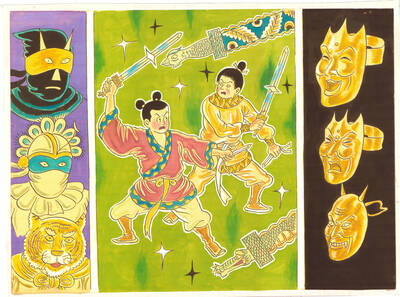
April 22 to April 28 The true identity of the mastermind behind the Demon Gang (魔鬼黨) was undoubtedly on the minds of countless schoolchildren in late 1958. In the days leading up to the big reveal, more than 10,000 guesses were sent to Ta Hwa Publishing Co (大華文化社) for a chance to win prizes. The smash success of the comic series Great Battle Against the Demon Gang (大戰魔鬼黨) came as a surprise to author Yeh Hung-chia (葉宏甲), who had long given up on his dream after being jailed for 10 months in 1947 over political cartoons. Protagonist


 RSS
RSS