


The toppling of the Berlin Wall represented for many a way to escape the horrors of living behind the Iron Curtain. For Joern Mothes, however, it was a reason to stay. Although the human rights and environmental activist had been given the opportunity to leave East Germany to take up a teaching post in Nicaragua, the momentous events of Nov. 9, 1989, prompted him to decline the offer.
“I was sitting at home and I was watching it on television. And my wife and I were crying, like many people at the time. And my first thought was my parents had to live 28 years behind this wall,” Mothes said in an interview Tuesday afternoon.
“My second thought was: I can’t leave Germany now. We will come back in three years and all will be changed. It was unbelievable. I had wanted to go [to Nicaragua] for a long time but now, with this historic event, I decided to stay.”
Mothes was invited by the German Institute in Taipei and the Taiwan Foundation for Democracy to give the keynote speech to mark the 20th anniversary of the toppling of the Berlin Wall on Monday. He will give a lecture tomorrow titled Berlin Wall — The Voice of the Other Side, where he will talk about the changes that have taken place in the former East Germany over the past two decades. He will also discuss how Germany has dealt with mountains of files collected by the Ministry for State Security, the former East Germany’s secret police, also known as the Stasi.
Established in 1950, the Ministry for State Security maintained strict control over East Germany’s population through fear, intimidation and violence. By the time the Iron Curtain fell in 1989, the Stasi had 91,015 full-time employees and had built up a network of 173,081 civilian informants who spied on anyone and everyone — even their own parents. At the height of the Cold War, the Stasi had records on roughly 6 million people. It also kept an archive of body odor samples.
The Stasi is something that Mothes has had intimate experience with, both before and after the toppling of the wall. As a rights activist during the Cold War, the Stasi compiled extensive files on him — files that he was able to gain access to in 1992. In 1993, he took up a post at the Stasi Archives for the Federal State of Mecklenburg-Vorpommern and served two terms, from 1998 to 2008, as its commissioner.
The lecture begins with Last to Know, a heart-wrenching 2006 documentary that looks at the stories of three families from the former German Democratic Republic who had one or more members imprisoned for dissident behavior and the difficulties they still have talking about their experiences as victims. Ku Chung-hwa (顧忠華), a sociology professor at National Chengchi University, will moderate the lecture.
Taipei Times: Why did the Stasi open a file on you?
Joern Mothes: It was in 1978 or 1979 — I was 15 or 16 years old — and it was because of my personal interest to protect the environment. There was so much pollution and nobody was really doing anything about it. So some of my friends and me organized a tree-planting activity. Thirteen people showed up. And then we organized a second activity to plant trees and 70 people showed up. For the third action 300 people showed up. But so did the security police. And they said: Is this a demonstration against the government? And we said: No, we want to help nature.
We were just a group of friends. But 300 [people] are a lot. And they came from all over and we had signboards. So we were told to stop.
But because of the state’s actions, we became even more politically active. Of course it was illegal what we did. But there were so many spies everywhere. It wasn’t really illegal because they knew exactly what we were doing.
TT: When did you first see your Stasi files?
JM: It was in 1992. Dissidents had a special right to see their files first ... They had eight very thick files on me starting from when I was 16 years old.
TT: What were your feelings as you looked through your Stasi files?
JM: Very angry. I was thinking: What right do they have to read such personal things? It was unbelievable how deep they penetrated into my personal life. They searched my room and photographed all its details. They even placed microphones into my bedroom. All the letters from my friends, they made copies and put them into my file. Many of these were very personal.
They also took pictures of my diary. And in the pictures you can see fingers holding my diary open. There are about 200 pages and in every picture his fingers are touching it. How is it possible that they could be so intrusive?
But later on I understood, of course, that I was the enemy. But the method they used, I was so surprised.
TT: When looking through the files, did you notice if any of your friends were informants?
JM: They tried to get my friends to spy on me. They asked my girlfriend to spy on me. But this is one of the happy things. I had a lot of friends and not one of them was a spy for the Stasi. Some of them encountered problems because the Stasi wanted them to spy but they rejected them.
One friend of mine told me that the Stasi came to her and asked her for reports. And I told her not to be afraid. But for all of the years, she was afraid and didn’t know what to do. The Stasi continued to hound her. Her soul was really poisoned at the time. And because the stress was so great, she developed mental problems, which she still has today.
TT: Has opening up the files provided some kind of closure for the victims?
JM: It has to a certain extent. The good news is that the victims of the Stasi don’t want revenge. They just want consideration. Our society has been able to deal with the communist period and opening up the Stasi files is a good example of this.
Before the Stasi files were opened, we couldn’t fully comprehend the injustice being done. This is very important for those who were persecuted because a person can now understand why, for example, he couldn’t get a job. At the time you didn’t know, but now you can understand why. So it’s a kind of [closure].
TT: Why did you choose to work in the State Commission for Stasi Files?
JM: In 1993, I was interested in the deputy post. One of the reasons why I wanted to do this job was because of the social situation. Quite a lot of victims from that era were not getting rehabilitated after unification. The second thing was that I was aware that the history of East Germany and the Stasi might be forgotten.
Thirdly, with the change in Germany’s
leadership, eastern Germans were being replaced by western Germans, which was, to a certain extent, not very justified.
TT: Can former Stasi officials be prosecuted under the Stasi File Act?
JM: The law only regulates the procedure of opening these files. It revolves around who is allowed to look at the files — if the files are about you, or for example if you are an academic. Also, if someone is about to take over an official government post then we check out his file to see if he worked for the Stasi.
There is a separate law for government officials, which states that anyone [who had] worked for the Stasi ... cannot be a government official.
TT: You had an opportunity to go to Nicaragua but chose to stay in Germany after the fall of the Berlin Wall. What did you hope to accomplish?
JM: To reform the GDR into a better Germany and have a new society based on common sense and rationalism. We wanted to have a social-oriented socialism, an open transparent socialism, with a transparent justice system, with a lot of [political] parties. We were really independent rights activists and we had high ethical aims.
TT: How did you feel about re-unification?
JM: We did not want to reunify with West Germany in the beginning. Let me tell you a story. I was teaching at a Lutheran church. And we were talking about the current political situation. The Lutheran church, you see, was very political. And I said to the students: We are now free, we can go wherever we want, we can establish political parties now. And a little girl said, But Mr Mothes, the most important thing is: When will we get the Deutsche mark?
So you can see what really happened when the Berlin Wall came down. Here was a real opportunity for political change. But the majority of people in East Germany, who were not really politically active before, said let’s reunify very quickly and get the German mark.
So the civil rights activists were unable to find their place in this new society.
TT: What were some of the problems you perceived with quick re-unification?
JM: The issue was, should Germany go through some changes or should the former East Germany become part of West Germany without any changes. We really wanted to get into a broad discussion about these different issues, about what is social economy, what is parliamentary democracy. We East German activists thought that we should have a new German constitution after unification.
Of course we knew that the Basic Law or constitution of West Germany was a really good one. But we wanted to be participants in forming a constitution that we wanted. We thought it would be very important to discuss these issues before Germany became unified. Many people [still] supported the old East Germany. We had Stasi functionaries. We had members of the Communist Party and teachers teaching this socialist stuff for all those years. On the one hand we were asking for the opening of the Stasi files and on the other side we were not talking about how the Stasi officials should be integrated into the new society. So we felt that we should be talking about this issue.
But in the end, the whole process of German unification was focused almost entirely on economic issues ... And today this is one of the problems because the discussion about the Stasi files, about this special part of history, is only discussed in [the former] East Germany. But in fact, this is not just a problem for East German society to deal with but the whole of German society to deal with.

Last week Joseph Nye, the well-known China scholar, wrote on the Australian Strategic Policy Institute’s website about how war over Taiwan might be averted. He noted that years ago he was on a team that met with then-president Chen Shui-bian (陳水扁), “whose previous ‘unofficial’ visit to the US had caused a crisis in which China fired missiles into the sea and the US deployed carriers off the coast of Taiwan.” Yes, that’s right, mighty Chen caused that crisis all by himself. Neither the US nor the People’s Republic of China (PRC) exercised any agency. Nye then nostalgically invoked the comical specter
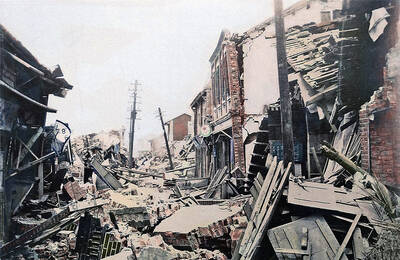
April 15 to April 21 Yang Kui (楊逵) was horrified as he drove past trucks, oxcarts and trolleys loaded with coffins on his way to Tuntzechiao (屯子腳), which he heard had been completely destroyed. The friend he came to check on was safe, but most residents were suffering in the town hit the hardest by the 7.1-magnitude Hsinchu-Taichung Earthquake on April 21, 1935. It remains the deadliest in Taiwan’s recorded history, claiming around 3,300 lives and injuring nearly 12,000. The disaster completely flattened roughly 18,000 houses and damaged countless more. The social activist and

Over the course of former President Ma Ying-jeou’s (馬英九) 11-day trip to China that included a meeting with Chinese Communist Party (CCP) leader Xi Jinping (習近平) a surprising number of people commented that the former president was now “irrelevant.” Upon reflection, it became apparent that these comments were coming from pro-Taiwan, pan-green supporters and they were expressing what they hoped was the case, rather than the reality. Ma’s ideology is so pro-China (read: deep blue) and controversial that many in his own Chinese Nationalist Party (KMT) hope he retires quickly, or at least refrains from speaking on some subjects. Regardless

Approaching her mid-30s, Xiong Yidan reckons that most of her friends are on to their second or even third babies. But Xiong has more than a dozen. There is Lucky, the street dog from Bangkok who jumped into a taxi with her and never left. There is Sophie and Ben, sibling geese, who honk from morning to night. Boop and Pan, both goats, are romantically involved. Dumpling the hedgehog enjoys a belly rub from time to time. The list goes on. Xiong nurtures her brood from her 8,000 square meter farm in Chiang Dao, a mountainous district in northern Thailand’s


 RSS
RSS