


It's rare that an autograph session accompanies a gallery show, but such is the fame of Yoshitaka Amano that one was arranged at the Metaphysical Art Gallery on Saturday.
Designer, illustrator, lithographer, printer, set designer and animator — there isn’t much in the world of Japanese manga and anime that Amano hasn’t done, and each new creation — whether the graphic novel Vampire Hunter D or the media franchise Final Fantasy — built on the successes, both in terms of visual content and fan base, of its predecessors.
Over the past decade, however, Amano, now 57, has gradually moved away from the world of commercial illustration in favor of fine art. Flying to Deva Loka, a series of 25 paintings currently on view at Metaphysical Art Gallery (形而上畫廊), continues this trend while closely adhering to the visual language and mythological themes he’s developed over his four-decade career as an illustrator.
Why the shift to fine art?
“I was bored,” Amano quipped. “I continue to work in the commercial field but I’m more interested in the artwork.”
Amano added that painting offers him more freedom to explore new imaginative territory.
“In the case of commercial work, I know what the client is expecting, and the client knows what kind of result I will produce. So it is a little less exciting for me. On the other hand, fine art, my own work, there are so many unknowns there and that is more adventurous,” he said.
Amano first hit Japan’s anime and manga scene at the remarkably young age of 15. He worked in the animation department for Tatsunoko Productions and struck out on his own in 1982 as a freelance illustrator. He drew considerable attention in Japan with his fantasy saga Vampire Hunter D.
Early hints of his impulse to create fine art can be seen with Maten (1984) and Hiten (1989), both portfolio-cum-art books, which presented his work freed from the narrative structure of the novel or anime film. In 1996, he opened a gallery and studio in New York that enabled him to focus more on fine art — a process that he’s been increasingly involved in ever since.
The paintings on display in Flying to Deva Loka are immediately eye-catching because of their glassy and polished surfaces of bold coloring. Amano achieves this effect by first applying the coloring and details on aluminum panels. The panels are then brought to an automotive coating specialist who polishes each work 18 times. The process eliminates the texture of the brushstrokes and gives the paintings a shiny graphic finish.
In Deva Loka/Awakening, the focal point is a young, partially dressed woman balanced on the back of a large white horse — a heroine awakening to an existence that she must somehow bend to her will.
Surrounding her and ready to attack are a profusion of monster-like animals, insects and plants. The creatures possess a manic fury reminiscent of the beasts found in the post-apocalyptic worlds of Amano’s manga and anime.
Candy Girls L-4 dispenses with the furious beasts but retains the siren-like girl rendered in a crisp manga style. The barely dressed nymph crouches in a prone position, her eyes fixed on the viewer in an inviting manner.
Most of the other panels in this show are reproductions of or variations on previously conceived characters or themes. Although rendered in Amano’s unique graphic style and complemented by the panel’s glossy finish, you’d probably have to be an avid fan to enjoy them.

In late October of 1873 the government of Japan decided against sending a military expedition to Korea to force that nation to open trade relations. Across the government supporters of the expedition resigned immediately. The spectacle of revolt by disaffected samurai began to loom over Japanese politics. In January of 1874 disaffected samurai attacked a senior minister in Tokyo. A month later, a group of pro-Korea expedition and anti-foreign elements from Saga prefecture in Kyushu revolted, driven in part by high food prices stemming from poor harvests. Their leader, according to Edward Drea’s classic Japan’s Imperial Army, was a samurai

Located down a sideroad in old Wanhua District (萬華區), Waley Art (水谷藝術) has an established reputation for curating some of the more provocative indie art exhibitions in Taipei. And this month is no exception. Beyond the innocuous facade of a shophouse, the full three stories of the gallery space (including the basement) have been taken over by photographs, installation videos and abstract images courtesy of two creatives who hail from the opposite ends of the earth, Taiwan’s Hsu Yi-ting (許懿婷) and Germany’s Benjamin Janzen. “In 2019, I had an art residency in Europe,” Hsu says. “I met Benjamin in the lobby
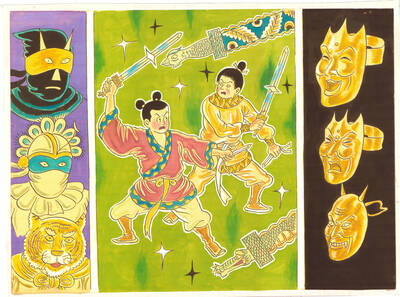
April 22 to April 28 The true identity of the mastermind behind the Demon Gang (魔鬼黨) was undoubtedly on the minds of countless schoolchildren in late 1958. In the days leading up to the big reveal, more than 10,000 guesses were sent to Ta Hwa Publishing Co (大華文化社) for a chance to win prizes. The smash success of the comic series Great Battle Against the Demon Gang (大戰魔鬼黨) came as a surprise to author Yeh Hung-chia (葉宏甲), who had long given up on his dream after being jailed for 10 months in 1947 over political cartoons. Protagonist

A fossil jawbone found by a British girl and her father on a beach in Somerset, England belongs to a gigantic marine reptile dating to 202 million years ago that appears to have been among the largest animals ever on Earth. Researchers said on Wednesday the bone, called a surangular, was from a type of ocean-going reptile called an ichthyosaur. Based on its dimensions compared to the same bone in closely related ichthyosaurs, the researchers estimated that the Triassic Period creature, which they named Ichthyotitan severnensis, was between 22-26 meters long. That would make it perhaps the largest-known marine reptile and would


 RSS
RSS