


A melancholy man lovingly decorates the grave of his dead wife with marigold petals and prepares for an all-night vigil. A raucous family in the same cemetery remembers their dead relative with alcohol, chilaquiles and song. A three-year-old excitedly carries a sugar skull to his kindergarten where he will proudly put it on the school altar. A protest group sets up an altogether more somber version outside a government office to demand justice for murdered young girls.
Mexico’s El Dia de Muertos is colorful, poignant, mystical, political, contradictory, satirical, macabre and rather childish — all at the same time.
The classic place to immerse yourself in Mexico’s Day of the Dead are the islands in Lake Patzcuaro in the central state of Michoacan, populated by indigenous Purepecha. The mist from the lake mingles with the mysticism of the indigenous culture to produce a particularly intense experience. But finding a place to stay can be a nightmare, and to get away from tourist trinkets you have to get yourself to the most remote islands.
Perhaps the purest sense of the celebration’s pre-Hispanic roots requires a trip to the Mayan town of Pomuch in the Yucatan peninsula, where relatives exhume the bones of dead loved ones to give them a brush up for the year to come. While the prize for the most aesthetic celebration may well belong to the city of Oaxaca, long renowned for the quality of its local artists who use colored sawdust in extraordinarily intricate altars set up on pavements.
But of all the many options available you could do a lot worse than choose the easiest of all: Mexico City. It may not sound very exotic, but it does drive home just how adept the Dia de Muertos (which is really two days, sometimes more) is at reinventing itself for each new era and remaining at the center of Mexican popular culture.
The origins of the festival stretch back to the different ancient Mesoamerican cultures who lived in the area but shared a fascination with death. None more intensely than the Aztecs who dominated central Mexico for centuries, and held a specific fiesta for the dead in the middle of the year that the Spanish colonial powers moved to coincide with the Catholic holiday of All Saints’ Day on Nov. 2.
At the core of the celebration are the ofrendas, or altars, which are said to guide the spirits of the departed back to Earth for a brief sojourn among the company of those they left behind. For a feel of how much preparation goes into them, pop into a market from the last week of October until the spirits go back where they came from on Nov. 2. Any market will do, outside the business districts, from the historic center to the southern barrio of Coyoacan.
There you will see locals struggling under the weight of huge bunches of bright orange cempazuchitl flowers (local marigolds) and a very smelly bright purple flower, that act as beckoning beacons. Then there are the piles of pan de muerto, a sweet round decorated bread that provides the spirits with sustenance when they’ve found their way.
Most of the stalls are dedicated to the more humorous side of the whole endeavor that became a key element of the urban celebration in the 20th century. There will be models of skeletons getting drunk in cantinas, sculptures of ornately clad female versions, and sugar skulls with space to write your name on the forehead in colored icing.
There is a lot of Halloween paraphernalia, too. But rather than smothering local traditions it has simply been incorporated into the general cacophony, rather like the Catholic theme imposed by the conquistadors who ensured it all happened around All Saints’ Day.
Public ofrendas are easy to find in Mexico City, beginning with those laid out in the great Zocalo (plaza) in the center of town. But my favorite is the Muertos exhibition at the Dolores Olmedo museum in the far south of the capital. The central theme changes each year. In 2008 it was icons from the golden age of Mexican cinema — represented in skeletal form.
Set up by one of the main patrons of Diego Rivera and Frida Kahlo, the museum also has an impressive permanent collection of their works set in grounds where peacocks roam and xoloitzcuintli (hairless dogs) pose.
For me, the highlight of being in Mexico City on the night of Nov. 1 (the heart of the ceremony) is the chance to drive about another 30 minutes down the road and spend a couple of hours or so in the cemetery in San Gregorio Atlapulco, Xochimilco, on the semi-rural edge of the city. Stretching up from the edge of what remains of the lake system that once filled the Valley of Mexico, many residents still farm the artificial islets known as chinampas that were the basis of Mesoamerican agriculture in the area. Definitely worth a wander around if you get there before dark.
Activity in the cemetery itself doesn’t really get going until well after dark, but it is worth the wait to see how this traditional community still within the confines of the metropolis fondly remembers its dead. By midnight, it is literally buzzing with activity as families arrive laden with brooms, buckets, flowers, candles and everything else they need to set up their ofrendas on top of the graves. Each is different, and some are stunningly creative. The collective result is both beautiful and rather otherworldly, without being overly solemn.
Some families sit around eating and drinking tequila, chatting about the departed and singing their favorite songs. Minstrels and mariachi bands wander along the paths offering a more professional rendition for a fee. Children play between the graves and the elderly sit wrapped up in heavy blankets preparing to wait the night through. If you speak Spanish, most people are happy to tell you about their dead and their traditions, although there are also those deep in silent thought and more melancholy tributes who obviously want to be left alone.
The cemetery is open to anybody who wants to go, and I have never seen any sign of irritation with strangers taking photographs although it is advisable to discretely ask permission before taking closer shots. The first time I went, in 2000, there were no other outsiders. The last time, in 2008, I spotted several other foreigners wandering around with cameras. But the cemetery is a long way from being overrun, unlike the much more famous village of Mixquic further down the road.
When you eventually draw yourself away, look back as you drive off towards the concrete jungle to see the orange glow above the cemetery fade into the black night.

In late October of 1873 the government of Japan decided against sending a military expedition to Korea to force that nation to open trade relations. Across the government supporters of the expedition resigned immediately. The spectacle of revolt by disaffected samurai began to loom over Japanese politics. In January of 1874 disaffected samurai attacked a senior minister in Tokyo. A month later, a group of pro-Korea expedition and anti-foreign elements from Saga prefecture in Kyushu revolted, driven in part by high food prices stemming from poor harvests. Their leader, according to Edward Drea’s classic Japan’s Imperial Army, was a samurai

The following three paragraphs are just some of what the local Chinese-language press is reporting on breathlessly and following every twist and turn with the eagerness of a soap opera fan. For many English-language readers, it probably comes across as incomprehensibly opaque, so bear with me briefly dear reader: To the surprise of many, former pop singer and Democratic Progressive Party (DPP) ex-lawmaker Yu Tien (余天) of the Taiwan Normal Country Promotion Association (TNCPA) at the last minute dropped out of the running for committee chair of the DPP’s New Taipei City chapter, paving the way for DPP legislator Su
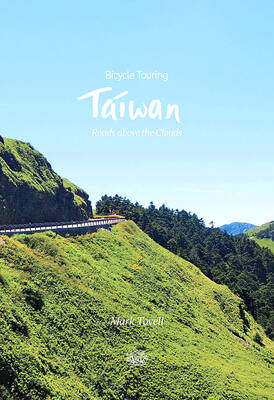
It’s hard to know where to begin with Mark Tovell’s Taiwan: Roads Above the Clouds. Having published a travelogue myself, as well as having contributed to several guidebooks, at first glance Tovell’s book appears to inhabit a middle ground — the kind of hard-to-sell nowheresville publishers detest. Leaf through the pages and you’ll find them suffuse with the purple prose best associated with travel literature: “When the sun is low on a warm, clear morning, and with the heat already rising, we stand at the riverside bike path leading south from Sanxia’s old cobble streets.” Hardly the stuff of your
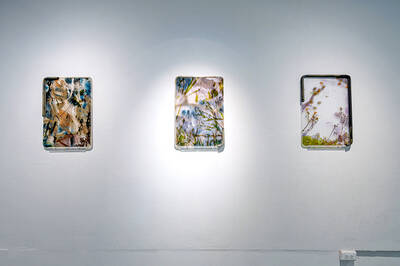
Located down a sideroad in old Wanhua District (萬華區), Waley Art (水谷藝術) has an established reputation for curating some of the more provocative indie art exhibitions in Taipei. And this month is no exception. Beyond the innocuous facade of a shophouse, the full three stories of the gallery space (including the basement) have been taken over by photographs, installation videos and abstract images courtesy of two creatives who hail from the opposite ends of the earth, Taiwan’s Hsu Yi-ting (許懿婷) and Germany’s Benjamin Janzen. “In 2019, I had an art residency in Europe,” Hsu says. “I met Benjamin in the lobby


 RSS
RSS